
Acceptance testing entry criteria are the mandatory prerequisites that must be fully satisfied before user acceptance testing (UAT) can begin, covering stable builds, finalized test cases, zero open critical defects, and a production-equivalent test environment. Recognized by ISTQB as formal phase-level conditions, these criteria function as quality gates that protect your testing cycle from wasted effort on unstable or unprepared software. Without them, UAT devolves into debugging sessions rather than genuine product validation. Project managers and QA professionals who define these conditions clearly, before a single test script runs, consistently deliver faster cycles and higher stakeholder confidence.
Acceptance testing entry criteria explained: the core components
The standard entry criteria for UAT fall into four categories: build readiness, environment readiness, documentation readiness, and stakeholder readiness. Each category carries specific, measurable conditions that must be verified before testing begins.
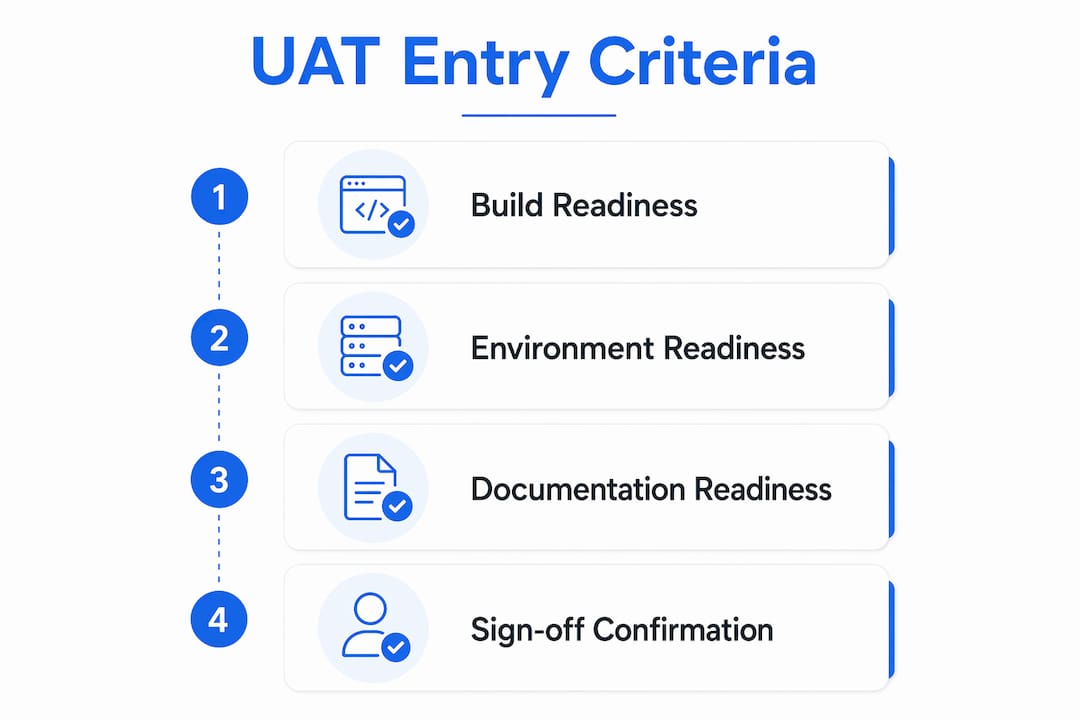
Build readiness is the most foundational requirement. UAT entry criteria require system and integration testing (SIT) to be fully completed, with 100% of SIT test cases signed off and zero open critical or high-severity defects. This means the development team has already resolved every blocker and major flaw. UAT is not a debugging phase. It is a validation phase.

Environment readiness goes deeper than most teams expect. The UAT environment must mirror production not just in configuration, but in API integration and rate limits to avoid bugs that exist only in the test environment. A mismatch between UAT and production environments is one of the most common sources of false positives and false negatives in acceptance testing. Pre-loaded, representative test data must also be in place before the first session starts.
Documentation readiness covers finalized acceptance criteria per user story, approved test scripts, and a signed-off test plan. Without these documents, testers have no objective basis for pass or fail decisions. Acceptance criteria should be specific enough that any two testers reading them independently reach the same verdict.
Stakeholder readiness confirms that business users, product owners, and QA leads are available and scheduled. UAT without committed user participation is a formality, not a validation.
Here is a practical entry criteria checklist that covers the essentials:
- System and integration testing completed with 100% sign-off
- Zero open critical or high-severity defects in the build
- UAT environment configured to match production, including external API simulations
- Test data pre-loaded and verified
- Acceptance criteria finalized and approved for all in-scope user stories
- Test scripts reviewed and signed off by the product owner
- Business users confirmed and scheduled for testing sessions
- Test plan and entry/exit criteria formally documented
Pro Tip: Create a shared entry criteria sign-off document in your project management tool, such as Jira or Azure DevOps, and require explicit approval from QA lead, product owner, and a business representative before the UAT sprint begins. This single step eliminates the most common cause of mid-cycle stalls.
Why entry criteria are critical quality gates in UAT
Entry criteria are not bureaucratic formalities. They are dynamic quality gates that prevent premature testing on unstable builds or unprepared environments, protecting both schedule and stakeholder trust.
When teams skip or rush entry criteria, the consequences are predictable. Testers encounter defects that should have been caught in SIT, blocking test execution entirely. Business users lose confidence in the product and in the QA process. The testing cycle stalls, rework accumulates, and the release date slips. Lack of clearly defined UAT entry criteria is a primary cause of stalled testing cycles and unstable builds reaching testers.
The data supports a disciplined approach. Teams with documented entry and exit criteria reduce testing cycle time by up to 30% and catch 25% more defects before UAT begins. That is not a marginal improvement. It represents the difference between a controlled release and a chaotic one.
“Treat entry criteria as dynamic quality gates, not static checklists, to effectively control test phase readiness and prevent wasted effort.” — VirtuosoQA
The distinction between static and dynamic matters in practice. A static checklist gets ticked once and forgotten. A dynamic quality gate is revisited whenever the build changes, the environment is updated, or scope shifts. In Agile environments with frequent sprint releases and CI/CD pipelines, entry criteria must be re-evaluated at the start of each UAT cycle, not just at project kickoff.
One underappreciated benefit of enforcing entry criteria is the signal they send to stakeholders. When a QA team formally confirms that all prerequisites are met before testing begins, business users enter UAT with justified confidence. That confidence translates directly into more focused, productive testing sessions and cleaner sign-off decisions at the end.
How to define and implement acceptance testing entry criteria
Defining entry criteria that actually work requires collaboration, specificity, and integration into your existing workflow. Here is a practical approach that works for both Agile sprints and waterfall release cycles.
-
Convene a criteria definition session early. Bring together the product owner, QA lead, a senior developer, and at least one business representative before development begins. Define entry criteria at the same time you define acceptance criteria for user stories. This prevents last-minute surprises.
-
Use SMART criteria. Each entry condition must be Specific, Measurable, Achievable, Relevant, and Time-bound. “The build is stable” is not a criterion. “Zero open P0 or P1 defects as verified in Jira on the day UAT begins” is a criterion.
-
Set a defect threshold, not a zero-bug policy. The zero critical/high-severity defect policy is the recommended standard. Requiring zero bugs of any severity delays UAT indefinitely, since minor UI issues that do not affect business workflows are always present in real software. Allow low-severity cosmetic defects through while blocking anything that impairs a core business process.
-
Verify environment parity explicitly. Assign a DevOps or infrastructure engineer to sign off on environment readiness as a separate gate. Test environment parity covers configuration, data, external API simulation, and operational conditions. Do not assume the environment is ready because it was ready last sprint.
-
Integrate criteria into your CI/CD pipeline. In modern delivery pipelines, entry criteria checks can be partially automated. Automated SIT pass rates, defect counts from Jira, and environment health checks can be pulled into a dashboard that gives the QA lead a real-time readiness view before UAT is formally opened.
-
Document and distribute the criteria. Every stakeholder who participates in UAT must see the entry criteria before testing begins. Use a shared document in Confluence, SharePoint, or your project management platform. Verbal agreements do not hold up when a cycle stalls.
| Entry criteria component | Measurable condition | Owner |
|---|---|---|
| Build stability | Zero P0/P1 defects in Jira at UAT start | QA Lead |
| SIT completion | 100% SIT cases passed and signed off | QA Lead |
| Environment readiness | UAT env matches production config and APIs | DevOps Engineer |
| Test data | Representative data sets pre-loaded and verified | QA / BA |
| Documentation | Test plan, scripts, and acceptance criteria approved | Product Owner |
| Stakeholder availability | Business users confirmed for scheduled sessions | Project Manager |
Pro Tip: Apply the same entry criteria rigor to vendor-delivered software components as you do to internal code. Vendor deliverables require detailed documentation and operational plans before they enter UAT, just like anything your own team builds.
Entry criteria vs. acceptance criteria: what is the difference?
These two terms are frequently confused, even by experienced practitioners. The distinction is straightforward once you see it clearly.
Acceptance criteria define feature-level conditions of “done” for individual user stories. They answer the question: “How do we know this feature works correctly?” Entry criteria define phase-level prerequisites for starting the acceptance testing phase. They answer the question: “Is the product ready for us to begin testing at all?”
Acceptance criteria are written at the story level, typically in Given/When/Then (Gherkin) format or as a numbered list of pass/fail conditions. Acceptance criteria describe the “what” — the desired user outcomes — while implementation details remain with the development team. Tricentis recommends keeping acceptance criteria between 3 and 7 points per user story. More than seven suggests the story is too large and should be split.
Entry criteria, by contrast, apply to the entire UAT phase. They are not tied to individual features. They confirm that the whole product, environment, and team are ready for structured validation. You can review a full breakdown of acceptance criteria types to see how these story-level conditions are structured in practice.
Exit criteria complete the picture. Where entry criteria define when testing can start, exit criteria define when testing is complete enough to release. Successful UAT exit criteria include a 95% or higher first-time pass rate, zero open P0 or P1 defects, and formal stakeholder sign-off with documented deferred defects and resolution timelines.
Here is a quick comparison to keep these concepts distinct:
- Acceptance criteria: Feature-level, written per user story, define pass/fail for individual functions, owned by the product owner
- Entry criteria: Phase-level, apply to the entire UAT cycle, define readiness to begin testing, owned by the QA lead and project manager
- Exit criteria: Phase-level, apply to the entire UAT cycle, define readiness to release, owned by the QA lead and business sign-off authority
Understanding where UAT fits relative to system testing also clarifies why entry criteria exist at the boundary between those two phases. SIT completion is itself an entry criterion for UAT, which means the two phases are formally linked through documented gates.
Key takeaways
Entry criteria for acceptance testing are phase-level prerequisites that confirm build stability, environment parity, documentation completeness, and stakeholder availability before UAT begins.
| Point | Details |
|---|---|
| Entry criteria are phase-level gates | They confirm the entire product and environment are ready, not just individual features. |
| Zero critical defects, not zero bugs | Block P0/P1 defects but allow minor UI issues to prevent indefinite UAT delays. |
| Environment parity is non-negotiable | UAT environments must replicate production APIs, data, and operational conditions exactly. |
| Entry vs. acceptance criteria | Acceptance criteria define story-level done conditions; entry criteria define phase-level readiness. |
| Document and automate | Integrate entry criteria checks into CI/CD pipelines and require formal sign-off before UAT opens. |
Why most teams get entry criteria wrong until it hurts
After working with QA and project management teams across multiple delivery cycles, the pattern is consistent. Entry criteria get defined once, placed in a document nobody revisits, and treated as a formality rather than a genuine gate. The first time a UAT cycle stalls because a critical defect slipped through SIT, the team scrambles to understand why. The answer is almost always the same: the entry criteria existed on paper but were never enforced.
The most damaging version of this problem is the “we’re close enough” decision. A QA lead or project manager, under schedule pressure, waves the build through to UAT with two or three open high-severity defects because the team believes they can work around them. Business users hit those defects in the first hour of testing, lose confidence in the product, and the cycle collapses. The schedule pressure that justified skipping the gate makes the final delay far worse.
What actually works is treating entry criteria sign-off as a formal event, not a checkbox. A 30-minute readiness review with the QA lead, product owner, and one business representative, held the day before UAT opens, catches the gaps that asynchronous document reviews miss. It also creates shared accountability. When everyone in that meeting confirms readiness, the UAT cycle starts with aligned expectations.
The other lesson worth stating directly: entry criteria must evolve with your delivery model. Criteria written for a waterfall release do not map cleanly onto a two-week Agile sprint. In CI/CD environments, entry criteria need to be lightweight enough to evaluate quickly but rigorous enough to catch genuine blockers. That balance is not a one-time decision. It is a conversation you have with your team at the start of every major release cycle.
— Marketing
Start your next UAT cycle with confidence using Wezardapp
Defining strong entry criteria is only half the work. The other half is executing UAT in a way that captures every issue clearly, routes it to the right place, and keeps your backlog clean. Wezardapp is built specifically for that second half. It records your screen during UAT sessions, transcribes issues in real time, and uses AI to detect duplicate tickets before they reach your Jira or Azure DevOps backlog. QA teams using Wezardapp spend less time managing noise and more time validating the product. If you are ready to see how structured UAT bug tracking works in practice, explore what Wezardapp does for acceptance testing teams.
FAQ
What are acceptance testing entry criteria?
Acceptance testing entry criteria are the phase-level prerequisites that must be met before UAT can begin, including completed system testing, zero open critical defects, a production-equivalent environment, finalized test scripts, and confirmed stakeholder availability.
How do entry criteria differ from acceptance criteria?
Entry criteria define readiness to start the UAT phase as a whole. Acceptance criteria define pass/fail conditions for individual user stories or features, and are evaluated during testing rather than before it begins.
What defect threshold should entry criteria require?
The recommended standard is zero open critical or high-severity (P0/P1) defects. Requiring zero bugs of any severity delays UAT indefinitely. Minor UI defects that do not impact core business workflows are acceptable at UAT entry.
Why do entry criteria reduce testing cycle time?
Teams with documented entry and exit criteria reduce testing cycle time by up to 30% and catch 25% more defects before UAT, because testers work on a stable build in a verified environment rather than diagnosing infrastructure or build problems mid-cycle.
Should entry criteria be the same for every UAT cycle?
No. Entry criteria should be reviewed and adjusted at the start of each major release cycle to reflect the delivery model, scope, and risk profile of that specific release. Agile sprints require lighter, faster-to-evaluate criteria than large waterfall releases.