
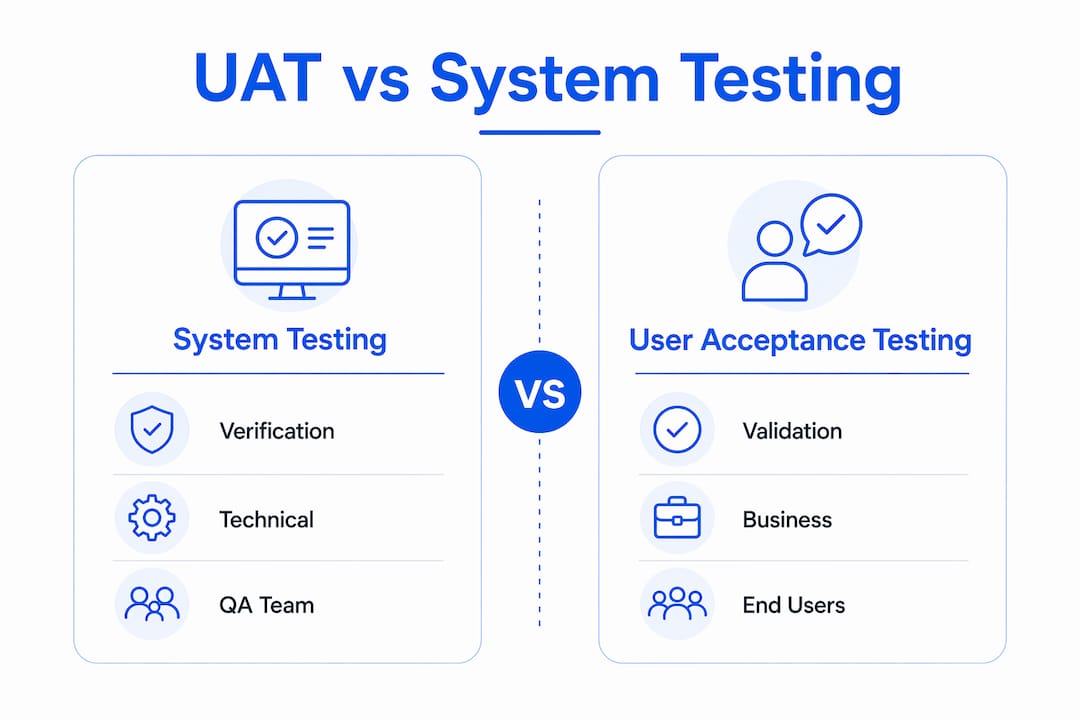
User acceptance testing (UAT) is the final validation phase before software release, where business users confirm the system meets real-world requirements. System testing, by contrast, is a technical verification phase where QA engineers check the complete integrated system against functional and non-functional specifications. These two test levels address entirely different quality dimensions, and confusing them is one of the most common reasons software projects ship with the wrong defects fixed. Understanding the difference between UAT and system testing is not optional for software professionals. It determines who tests, what they test, when they test, and what counts as a passing result.
UAT vs system testing explained: the core distinction
System testing verifies the complete integrated system against specified requirements, treating the application as a black box. QA engineers run it after integration testing and before acceptance testing, focusing entirely on whether the product meets its technical specifications. The testers do not care whether a workflow feels natural to a business user. They care whether the system behaves according to documented requirements.
UAT is the last test level before release, where business stakeholders validate that the system supports real workflows and business rules. According to ISTQB, UAT is a subtype of acceptance testing that involves scripted scenario execution by the people who will actually use the software. The distinction matters because a system can pass every technical check and still fail in the hands of real users.

A useful mental model comes from verification versus validation. System testing aligns with verification, confirming the system was built correctly. UAT aligns with validation, confirming the right system was built. Both are necessary. Neither substitutes for the other.
What is system testing and how is it performed?
System testing covers a wide range of technical quality checks. QA teams run functional tests, performance tests, security tests, regression tests, and compatibility tests, all within a staging environment that mirrors production as closely as possible. The system is treated as a black box, meaning testers interact through the user interface or API without knowledge of internal code structure.
Entry criteria for system testing typically include completed integration testing, a stable build deployed to the test environment, and a signed-off test plan. Exit criteria require that all planned test cases have been executed, defect counts fall below agreed thresholds, and critical or high-severity bugs are resolved. These gates exist to prevent premature progression to UAT.
The types of defects system testing uncovers are technical in nature: broken integrations, incorrect data transformations, failed API calls, performance bottlenecks under load, and security vulnerabilities. These are not the kinds of issues business users are equipped to diagnose or articulate. That is precisely why QA engineers own this phase.
Pro Tip: Automate regression and performance test suites during system testing so your QA team can focus manual effort on exploratory and edge-case scenarios. Automation pays back quickly when builds change frequently.
The table below summarizes what system testing covers and who is responsible.
| Test type | Focus area | Owner |
|---|---|---|
| Functional testing | Feature behavior vs. requirements | QA engineers |
| Performance testing | Load, speed, and scalability | QA/performance engineers |
| Security testing | Vulnerabilities and access control | QA/security engineers |
| Regression testing | No new defects from recent changes | QA engineers |
| Compatibility testing | Browser, device, OS behavior | QA engineers |
What is user acceptance testing and how does it differ?
UAT detects requirement gaps and workflow issues that purely technical testing cannot surface. A QA engineer verifying that a purchase order form submits correctly is doing system testing. A procurement manager confirming that the three-way matching workflow aligns with company policy is doing UAT. The questions being answered are fundamentally different.
The UAT testing process follows a structured sequence:
- Confirm system testing is complete with no critical open defects.
- Prepare a stable UAT environment with realistic, production-like test data.
- Write acceptance criteria in user-focused language, often using Given/When/Then format.
- Brief and train business participants on test objectives and session structure.
- Execute scripted test scenarios, then allow time for exploratory testing.
- Log defects with enough context for the development team to reproduce them.
- Obtain formal sign-off from authorized stakeholders once exit criteria are met.
UAT acceptance criteria written in Given/When/Then style map directly to business scenarios, making it easier for non-technical participants to validate workflows and business rules. This format also makes pass/fail decisions objective rather than subjective.
UAT sessions are often time-boxed to 2 to 4 hours, combining scripted and exploratory testing to keep stakeholders engaged without exhausting them. This structure balances thorough validation with efficient use of business user time, which is always limited.
UAT exit criteria require a high scenario pass rate and zero critical defects, plus formal stakeholder sign-off. Pre-agreed thresholds make the acceptance decision objective and prevent release debates driven by opinion rather than evidence.
Pro Tip: Never use UAT as a substitute for system testing. If business users are spending their sessions finding broken buttons or crashed screens, your system testing phase was not complete. Fix that sequencing problem first.
UAT entry criteria include completed system testing, a stable UAT environment, prepared test data, and trained participants. Skipping any of these conditions turns UAT into a chaotic bug hunt rather than a business fitness check.
How do UAT and system testing compare across key dimensions?
System testing is a technical verification phase run by QA teams, while UAT is a business validation phase led by end users or stakeholders. That single sentence captures the most important difference, but the practical implications run deeper.
| Dimension | System testing | UAT |
|---|---|---|
| Primary purpose | Verify system meets technical specs | Validate system meets business needs |
| Who tests | QA and test engineers | Business users, clients, product owners |
| Test basis | Functional and non-functional requirements | Business requirements, user stories, workflows |
| Defects found | Technical, integration, performance issues | Business logic gaps, usability mismatches |
| Automation potential | High (regression, performance suites) | Low (scenario-based, judgment-driven) |
| Environment | Staging, mirrors production | UAT environment, production-like data |
| Timing | After integration testing | After system testing, before release |
| Sign-off authority | QA lead or test manager | Business stakeholder or product owner |
Automation potential is worth examining closely. System testing lends itself to automated regression suites because the expected outputs are deterministic and technical. UAT relies on human judgment about whether a workflow feels correct and complete for a business context. Automating UAT scripts is possible for regression scenarios, but the core value of UAT comes from human business users exercising real-world judgment.
Neither phase substitutes for the other. A system that passes all technical tests can still fail UAT because a business rule was misunderstood during requirements gathering. A system that satisfies business users in UAT can still carry performance or security risks that only system testing would catch. Both gates must be passed.
What are the common challenges and best practices?
The most damaging mistake in UAT is running it before system testing is stable. Using UAT to discover fundamental software bugs signals premature testing. Business users lose confidence, sessions get derailed by environment crashes, and the real purpose of UAT, validating business fitness, never gets addressed.
Several other challenges consistently undermine UAT quality:
- Vague acceptance criteria. Without measurable criteria, sign-off becomes a negotiation rather than a decision. Write criteria in Given/When/Then format and get stakeholder agreement before testing begins.
- Unrealistic test data. Test data that does not reflect production volumes, edge cases, or regional variations will miss defects that only appear at scale or in specific contexts.
- Untrained participants. Business users who do not understand the difference between a product defect and an environment issue will log noise that wastes developer time.
- Environment instability. Separating environment issues from product defects during UAT is critical to maintain evidence integrity and stakeholder trust in acceptance decisions.
- Reusing system test scripts verbatim. UAT scripts must reflect user goals and business processes, not technical specifications. A script that checks whether a field accepts alphanumeric input is a system test. A script that walks through a complete invoice approval workflow is a UAT script.
Executing UAT only after system testing stabilizes the build and after user training minimizes rework and maximizes validation efficiency. This sequencing is not a formality. It is the difference between UAT that delivers a confident release decision and UAT that produces a backlog of mixed defects nobody knows how to prioritize.
Clear, measurable acceptance criteria and formal sign-off documents transform UAT from a subjective process into a reliable quality gate. UAT documentation including test plans, scripts, and defect logs written in business language reduces project failures and supports auditing processes. Documentation is not overhead. It is the evidence that a business decision was made deliberately.
Pro Tip: Create a shared defect triage channel between your QA team and business UAT participants. When testers can ask “is this a product defect or an environment issue?” in real time, you cut resolution time significantly and keep sessions on track.
Key takeaways
System testing and UAT are sequential, non-interchangeable quality gates: system testing verifies technical correctness, and UAT confirms business fitness, and both must pass before a release is trustworthy.
| Point | Details |
|---|---|
| Different owners, different goals | QA engineers own system testing; business users own UAT. Mixing these roles degrades both phases. |
| Sequencing is non-negotiable | UAT must follow stable system testing. Running UAT on an unstable build wastes stakeholder time and trust. |
| Acceptance criteria drive objectivity | Given/When/Then criteria and pre-agreed exit thresholds make sign-off a decision, not a debate. |
| Automation applies differently | System testing supports high automation; UAT depends on human business judgment for its core value. |
| Documentation protects everyone | Formal sign-off documents and defect logs create auditable evidence that the release decision was sound. |
Why the distinction matters more than most teams realize
Most teams I have worked with treat UAT as a formality. They schedule it for the last two days before a release, hand business users a list of test cases written by developers, and call the sign-off meeting before anyone has actually finished testing. The result is a rubber-stamp process that catches nothing and protects no one.
The real value of UAT is not finding bugs. System testing should have handled that. The real value is answering a question that QA engineers cannot answer: does this software actually support the way our business works? That question requires business users, realistic scenarios, and enough time to exercise edge cases that only appear in real workflows.
I have seen projects where system testing passed with flying colors and UAT revealed that an entire approval workflow was built for the wrong organizational structure. The technical implementation was flawless. The business requirement had been misunderstood six months earlier. No amount of regression testing would have caught that. Only a business user walking through the actual process could surface it.
The other trap is treating sign-off as a social event rather than a formal decision. Without documented acceptance criteria and a written sign-off record, “everyone agreed it was fine” becomes the defense when something goes wrong in production. Formal documentation is not bureaucracy. It is the difference between a release decision and a guess.
Run cleaner UAT with Wezardapp
UAT sessions generate a high volume of feedback fast, and managing that feedback manually creates exactly the kind of noise that slows releases down.
Wezardapp is the only UAT testing tool that records your screen, transcribes the issue in real time, and uses AI to detect duplicate tickets before they reach your Jira or Azure DevOps backlog. Business users report defects in seconds without writing a single line of description. QA teams receive clean, deduplicated tickets with full context attached. You can explore how teams use Wezardapp to cut UAT cycle time and improve the quality of every sign-off decision.
FAQ
What is the main difference between UAT and system testing?
System testing verifies that the complete integrated system meets technical specifications, executed by QA engineers. UAT validates that the system meets real-world business needs, executed by business users or clients.
When should UAT happen in the testing cycle?
UAT occurs after system testing is complete with no critical open defects. Running UAT before system testing stabilizes the build wastes business user time and produces unreliable results.
Can system testing replace UAT?
System testing cannot replace UAT because it focuses on technical correctness, not business fitness. UAT surfaces requirement gaps and workflow mismatches that technical testing is not designed to detect.
Who signs off on UAT?
Formal UAT sign-off is the responsibility of an authorized business stakeholder or product owner, not the QA team. Pre-agreed exit criteria and documented sign-off records make this decision objective and auditable.
What makes UAT acceptance criteria effective?
Acceptance criteria written in Given/When/Then format, mapped to real business scenarios, give UAT participants clear pass/fail conditions. Vague criteria lead to subjective sign-offs and release disputes.
Recommended
- UAT Testing Feedback Tool — Collect & Track UAT Bugs | Wezard
- Use Cases Wezards: Streamline UAT Testing & Bug Reporting | WezardApp
- Blogs – WezardApp
- Wezard: AI-Powered Bug Reporting & Duplicate Detection