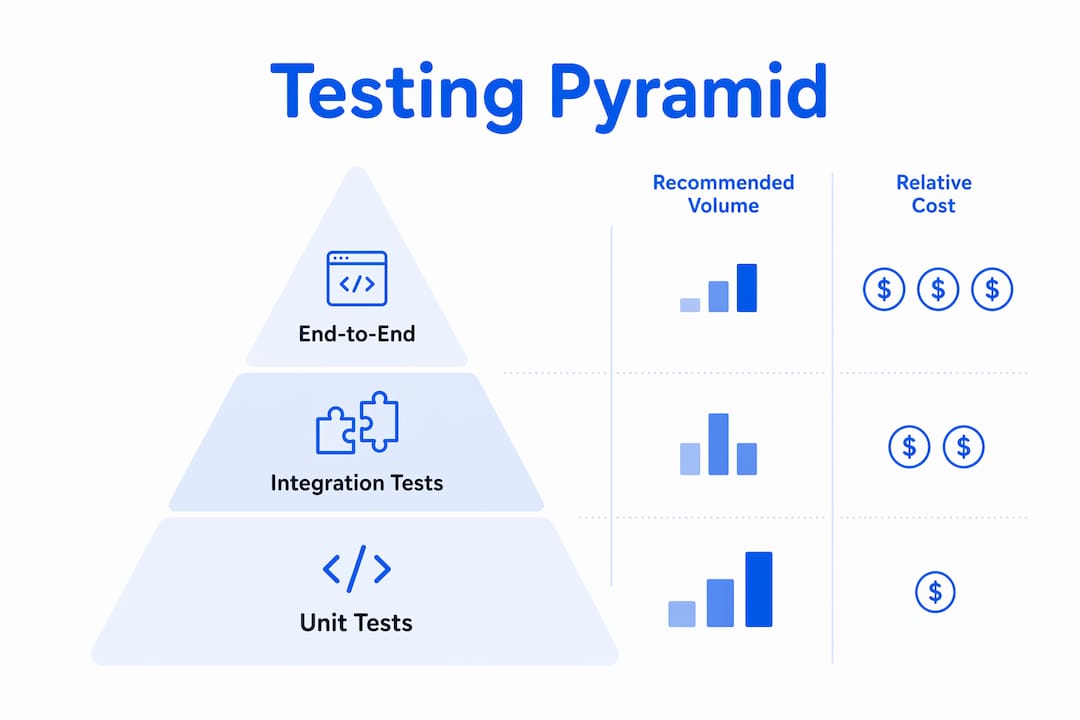
The software testing pyramid is a hierarchical model that organizes automated tests into three layers: a broad base of unit tests, a middle layer of integration tests, and a narrow top of end-to-end tests. Coined by Mike Cohn in Succeeding with Agile, the model gives QA teams a practical framework for balancing test speed, cost, and reliability. The core principle is simple: run the most tests where they are fastest and cheapest. Industry standards recommend a 70/20/10 distribution for automated tests, meaning 70% unit, 20% integration, and 10% end-to-end. That ratio keeps feedback loops tight and defect costs low across Agile and DevOps workflows.
What is a software testing pyramid?
The software testing pyramid is a software testing model that maps test types to three distinct layers, each with a different scope, speed, and cost profile. The bottom layer holds unit tests, the middle holds integration tests, and the top holds end-to-end (E2E) tests. The shape itself is intentional: wider at the base means more tests, narrower at the top means fewer. This visual metaphor, popularized by Mike Cohn and later expanded by Martin Fowler, tells you at a glance where to invest your testing effort.
The pyramid sits within a broader software testing hierarchy that includes manual testing, exploratory testing, and user acceptance testing (UAT). The pyramid specifically addresses automated test distribution. It does not replace manual or exploratory testing. It tells you how to structure the automated portion of your test suite so you get maximum coverage with minimum maintenance overhead.

Understanding the testing pyramid framework matters most when your test suite starts slowing down CI/CD pipelines or producing unreliable results. Those are the symptoms of a pyramid that has been inverted or ignored.
What are the three layers of the testing pyramid?
Each layer of the pyramid has a distinct job. Confusing those jobs is the most common source of test suite problems.
Unit tests: the foundation
Unit tests verify a single function, method, or class in complete isolation. They mock all external dependencies, including databases, APIs, and file systems. Unit tests run in milliseconds, making them the fastest and cheapest tests to write, run, and maintain. A suite of 10,000 unit tests can complete in under two minutes on a standard CI server. That speed is why they form the base of the pyramid and why the 70% target exists.
Integration tests: the middle layer
Integration tests verify that two or more components work correctly together. A typical example is testing whether a service correctly reads from and writes to a database, or whether an API endpoint correctly calls a downstream service. These tests are slower than unit tests because they involve real infrastructure or at least partial infrastructure. They cost more to maintain because they depend on the behavior of multiple components. The 20% target reflects their higher value per test compared to unit tests, balanced against their higher cost.
End-to-end tests: the narrow top
E2E tests simulate a real user moving through a complete workflow, from login to checkout or from form submission to confirmation email. They are the most expensive tests to write, run, and debug. E2E tests can take minutes or hours to complete and are the most brittle layer in any test suite. A single UI change can break dozens of E2E tests at once. The 10% target reflects their value for catching cross-system failures that unit and integration tests cannot catch, while limiting the maintenance burden they create.
| Layer | Scope | Speed | Relative Cost | Recommended Volume |
|---|---|---|---|---|
| Unit | Single function or class | Milliseconds | Low | 70% of test suite |
| Integration | Component interaction | Seconds | Medium | 20% of test suite |
| End-to-End | Full user workflow | Minutes to hours | High | 10% of test suite |
Why does the testing pyramid improve software quality?
The importance of the testing pyramid comes down to feedback speed and defect cost. The earlier a bug is caught, the cheaper it is to fix. Maximizing ROI with fast, reliable unit tests reduces costly defect fixes later in the development lifecycle. A bug caught at the unit test level costs a fraction of what it costs when caught in production.
Here is how the pyramid delivers that ROI in practice:
- Fast feedback in CI/CD. Unit tests complete in seconds. Developers get a pass or fail signal before they push code. That speed prevents defects from compounding across branches.
- Reduced flakiness. Unit tests are deterministic. They do not depend on network latency, third-party APIs, or browser rendering. A green unit test suite is a reliable signal.
- Lower maintenance overhead. Fewer E2E tests mean fewer tests to update when the UI changes. Teams that follow the pyramid spend less time fixing broken tests and more time writing new features.
- Supports Agile and DevOps. Automated tests integrated into CI/CD pipelines provide immediate feedback and prevent technical debt from building up across sprints.
Pro Tip: If your CI pipeline takes longer than 10 minutes to run, audit your test distribution first. A pipeline dominated by E2E tests is the most common cause of slow feedback in Agile teams.
The pyramid also helps you understand where to look when something breaks. A failing unit test points to a specific function. A failing E2E test could point to anything in the stack. The pyramid reduces debugging time by making failures more specific and more localized.
What are the most common testing pyramid anti-patterns?
The testing pyramid is a guide, not a guarantee. Teams that misapply it create problems that are often worse than having no strategy at all.
The Ice Cream Cone Anti-Pattern
The ice cream cone is the inverted pyramid. Teams that rely heavily on manual testing and E2E tests, with few or no unit tests, end up with a test suite shaped like an ice cream cone: narrow at the bottom, wide at the top. Over-reliance on E2E tests leads to slow feedback and high maintenance costs. This is the direct opposite of what the pyramid recommends and the most common anti-pattern in legacy codebases.
Test Flakiness
Flaky tests pass sometimes and fail sometimes without any code changes. They are almost always a symptom of tests placed at the wrong layer. A test that checks database state through a UI is doing the job of three different test types at once. Reducing flaky tests involves shifting brittle E2E logic into more isolated, deterministic integration or unit tests. That shift improves both stability and debugging efficiency.
Rigid Adherence to 70/20/10
The 70/20/10 ratio is a starting point, not a law. The test pyramid is a metaphor, not a rigid rule. A microservices architecture with many external dependencies may need a higher proportion of integration tests. A data-processing pipeline with complex business logic may need 90% unit tests. The goal is fast, reliable feedback. The ratio is just a tool to get there.
Pro Tip: When a team member says “we need more E2E coverage,” ask what specific failure mode they are trying to catch. Nine times out of ten, an integration test covers it faster and more reliably.
You can also explore AI tools in test reporting to identify patterns in test failures that point to misplaced tests in your suite.
How does the testing pyramid adapt to modern development?
The classic three-layer pyramid works well for monolithic web applications. Modern architectures require adjustments, but the core principle stays the same: test at the lowest level that gives you confidence.
| Architecture | Adaptation | Key Addition |
|---|---|---|
| Microservices | Contract tests between services | Service-level test layer |
| Mobile apps | Device and OS matrix testing | Mobile UI test layer |
| Event-driven systems | Message queue integration tests | Async integration layer |
| Serverless | Function-level unit tests | Cold-start performance tests |
Adjustments to the pyramid include adding mobile testing layers and service-level tests to fit modern project complexity. For microservices, tools like Pact enable contract testing between services, which sits between integration and E2E in the hierarchy. This keeps the feedback loop fast without requiring a full system deployment to catch interface mismatches.
In CI/CD workflows using GitHub Actions, GitLab CI, or Jenkins, the pyramid maps directly to pipeline stages. Unit tests run on every commit. Integration tests run on every pull request. E2E tests run before deployment to staging. That sequencing means most failures are caught early, where they are cheapest to fix.
The transition from manual QA to AI-assisted testing is also reshaping how teams apply the pyramid. AI-generated unit tests from tools like GitHub Copilot and Diffblue Cover are making it easier to reach the 70% unit test target without proportionally increasing developer time. Context matters more than strict ratios: the right distribution depends on your architecture, your team’s skill set, and your deployment frequency.
Key takeaways
The testing pyramid works because it aligns test volume with test speed and cost, putting the most tests where they run fastest and cost least.
| Point | Details |
|---|---|
| Follow the 70/20/10 rule as a starting point | Aim for 70% unit, 20% integration, and 10% E2E tests in your automated suite. |
| Unit tests are your highest-ROI investment | They run in milliseconds, catch bugs early, and cost the least to maintain. |
| Avoid the ice cream cone anti-pattern | Over-relying on E2E tests slows feedback and inflates maintenance costs. |
| Adapt the pyramid to your architecture | Microservices, mobile, and serverless projects need additional test layers. |
| Flaky tests signal misplaced test logic | Shift brittle E2E logic down to integration or unit tests to restore reliability. |
The part most teams get wrong
Teams adopt the pyramid as a ratio exercise. They count tests, calculate percentages, and declare success when the numbers look right. That misses the point entirely.
The pyramid is a feedback design problem. The question is not “do we have 70% unit tests?” The question is “does our test suite tell us, within two minutes, whether the last change broke something?” If the answer is yes, your pyramid is working. If the answer is no, the ratio is irrelevant.
The teams I have seen struggle most with the pyramid are the ones that inherited a large E2E suite from a previous QA approach and tried to add unit tests on top without removing anything. The result is a bloated suite that takes 45 minutes to run and produces 20 flaky failures per build. The fix is not addition. It is replacement. Every E2E test you delete and replace with a targeted integration test makes your suite faster and more trustworthy.
The other mistake is treating the pyramid as a one-time decision. Your test distribution should be reviewed every quarter, especially after major architectural changes. A microservices migration, a new mobile platform, or a shift to serverless all change the optimal shape of your test suite. The pyramid gives you the vocabulary to have that conversation with your team. Use it.
— Marketing
How Wezardapp fits into your testing strategy
The testing pyramid covers automated tests well. User acceptance testing sits at the top of the hierarchy, and that layer has its own challenges: capturing bugs clearly, avoiding duplicate tickets, and getting issues into your backlog without friction.

Wezardapp is the only UAT tool that records your screen, transcribes the issue in real time, and uses AI to detect duplicate tickets before they reach your Jira or Azure DevOps backlog. If your team is working through acceptance testing entry criteria or managing a high-volume UAT cycle, Wezardapp removes the manual overhead that slows down the top of your testing pyramid. You can also explore UAT vs. system testing to clarify where UAT fits within your overall testing strategy.
FAQ
What is the software testing pyramid?
The software testing pyramid is a model that organizes automated tests into three layers: unit tests at the base, integration tests in the middle, and end-to-end tests at the top. It guides teams to write more fast, cheap tests and fewer slow, expensive ones.
What is the recommended test distribution in the pyramid?
Industry standards recommend 70% unit, 20% integration, and 10% end-to-end tests as a starting distribution for Agile projects. The exact ratio should be adjusted based on your architecture and deployment context.
What is the ice cream cone anti-pattern?
The ice cream cone is an inverted testing pyramid where most tests are manual or end-to-end, with few unit tests at the base. It produces slow feedback, high maintenance costs, and brittle test suites.
How does the testing pyramid apply to microservices?
Microservices architectures add a contract testing layer between integration and E2E tests. Tools like Pact verify service interfaces without requiring full system deployments, keeping feedback fast across distributed systems.
How do i fix a flaky test suite using the pyramid?
Shift brittle E2E test logic into integration or unit tests to make those checks more deterministic. Flakiness almost always signals that a test is operating at a higher layer than the logic it is verifying requires.