
A test audit in software is a systematic review of the testing process designed to verify that it is effective, compliant, and aligned with business objectives. The formal industry term is “QA process audit,” and both terms describe the same structured evaluation. Software teams use test audits to identify gaps in documentation, tool usage, team practices, and test coverage before those gaps become costly defects or compliance failures. Standards like ISTQB guidelines and ISO/IEC 29119 define the artifacts and evidence a mature audit must examine. Organizations that skip this process face real consequences: 67% of audit failures trace directly to incomplete or untraceable test documentation.
What is a test audit in software, and what does it cover?
A test audit reviews every layer of the testing process, not just the test cases themselves. Auditors examine process adherence, documentation quality, tool fitness, and team roles to build a complete picture of QA health.
The core areas a test audit covers include:
- Test plans and strategy documents: Are they current, approved, and linked to actual requirements?
- Traceability matrices: A traceability matrix documents bidirectional links between requirements, test cases, executions, and defects. Regulated industries treat this as mandatory evidence.
- Defect reports and resolution records: Do defects have clear owners, root cause analysis, and verified fixes?
- Tool assessment: Are testing tools appropriate for the project type, and do they integrate with CI/CD pipelines?
- Team capabilities and responsibilities: Are roles clearly defined, and does the team follow the documented process?
- Test evidence: Execution logs, screenshots, environment configs, and defect reports organized by test cycle form the audit evidence package.
Each artifact tells a story. A missing traceability matrix does not just mean a documentation gap. It means a regulator cannot confirm that every requirement was tested, which is a compliance failure waiting to happen.
Pro Tip: Before your audit begins, collect all artifacts into a single shared location organized by test cycle. Auditors who spend time hunting for evidence tend to assume the worst about what they cannot find.
What are the main types of software test audits?
Test audits are not one-size-fits-all. The type of audit you run depends on what you need to learn and what risk you are managing.

| Audit type | Primary focus | Common trigger |
|---|---|---|
| QA process audit | Maturity, workflow adherence, team practices | Project milestone, new team, or quality decline |
| Automation testing audit | Framework architecture, code modularity, CI/CD alignment | Slow test suites, high flakiness, or scaling plans |
| Compliance audit | Regulatory adherence (SOX, HIPAA, FDA 21 CFR Part 11) | Regulatory review, contract requirement, or incident |
| Technical testing audit | Tool selection, execution reliability, environment stability | Tool migration or persistent environment failures |
A QA process audit measures how closely the team follows its own defined workflows and whether those workflows produce reliable results. An automation testing audit goes deeper into framework design, assessing code modularity, execution reliability, and alignment with CI/CD pipelines. Teams that run automation audits regularly find that optimization can cut test suite execution time by more than 50%. That is not a minor efficiency gain. It directly shortens feedback loops for every developer on the team.
Compliance audits carry the highest financial stakes. Organizations that fail regulatory audits due to inadequate test evidence face average penalties of $14.82 million. That figure makes a compliance audit one of the highest-return investments a QA team can make. Technical testing audits focus on the tools and environments themselves, catching configuration drift and integration failures that corrupt test results without anyone noticing.
How to conduct a test audit: process steps and best practices
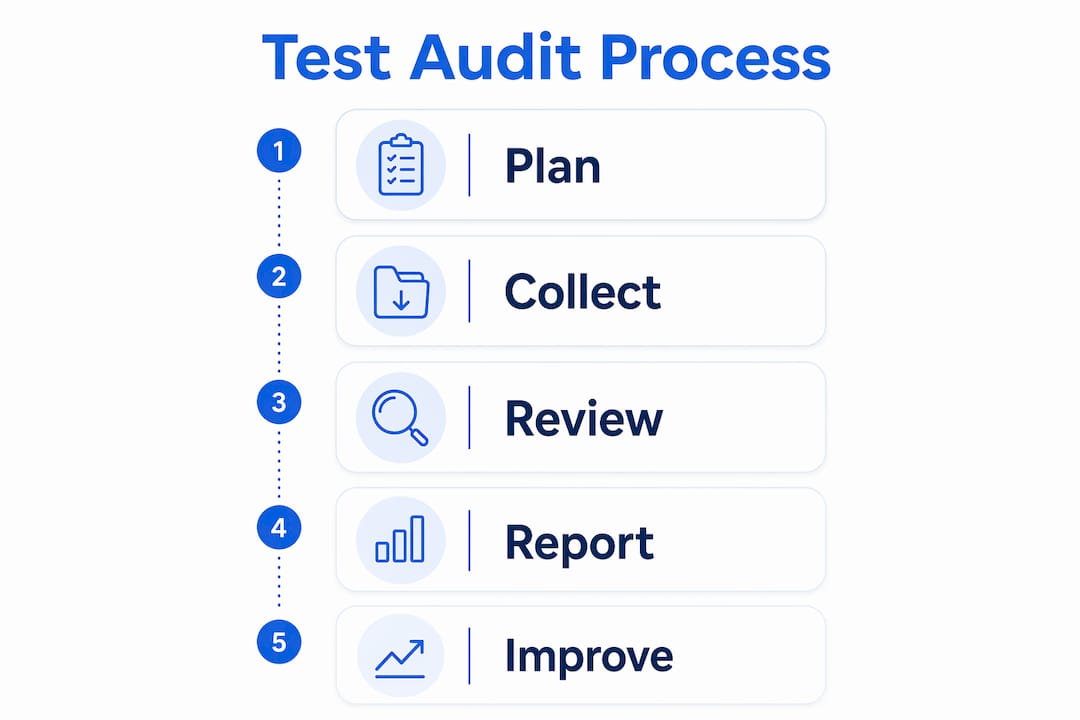
A well-run test audit follows a defined sequence. Skipping steps, especially scope definition and follow-up, is the most common reason audits produce reports that nobody acts on.
-
Define the scope by risk. Focus on high-risk or recently changed modules rather than the entire system. Stable, low-change areas rarely contain the defects worth auditing. Scope by risk keeps the audit focused and the findings credible.
-
Gather and organize evidence. Collect test plans, traceability matrices, execution logs, defect reports, and environment configs before the first interview. A QA audit must be evidence-based, grounding findings in artifacts rather than informal team opinions.
-
Review documentation for completeness and accuracy. Check that test plans reflect the current system, that traceability matrices are bidirectional, and that defect reports include resolution evidence. Gaps here are the most common audit finding.
-
Assess tools and automation. Confirm that tools match the project’s technical requirements and that automation frameworks integrate cleanly with the CI/CD pipeline. A tool that works in isolation but breaks in the pipeline is a liability.
-
Interview stakeholders, but anchor every claim to an artifact. Conversations surface context that documents miss. They do not replace evidence. If a team member says “we always do X,” the audit must confirm X in the logs.
-
Document findings with assigned owners and deadlines. Audit reports require systematic follow-up with named owners and firm deadlines. Without this step, audits yield limited long-term improvement.
-
Validate remediation. Return to each finding after the deadline and confirm the fix is in place. This is the step most teams skip, and it is the step that determines whether the audit had any real effect.
Pro Tip: Use a test audit checklist tied to your documentation standards. A checklist forces consistency across auditors and makes the findings defensible if they are challenged.
The role of automation in the audit process itself is growing. Teams that use automated evidence collection reduce compliance costs by 43% annually and cut audit preparation time from weeks to days compared to manual methods. That efficiency gain frees auditors to focus on interpretation rather than data gathering.
What are the benefits of test audits for software quality and compliance?
Test audits deliver value across three dimensions: technical quality, regulatory readiness, and business impact.
On the technical side, audits surface inefficiencies that teams have normalized. A test suite with 40% redundant cases, a traceability matrix that has not been updated since the last major release, or an automation framework with no modularity. These problems are invisible until someone looks for them systematically.
“QA audits translate technical debt and process gaps into business terms — cost, risk, and predictability — unlocking resources to address critical issues.” This framing matters because it turns audit findings into budget conversations, not just engineering tasks.
The compliance benefits are concrete and measurable. Key outcomes include:
- Reduced audit preparation time: Automated evidence collection cuts prep from weeks to days.
- Lower compliance costs: Automated QA systems reduce compliance costs by 43% annually compared to manual approaches.
- Stronger traceability: Bidirectional traceability matrices satisfy regulators in industries governed by SOX, HIPAA, and FDA 21 CFR Part 11.
- Fewer surprise failures: Audits improve workflows and reduce risks by aligning QA processes with business goals before a regulator or client does the same review.
The strategic benefit is harder to quantify but equally real. A comprehensive QA audit connects technical findings to reliability, user experience, and cost control. That connection gives project managers the language to request resources, justify tool investments, and make the case for process changes to leadership.
Key Takeaways
A software test audit is the most direct way to confirm that your QA process is producing reliable, compliant, and traceable results before a regulator or client does it for you.
| Point | Details |
|---|---|
| Definition and scope | A test audit is a structured review of testing processes, documentation, tools, and team practices against defined standards. |
| Risk-based scoping | Focus audit effort on high-risk and recently changed modules to maximize findings per hour of review. |
| Evidence over opinion | Ground every finding in artifacts like logs, traceability matrices, and defect reports, not team interviews alone. |
| Follow-up is mandatory | Assign owners and deadlines to every finding, then validate fixes. Without this step, audits produce reports, not improvements. |
| Automation cuts costs | Automated evidence collection reduces compliance costs by 43% annually and cuts audit prep time from weeks to days. |
Why most test audits fail to change anything
The most common misconception about test audits is that the report is the deliverable. Teams spend weeks preparing evidence, sit through the review, receive a findings document, and then file it. Six months later, the same gaps appear in the next audit. The audit did not fail because the findings were wrong. It failed because nobody owned the remediation.
The second misconception is that audits are about blame. They are not. An objective, evidence-based assessment conducted by someone outside the immediate team is the only way to see what the team has stopped seeing. Internal teams normalize their own workarounds. An independent auditor reads the traceability matrix and immediately notices that 30% of requirements have no linked test case. The team knew this was a problem but had deprioritized it for two sprints. The audit makes it visible and urgent.
The audits I have seen deliver real change share one trait: they treat the findings document as the beginning of the work, not the end. Each finding has a named owner, a deadline, and a scheduled validation check. The real value lies in rigorous post-audit action. That is the difference between a compliance checkbox and a process that actually improves. If your team is running audits without that follow-through, you are paying the cost of the audit without collecting the return.
— Marketing
How Wezardapp supports audit-ready QA teams
Audit readiness starts with the quality of your test evidence, and that quality depends on how you capture and organize bugs during testing.

Wezardapp is the only UAT tool that records your screen, transcribes issues in real time, and uses AI to detect duplicate tickets before they reach your Jira or Azure DevOps backlog. Every session produces structured, traceable evidence that maps directly to the artifacts auditors look for. Teams preparing for compliance reviews can use Wezardapp’s UAT bug tracking to build a complete audit trail without manual documentation effort. For teams focused on defining clear entry and exit criteria before testing begins, the acceptance testing entry criteria guide covers the prerequisites that keep audits clean and findings defensible.
FAQ
What is a test audit in software?
A test audit in software is a structured review of the testing process that evaluates documentation, tools, team practices, and test evidence against defined quality and compliance standards. The goal is to identify gaps and drive measurable improvements before they become defects or regulatory failures.
What should a test audit checklist include?
A test audit checklist should cover test plans, traceability matrices, defect reports, execution logs, tool configurations, and team role definitions. Every item on the checklist should map to a specific artifact that auditors can examine directly.
How often should software teams run test audits?
Most teams run formal audits at major project milestones, before regulatory reviews, or after a significant quality incident. High-compliance industries like healthcare and finance typically require annual audits at minimum.
What is the difference between a test audit and quality assurance?
Quality assurance is the ongoing process of building quality into the development cycle. A test audit is a point-in-time evaluation of whether that QA process is working as intended. Audits assess QA; QA prevents defects.
Why do test audits fail to produce lasting improvements?
Test audits fail when findings are documented but not assigned to owners with deadlines. Without systematic follow-up and validation, the audit produces a report rather than a change, and the same gaps reappear in the next review cycle.


