
Verifying UAT scenarios against acceptance criteria is the process of confirming that user acceptance tests prove software meets clear, measurable business requirements through realistic, user-focused test scenarios. This is not a formality. Without this verification, teams collect vague feedback, miss critical edge cases, and risk signing off on software that fails real users. The industry-standard term for this process is acceptance criteria validation, and it sits at the heart of every successful UAT cycle. A traceability matrix, business-centric acceptance criteria, and end-to-end scenario design are the three tools that make it work.
How to verify UAT scenarios against acceptance criteria through strong scenario design
Strong UAT scenarios share five characteristics: a named actor, a clear goal, a realistic starting condition, a defined action path, and a verifiable business outcome. A scenario that says “user logs in and checks order” fails all five. A scenario that says “a registered customer with an active account submits a return request for a delivered order and receives a confirmation email within two minutes” passes all five. The difference is not cosmetic. The second version gives testers a concrete pass/fail signal tied to a business promise.
UAT scenarios reflect full end-to-end workflows verified against acceptance criteria, not isolated clicks or menu navigations. This matters because real users do not interact with features in isolation. They complete tasks that cross multiple system functions. A checkout scenario, for example, should cover product selection, cart update, payment processing, and order confirmation in one continuous flow.

Write scenarios in business language, not technical language. “The system processes the API call” is a developer concern. “The customer receives an order confirmation within 60 seconds of payment” is a business concern and a testable UAT criterion. Business stakeholders can read and approve the second version. They cannot validate the first.
Negative and exception scenarios are not optional. Including exception scenarios in UAT plans prevents production issues from untested edge cases. Test what happens when a user submits an expired coupon, attempts a payment with insufficient funds, or tries to access a page without the required permissions. These cases expose gaps that happy-path testing never finds.
Use this checklist to confirm scenario quality before execution:
- The scenario names a specific user role or actor
- The starting condition is realistic and reproducible
- Each step uses business language, not system terminology
- The expected outcome is measurable, not subjective
- At least one negative or exception case is included per workflow
- The scenario maps directly to one or more acceptance criteria
Pro Tip: Write scenarios with a business stakeholder in the room. If they cannot follow the steps and confirm the expected outcome, the scenario is not ready for UAT.
How do you map UAT scenarios to acceptance criteria?
Acceptance criteria define what must be true; UAT scenarios define how to verify it. These are two distinct artifacts that must connect explicitly. A scenario without a linked criterion is an opinion. A criterion without a linked scenario is an untested assumption.
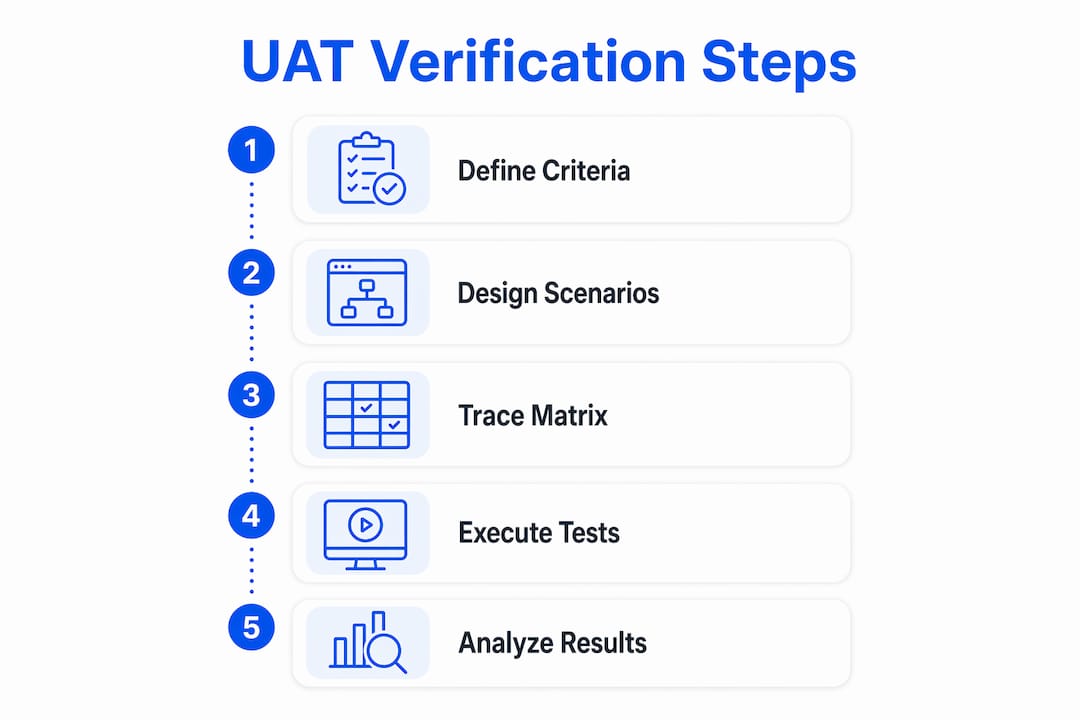
A traceability matrix is the operational tool that makes this connection visible. It is a table that links each UAT scenario to its acceptance criterion, and each criterion to its original business requirement. A traceability matrix linking test cases to acceptance criteria and business requirements provides objective evidence of coverage and confirms which business promises the test suite actually validates.
Acceptance criteria must be measurable and independent to support objective validation. “The system should be fast” is not a criterion. “The search results page loads in under two seconds for 95% of queries under peak load” is a criterion. The types of software acceptance criteria that work best in UAT are outcome-based, written in plain language, and tied to a single verifiable condition.
| Traceability element | Purpose | Example |
|---|---|---|
| Business requirement | States the business need | Customers must receive order confirmations |
| Acceptance criterion | Defines the measurable condition | Confirmation email arrives within 60 seconds |
| UAT scenario | Describes the verification steps | Customer completes checkout; tester checks inbox |
| Pass/fail result | Records objective outcome | Pass: email received in 47 seconds |
Pro Tip: If your acceptance criteria are written by developers, rewrite them with a business analyst before UAT starts. Technical criteria produce technical feedback, which business stakeholders cannot use to approve a release.
What is the step-by-step process for executing UAT scenarios?
Execution without preparation produces noise, not evidence. Follow this sequence to run UAT scenarios against acceptance criteria with confidence.
- Confirm environment readiness. The UAT environment must mirror production data, permissions, and integrations. Testing in a degraded environment invalidates results.
- Prepare and approve test data. Use realistic data that reflects actual user profiles. Synthetic data that does not match production patterns produces false positives.
- Get scenario sign-off before execution. Business stakeholders must review and approve scenarios before testing begins. This prevents disputes about what was tested after the fact.
- Execute each scenario step by step. Follow the documented steps exactly. Do not improvise. Deviations from the scenario invalidate the link to the acceptance criterion.
- Record pass or fail against each criterion. Every scenario produces a binary result tied to its criterion. “Mostly passed” is not a valid outcome.
- Document every defect with full reproduction steps. A defect report without a reproduction path is useless to developers. Record the exact steps, the expected outcome, and the actual outcome.
- Assign severity to each defect. Not every defect blocks release. Classify defects as critical, major, or minor based on their impact on the acceptance criterion they violate.
- Involve business stakeholders during execution. UAT is a business readiness process focused on usability and operational fit, not just functional correctness. Business owners who observe testing catch issues that testers miss.
- Handle unexpected outcomes explicitly. When a scenario produces an unexpected result that is not a defect, document it as an observation and escalate to the business owner for a decision.
- Apply exit criteria before sign-off. Define exit criteria in advance: for example, 100% of critical scenarios pass, and no critical defects remain open. Sign-off without exit criteria is a judgment call, not a verified decision.
What are the most common UAT verification mistakes?
The most damaging mistake in UAT is treating it as a repeat of system testing. UAT is not bug hunting. It confirms that the software supports real business processes, fits the way users actually work, and meets the data and usability expectations of the people who will use it daily. Running the same functional test scripts through UAT wastes time and misses the point entirely.
These are the mistakes that most often derail UAT scenario verification:
- Vague acceptance criteria. Vague criteria cause subjective feedback and make sign-off contentious. If a criterion cannot be measured, it cannot be verified.
- No traceability between scenarios and criteria. Without a traceability matrix, teams cannot prove which criteria were tested or which gaps remain.
- Skipping negative scenarios. Happy-path testing leaves edge cases untested. Production failures most often come from the cases no one thought to test.
- Starting UAT too late. Integrating UAT scenarios early into agile sprints makes end-user approval part of the definition of done. Treating UAT as a last step compresses timelines and forces rushed sign-offs.
- Excluding business stakeholders. When testers run UAT without business owner involvement, the results lack the authority needed for a credible go/no-go decision.
- Ignoring performance criteria. A UAT pass does not guarantee launch success unless acceptance criteria include at least basic load conditions. A checkout that completes in under three seconds under peak load is a testable performance criterion that belongs in UAT.
Fixing these mistakes starts with writing better criteria before scenarios are designed. If UAT feedback is vague, the criteria are almost certainly technical rather than outcome-focused. Rewrite them in business language and the feedback quality improves immediately.
What tools and metrics support UAT scenario verification?
Test management tools that link scenarios to acceptance criteria and business requirements are the foundation of objective UAT verification. Entry-level options handle basic scenario tracking and pass/fail recording. Enterprise platforms add traceability matrices, defect integration with Jira or Azure DevOps, and real-time reporting dashboards. The right choice depends on team size and the complexity of the acceptance criteria being tracked.
Metrics that matter in UAT verification fall into three categories:
- Coverage: What percentage of acceptance criteria have at least one linked scenario? A coverage rate below 100% means some criteria will not be verified.
- Pass rate: What percentage of executed scenarios pass on first run? A low pass rate signals either poor software quality or poorly designed scenarios.
- Defect severity distribution: What proportion of defects are critical versus minor? A high proportion of critical defects signals systemic issues that require a re-test cycle before sign-off.
Pro Tip: Track scenario pass rates by acceptance criterion, not just by scenario count. A criterion with three linked scenarios that all fail is a release blocker. A criterion with one scenario that passes is verified. Aggregate counts hide this distinction.
Wezardapp addresses a specific gap in this process. It records the tester’s screen, transcribes the issue in real time, and uses AI to detect duplicate tickets before they reach the Jira or Azure DevOps backlog. This eliminates the manual effort of writing defect reproduction steps and prevents duplicate reports from cluttering the backlog during high-volume UAT cycles. Teams using Wezardapp spend less time on defect administration and more time on scenario execution.
Key Takeaways
Verifying UAT scenarios against acceptance criteria requires measurable criteria, explicit traceability, end-to-end scenario design, and active business stakeholder involvement at every stage.
| Point | Details |
|---|---|
| Design scenarios around user goals | Every scenario needs a named actor, realistic start condition, and a verifiable business outcome. |
| Use a traceability matrix | Link each scenario to its acceptance criterion and original business requirement for objective coverage proof. |
| Include negative scenarios | Exception cases prevent production failures from untested edge cases like expired permissions or missing data. |
| Integrate UAT early in sprints | Embedding UAT in sprint planning makes end-user approval part of the definition of done. |
| Track metrics by criterion | Measure coverage, pass rate, and defect severity per criterion, not just total scenario counts. |
Why I think most teams verify UAT the wrong way
Most teams treat UAT verification as a documentation exercise. They write scenarios, run them, record pass/fail, and hand the results to a project manager who declares success. What they miss is that the quality of the verification depends entirely on the quality of the acceptance criteria, and most acceptance criteria are written by developers who are thinking about system behavior, not business outcomes.
The teams that get UAT right write their acceptance criteria with business owners before a single line of code is written. They treat the criteria as a contract, not a checklist. When a scenario fails, they do not ask “what broke?” They ask “which business promise did we fail to keep?” That reframe changes everything. It forces developers, testers, and business stakeholders into the same conversation about what the software is actually supposed to do for real users.
The other thing most teams skip is the exception scenario. I have seen releases go live with zero negative test coverage because the team ran out of time. Those releases almost always produce the first production incident within 48 hours. An expired session, a missing permission, a malformed input. These are not edge cases. They are the normal behavior of real users under real conditions. If your UAT test scenarios do not cover them, your sign-off is not a business readiness decision. It is a guess.
— Marketing
Wezardapp makes UAT scenario verification faster and cleaner
UAT cycles generate a high volume of defect reports, and managing them manually slows teams down. Wezardapp records the tester’s screen, transcribes issues in real time, and uses AI to catch duplicate tickets before they reach your Jira bug tracking or Azure DevOps backlog.
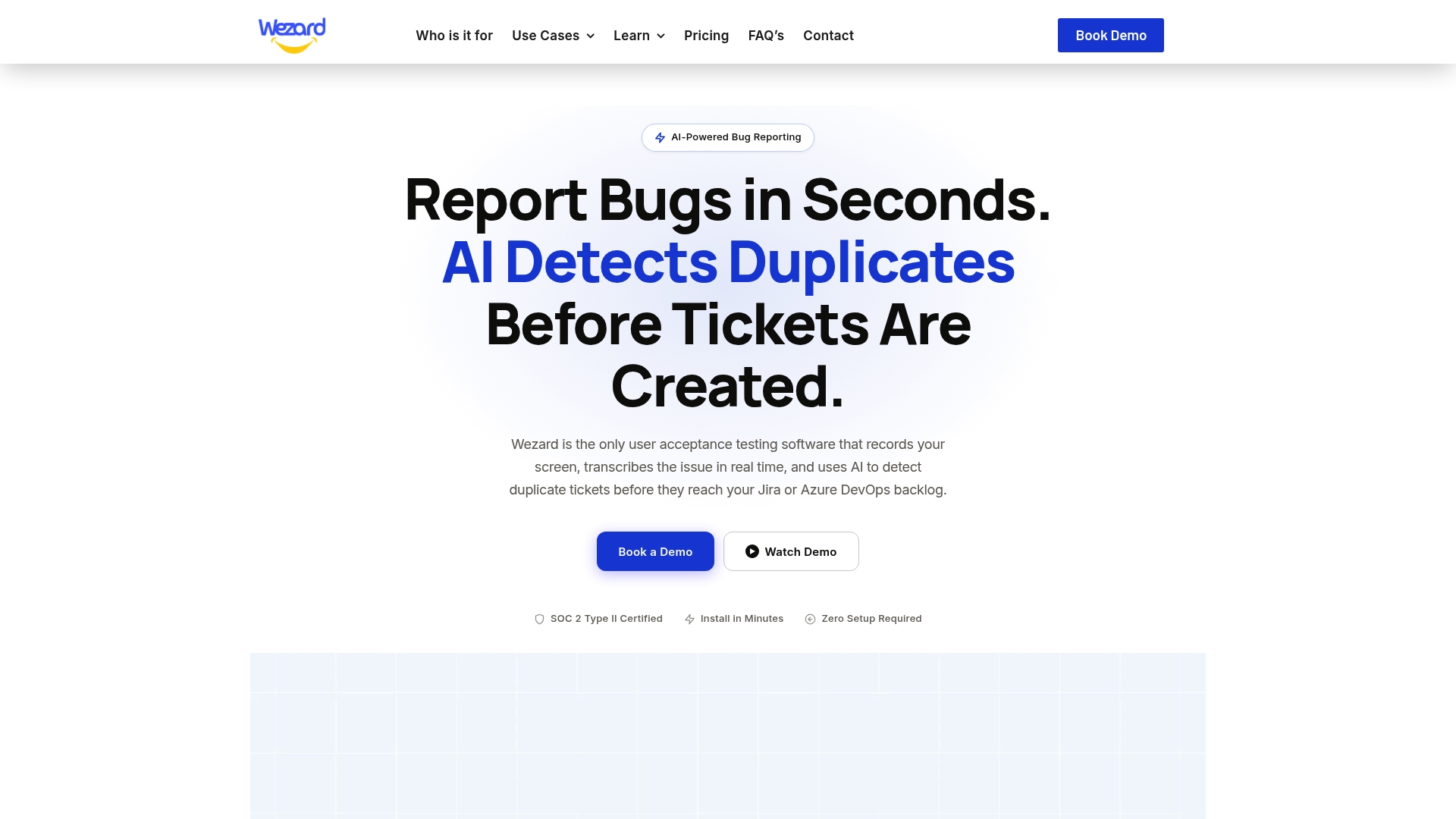
Teams running structured UAT against acceptance criteria get the most value from Wezardapp because every defect arrives with a full screen recording and a transcribed description, already checked for duplicates. That means less time writing reproduction steps and more time closing gaps against your acceptance criteria. If you want to see how this fits into a complete UAT workflow, the UAT testing feedback tool page walks through the full process.
FAQ
What does it mean to verify UAT scenarios against acceptance criteria?
Verifying UAT scenarios against acceptance criteria means confirming that each test scenario produces a measurable result that proves a specific business requirement has been met. The scenario defines the steps; the criterion defines the pass condition.
How do you write acceptance criteria for UAT?
Write acceptance criteria in plain business language as measurable outcome statements, such as “the confirmation email arrives within 60 seconds of payment.” Criteria written in technical language produce feedback that business stakeholders cannot use to approve a release.
What is a traceability matrix in UAT?
A traceability matrix is a table that links each UAT scenario to its acceptance criterion and the original business requirement it validates. It provides objective proof of test coverage and identifies which criteria remain untested.
Why should UAT include negative scenarios?
Negative scenarios test what happens when users encounter errors, missing permissions, or invalid inputs. Skipping them leaves edge cases untested, and those cases are the most common source of post-release production failures.
When should UAT scenario verification start in an agile project?
UAT scenario verification should start at sprint planning, not at the end of the project. Embedding UAT into the definition of done ensures business stakeholders validate each increment before it accumulates into a high-risk final release.