
Data validation in UAT is defined as the process of confirming that data within a system is accurate, consistent, and meaningful for real-world business use before software goes live. This is not a technical formality. IBM research shows a $3.1 trillion annual loss in the U.S. economy from bad data quality. That figure makes UAT the last viable control point before bad data reaches production. The role of data validation in UAT extends well beyond checking field formats. It confirms that the system produces outputs business users can actually trust and act on.
What are the key data validation techniques applied during UAT?
Effective data validation in UAT uses multiple techniques working together, not a single pass at the end of a test cycle. Each technique targets a different failure mode.
Core validation checks used in UAT:
- Data type checks: Confirm that fields accept only the correct data format, such as dates in date fields and integers where decimals are not permitted.
- Boundary checks: Test values at the edges of accepted ranges. A price field that accepts negative numbers will not surface that problem with clean, mid-range test data.
- Consistency checks: Verify that related fields agree with each other. An order marked “shipped” with a blank shipping date is a consistency failure.
- Code and lookup checks: Confirm that coded values, such as country codes or product categories, match the approved reference list.
- Semantic validations: Catch cases where data is technically valid but business illogical, such as a refund amount exceeding the original purchase.
Multi-layer validation covers the UI, backend, database constraints, business logic, and external data ingestion points. Each layer stops different categories of bad data. Relying on only one layer, typically the frontend, leaves the backend and database exposed to invalid records that slip through during real user workflows.
The test data itself matters as much as the technique. Using realistic “dirty” data that includes anomalies, edge cases, and historical inconsistencies uncovers issues that clean synthetic data will never surface. A UAT cycle run entirely on perfect sample data is not a UAT cycle. It is a rehearsal with a script that real users will never follow.

Automation handles repetitive checks efficiently, such as running boundary and type validations across thousands of records. Manual review remains necessary for semantic and business logic validations, where a tester must apply judgment about whether an output makes sense in context. The right balance depends on the system, but neither approach alone is sufficient.
Pro Tip: Build a small “poison dataset” of intentionally malformed records before UAT begins. Run it through the system on day one. Any record that passes without triggering an error reveals a validation gap that needs fixing before real users encounter it.
How does data validation enhance the effectiveness of UAT?
UAT validates business rules, workflows, and data relevance beyond what technical specifications cover. This distinction matters because a system can pass every functional test and still produce outputs that business users reject as meaningless or wrong.
Data validation directly supports UAT effectiveness in four ways:
- Trust in outputs: Business users sign off on a system only when reports, calculations, and displayed data match their expectations. Validation confirms those outputs are grounded in accurate data.
- Realistic workflow testing: When testers work with production-like data, they exercise role permissions, error handling, and edge-case paths that clean data never triggers.
- Semantic error detection: Semantic gaps where data passes technical validation but fails business logic are the most frequent source of costly defects found in UAT. Automated tests cannot catch negative inventory counts or contradictory order statuses. Human testers reviewing real data can.
- Reduced adoption risk: Users who encounter placeholder values or obviously wrong data during UAT lose confidence in the system before it launches. That psychological barrier is hard to reverse after go-live.
Data validation is a crucial, commonly overlooked step that ensures valid conclusions and reliable business decisions during UAT. Without it, stakeholders are approving a system based on outputs they cannot verify are real.
For AI and data-intensive systems, UAT success depends entirely on trust in data outputs. A machine learning model that produces predictions based on corrupted training or input data will fail UAT even if the code is technically correct. End-to-end data validation is the mechanism that builds that trust. Teams that skip it are not saving time. They are deferring a more expensive problem to production.
Learning how to structure UAT test cases around validation scenarios is one of the highest-leverage investments a QA team can make before a testing cycle begins.
What common pitfalls occur in data validation during UAT?
Most UAT data validation failures trace back to a small set of recurring mistakes. Recognizing them early prevents the retesting cycles that delay releases and erode stakeholder confidence.
- Using only clean synthetic data. Test environments filled with perfectly formatted, complete records hide the edge cases that real users generate daily. Historical inconsistencies and partial records must be part of the dataset.
- Confusing verification with validation. Verification asks “did we build the system correctly?” Validation asks “did we build the correct system?” UAT belongs to validation. Testing whether a field saves correctly is verification. Testing whether the saved value drives the right business outcome is validation.
- Test environment parity gaps. A UAT environment with different database constraints, reference data, or integration endpoints than production will produce validation results that do not transfer. What passes in UAT fails in production.
- Ignoring stakeholder roles. A finance user and a warehouse manager interact with the same data differently. Validation criteria that ignore role-based context miss defects that only surface under specific permission sets or workflows.
- Undefined acceptance criteria. Multi-stakeholder coordination prevents confusion and reduces retesting cycles. Without documented validation criteria tied to business acceptance standards, testers and business users argue about whether a result is a defect or a feature.
Pro Tip: Run a parity audit between your UAT and production environments before the first test session. Check database constraints, reference tables, and integration endpoints. A 30-minute audit prevents weeks of false-positive results.
Defining validation criteria as part of acceptance criteria, not as an afterthought, is the single most effective structural change a QA team can make to UAT planning. Teams that document what “valid” means before testing starts spend far less time debating results during the cycle.
How can QA teams implement effective data validation strategies?
A repeatable data validation strategy requires structure at every stage of the UAT cycle, from planning through sign-off. The following framework covers the key implementation decisions.
Align validation criteria with business acceptance standards
Every validation rule must trace back to a business requirement. If a rule cannot be linked to a specific acceptance criterion, it either belongs in a different testing phase or the acceptance criteria are incomplete. Documenting validation criteria upstream in the development process shifts validation left and prevents costly downstream failures.
Apply layered validation checks
| Validation layer | What it checks | Who owns it |
|---|---|---|
| Frontend (UI) | Input format, required fields, allowed values | QA testers |
| Backend (API/service) | Business logic, calculation rules, workflow conditions | QA and developers |
| Database | Constraints, referential integrity, data types | Database administrators |
| Data ingestion | External feed accuracy, transformation correctness | Data engineers |
| Business scenario | End-to-end output relevance for real user tasks | Business users and QA |
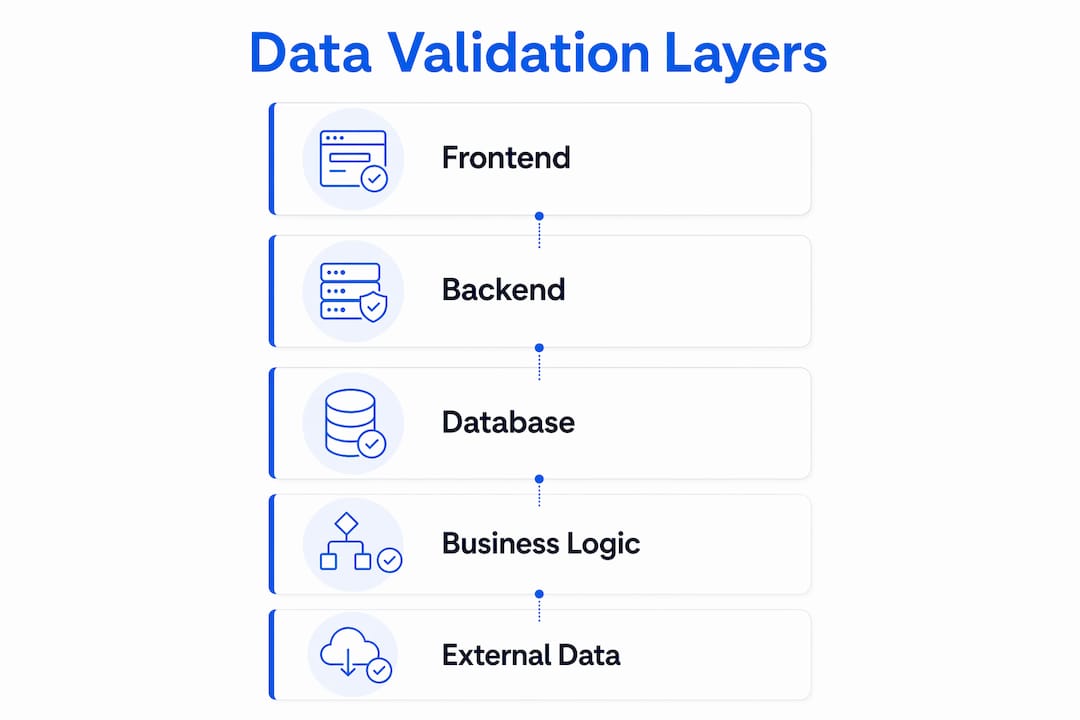
Each layer catches what the others miss. Skipping any layer creates a gap that bad data will eventually find.
Incorporate automated and manual checks
Automated contract validations handle high-volume, repetitive checks efficiently. Manual business scenario reviews handle judgment-based validations that require a human to assess whether an output makes sense. Both belong in every UAT cycle. Preparing realistic data and validation criteria before sessions start is what separates productive UAT cycles from ones that stall on basic data issues.
Practical steps for implementation:
- Document validation rules in a shared register before UAT begins, with each rule linked to a specific acceptance criterion.
- Seed the test environment with production-like data, including edge cases and known historical anomalies.
- Assign validation ownership by layer so every check has a named responsible party.
- Log validation failures in a tracking system that connects defects to the specific data condition that triggered them.
- Review validation outcomes with business stakeholders before sign-off, not after.
Achieving stakeholder sign-off becomes significantly faster when validation results are documented, traceable, and tied to agreed acceptance criteria. Stakeholders who can see exactly what was tested and what passed are far more confident approving a release.
Gartner research shows organizations lose an average of $15 million annually due to poor data quality. That cost is preventable at the UAT stage when validation is treated as a structured discipline rather than an informal check.
Key Takeaways
Data validation in UAT is the primary mechanism for confirming that a system produces accurate, business-relevant outputs that stakeholders can trust before production deployment.
| Point | Details |
|---|---|
| Validation goes beyond technical checks | UAT data validation confirms business fit, not just field-level correctness. |
| Layered validation is non-negotiable | Checks must cover UI, backend, database, and business logic to catch all failure types. |
| Dirty data reveals real problems | Production-like datasets with anomalies surface defects that clean synthetic data hides. |
| Semantic errors are the costliest gap | Technically valid but business-illogical data passes automated tests and fails in production. |
| Documented criteria accelerate sign-off | Validation rules tied to acceptance criteria reduce stakeholder debate and retesting cycles. |
Data validation is the trust layer UAT cannot skip
Most QA teams treat data validation as a supporting activity inside UAT. After working closely with testing workflows across multiple release cycles, I think that framing undersells what validation actually does. It is not support. It is the mechanism that converts UAT from a technical exercise into a business confidence decision.
The teams I have seen struggle most with UAT sign-off share one pattern: they validate that the system works but not that the data it produces is meaningful. Business users do not approve systems because the code is correct. They approve systems because the outputs match their mental model of how the business operates. Validation is what closes that gap.
The shift toward AI-driven systems makes this more urgent, not less. When a model’s output depends on the quality of its input data, end-to-end validation becomes the only way to verify that the system is doing what it claims. Shift-left validation, where data contracts are defined and enforced upstream in the development pipeline, is the direction the industry is moving. QA teams that build this practice now will run faster, cleaner UAT cycles as systems grow more complex.
My practical advice: stop treating validation criteria as a checklist item and start treating it as a design artifact. Define what “valid” means for every critical data output before a single test session runs. That one change reduces retesting, accelerates sign-off, and gives business stakeholders a reason to trust the results they see.
— Marketing
Wezardapp makes UAT validation issues impossible to miss
When data validation surfaces a defect during UAT, capturing it accurately and routing it to the right team is where cycles slow down. Wezardapp records your screen, transcribes the issue in real time, and uses AI to detect duplicate tickets before they reach your Jira backlog or Azure DevOps queue.

Every validation defect gets logged with full context, including the exact data state that triggered it, so developers can reproduce and fix it without a back-and-forth thread. QA teams using Wezardapp spend less time writing bug reports and more time running the validation scenarios that matter. Explore the UAT feedback tool to see how it fits your current testing workflow.
FAQ
What is the role of data validation in UAT?
Data validation in UAT confirms that system data is accurate, consistent, and meaningful for real business use before go-live. It shifts the focus from technical correctness to business fit, ensuring stakeholders can trust the outputs they approve.
Why does data quality matter specifically during UAT?
UAT is the final control point before production deployment. Poor data quality at this stage leads to defects that reach real users, and Gartner research shows organizations lose an average of $15 million annually from bad data.
What data validation techniques are most important in UAT?
The most critical techniques are semantic validation, consistency checks, and boundary checks applied across multiple layers, including UI, backend, database, and business logic. Semantic validation catches errors that automated tests cannot detect.
How does using dirty test data improve UAT outcomes?
Realistic datasets that include anomalies, edge cases, and historical inconsistencies surface defects that clean synthetic data hides. Testing with only perfect data produces UAT results that do not reflect real-world system behavior.
How does data validation support stakeholder sign-off?
When validation results are documented and tied to agreed acceptance criteria, stakeholders can see exactly what was tested and what passed. That transparency removes ambiguity and accelerates the approval decision.


