
SAML proves who a user is; OAuth decides what an app can access on that user’s behalf. They aren’t competitors, they’re layers. For workforce single sign-on with an enterprise identity provider, SAML is usually the right call. For API access, mobile apps, and modern login screens, use OAuth 2.0 paired with OpenID Connect. Most mature systems end up running both.
TL;DR:
- Ensuring proper signature validation and regular certificate rotation is crucial to prevent security breaches and authentication failures in SAML and OAuth systems.
- Manual metadata exchange in SAML is a common operational failure; automating configuration retrieval through well-known endpoints improves reliability.
- Using OAuth access tokens as identity proof leads to errors; only implement OIDC with ID tokens for reliable user login semantics.
- Combining SAML for enterprise federation with OIDC for modern app login offers a scalable, dual-protocol architecture that suits diverse user needs.
- Regular testing of token revocation, session termination, and certificate renewal is essential to maintain continuous, secure identity management.
Table of Contents
- SAML vs OAuth vs OIDC: A Quick Comparison
- How SAML Authentication Works Under the Hood
- How OAuth 2.0 and OIDC Work Together
- Data Format, Discovery, and Session Handling: The Technical Gap
- Where SAML and OAuth Integrations Actually Break
- Decision Checklist: Picking SAML, OAuth, or OIDC
- Making SAML and OAuth/OIDC Work Together in One System
- The Pre-Deploy Checklist Every Architect Should Run
- Why Both Protocols Belong in a Serious B2B Stack
- Sources
SAML vs OAuth vs OIDC: A Quick Comparison
Confusing these three is a category error. SAML handles authentication. OAuth handles authorization. OIDC bolts an identity layer onto OAuth so it can handle authentication too, without borrowing SAML’s plumbing.
| Protocol | Primary function | Token/assertion format | Discovery | Best for |
|---|---|---|---|---|
| SAML | Authentication (AuthN) | Signed XML assertions | Manual metadata exchange | Enterprise workforce SSO |
| OAuth 2.0 | Authorization (AuthZ) | Access tokens (JWT or opaque) | Varies by provider | API access, machine-to-machine |
| OIDC | Identity layer on OAuth | id_token (JWT) | Well-known endpoints, JWKS | Social login, modern app login |
A few things worth remembering when you’re scanning that table on a deadline:
- SAML assertions carry identity attributes (email, roles, department) directly inside signed XML, verified against the IdP’s certificate.
- OAuth access tokens say nothing about identity by design. They just prove the bearer has permission to call an API.
- OIDC’s id_token is the piece that was missing from OAuth. It’s a JWT with actual identity claims, plus a standard
/userinfoendpoint.
Here’s the anti-pattern that causes real damage: using a bare OAuth access token to answer “who is this user?” Auth0’s protocol comparison calls this out directly. Access tokens are authorization artifacts, not identity proofs. If your app needs login semantics, implement OIDC. Don’t improvise identity checks on top of a framework that was never built to provide them.
How SAML Authentication Works Under the Hood
SAML runs on three actors: the principal (your user), the identity provider (IdP), and the service provider (SP), the app the user is trying to reach. The OASIS SAML 2.0 specification defines how these three exchange signed XML assertions over browser redirects.
The flow itself is almost boring in its simplicity. A user hits the SP, gets redirected to the IdP, logs in there, and the IdP posts back a signed assertion confirming identity and attributes. Two bindings dominate in practice:
- HTTP-Redirect binding: used for the initial request, since it fits comfortably in a URL.
- HTTP-POST binding: used to return the assertion, since XML payloads are too large for a query string.
The assertion itself contains claims like NameID, email, group membership, and a validity window, all signed by the IdP’s private key so the SP can verify authenticity against a shared certificate.
Where SAML gets fragile is operations, not protocol design. Metadata exchange between IdP and SP is often a manual, one-time setup that nobody revisits until it breaks. Certificates expire on a schedule nobody put on a calendar, and when they do, authentication fails silently until someone notices a spike in support tickets.
Pro Tip: Put certificate expiration dates in your monitoring system, not just your IdP’s admin console. A 90-day heads-up beats a Monday morning outage.
How OAuth 2.0 and OIDC Work Together
RFC 6749 defines four roles: the resource owner (your user), the client (the app requesting access), the authorization server (issues tokens), and the resource server (the API being protected). Everything in OAuth flows from those four actors negotiating scoped access.
Two grants matter most in current architecture:
- Authorization code grant (with PKCE): the standard for web and mobile apps, where a code gets exchanged server-side for tokens, and PKCE stops interception attacks against public clients.
- Client credentials grant: used for machine-to-machine calls with no human user in the loop, common in backend service integrations.
OAuth alone stops at authorization. That’s exactly the gap OpenID Connect fills: OIDC adds the id_token, a JWT carrying identity claims, plus a /userinfo endpoint and standardized discovery through well-known configuration URLs and JWKS for public key retrieval.
That JWKS piece matters more than it sounds like it should. Instead of manually swapping certificates the way SAML requires, OIDC clients fetch signing keys automatically from a published endpoint. Key rotation becomes a non-event instead of a change-management ticket.
Refresh tokens deserve their own paragraph of caution. They’re long-lived by design, which makes them valuable to attackers if leaked, so rotate them on use and bind them to a client where possible.
Data Format, Discovery, and Session Handling: The Technical Gap
The differences that matter for engineering teams aren’t philosophical, they show up in build time and runtime behavior.
Message format and parsing cost. SAML assertions are XML, which means canonicalization rules, namespace handling, and signature verification that trips up hand-rolled parsers constantly. OIDC’s JSON Web Tokens are smaller, faster to parse, and supported by mature libraries in nearly every language, which is part of why greenfield projects default to it.
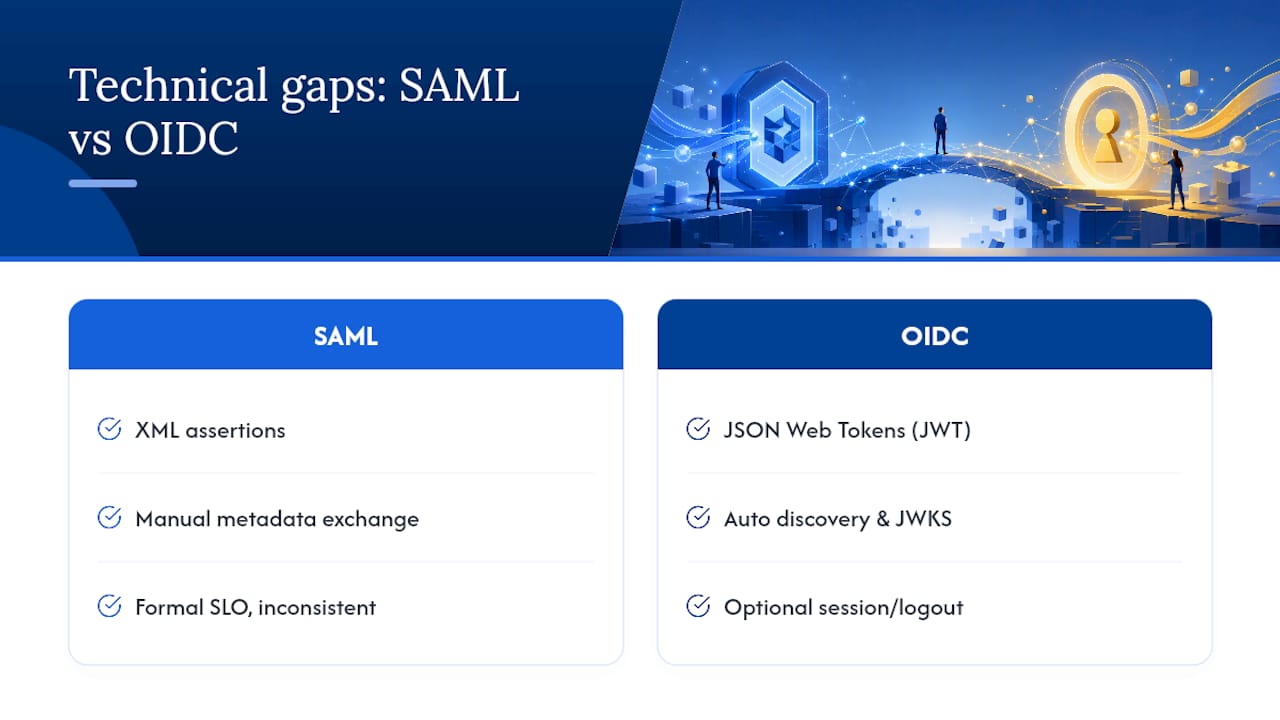
Discovery. This is where the gap is widest. SAML metadata exchange between IdP and SP is typically a manual XML file swap, sometimes automated through federation tools, but often not. OIDC’s well-known endpoints and JWKS let a client fetch configuration and signing keys automatically, cutting the manual metadata work that causes SAML outages.
Session and logout. SAML has a formal Single Logout (SLO) mechanism defined in the spec, though it’s notoriously inconsistent across vendor implementations, some browsers block the background requests SLO depends on. OIDC’s session management and logout extensions are optional add-ons, not core spec, so support varies by provider and you need to test it explicitly rather than assume it works.
None of this makes one protocol categorically better. It means the operational burden lands in different places, and you should plan your team’s time accordingly.
Where SAML and OAuth Integrations Actually Break
Most identity outages trace back to a handful of repeat offenders, and they’re almost never about the protocol spec itself.
- Skipping signature validation properly. Accepting an assertion without verifying it against the IdP’s actual certificate, or accepting unsigned assertions at all, is the single most dangerous SAML mistake.
- Letting certificates expire. Manual metadata management is a documented failure point precisely because nobody owns the renewal calendar.
- Treating access tokens as identity proof. This is the OAuth equivalent of the SAML signature mistake, using a token that proves permission as if it proves who someone is.
- Leaking refresh tokens through logs, client-side storage, or overly long lifetimes.
- Granting scopes wider than the integration needs, then never revisiting them once the app matures.
The fix across all five is the same discipline: enforce audience and issuer checks on every token, keep token lifetimes short, automate key and certificate rotation instead of calendaring it manually, and centralize your auth logs so a signature failure shows up in one place, not scattered across app servers.
Pro Tip: Validate the issuer, audience, and expiration fields on every single token, even internal ones. Skipping this “because it’s just our own service” is how internal breaches happen.
Decision Checklist: Picking SAML, OAuth, or OIDC
Run through this before you write a single line of integration code:
- Does the customer’s IT department mandate a specific enterprise IdP (Okta, Entra ID, Ping)? That’s a SAML signal.
- Are you building a single-page app, mobile app, or anything with a public client that can’t hold a secret? That points to OAuth with PKCE, paired with OIDC for login.
- Is this a service-to-service integration with no human in the session? Client credentials grant, OAuth only, no identity layer needed.
- Does procurement or a security questionnaire specifically require SAML assertions for compliance sign-off? Build it, even if OIDC would be technically cleaner.
Mapped against real use cases, the pattern holds consistently:
| Use case | Recommended protocol | Why |
|---|---|---|
| Enterprise workforce SSO | SAML | Matches existing enterprise IdP standards and procurement expectations |
| Consumer or B2B app login | OIDC | JWT-based, modern tooling, automated key rotation |
| API access for third-party developers | OAuth 2.0 | Scoped access tokens without identity coupling |
| Machine-to-machine backend calls | OAuth 2.0 (client credentials) | No user session to manage |
If you need language for an architecture doc, this covers it: “We support SAML 2.0 for enterprise SSO federation and OIDC for standard application login, sharing a common backend authorization layer for API scopes.” Paste it, adjust it, move on with your day.
Making SAML and OAuth/OIDC Work Together in One System
Nobody runs a pure-SAML or pure-OAuth shop for long. The realistic pattern is a broker: an identity provider or middleware layer that accepts a SAML assertion from the enterprise IdP, then mints an OIDC token internally so the rest of your stack, APIs, mobile clients, microservices, only has to speak one protocol.

This bootstrapping pattern is common enough that WorkOS documents it explicitly as a standard integration shape for B2B products serving both enterprise and modern-app customers simultaneously.
A few operational habits make this pattern survivable long-term:
- Log correlation IDs across the SAML assertion and the resulting OIDC token so a support ticket can trace one user session end to end.
- Use token exchange standards for service-to-service handoffs rather than inventing your own bridging logic.
- Run end-to-end tests specifically for certificate rotation, not just happy-path login, since rotation is where SAML brokers tend to fail silently.
Reviewing how identity and access management platforms structure this brokering is worth the hour before you build your own version from scratch.
The Pre-Deploy Checklist Every Architect Should Run
Before anything ships to production, work through three phases.
Pre-deploy: validate that assertions and tokens parse correctly against real IdP test accounts, confirm metadata exchange with the actual IdP rather than a mock, and schedule certificate rotation automation now, not after the first expiration incident.
Deploy: turn on monitoring for token errors and signature failures immediately, and verify your OIDC discovery endpoints and JWKS URLs resolve correctly from production network paths, not just your laptop.
- Confirm SLO and logout behavior actually terminates sessions on both IdP and SP sides.
- Run a token revocation test to confirm a revoked token is rejected within your expected window.
- Schedule a recurring security review, quarterly at minimum, covering key rotation and scope creep.
Pro Tip: Treat certificate rotation like a database migration: automated, tested in staging, and never done manually on a Friday afternoon.
Why Both Protocols Belong in a Serious B2B Stack
Shipping both SAML and OIDC isn’t hedging, it’s recognizing that enterprise buyers and modern developers have genuinely different requirements. Enterprise IT wants federation with an IdP they already trust. Developers building against your API want tokens and scopes that fit a JSON world.
The operational trade-off comes down to automation. Teams that treat certificate and key rotation as a scheduled, tested process rarely have identity outages. Teams that treat it as a one-time setup step eventually do. Governance and testing catch what protocol choice alone never will.
— Marketing
Sources
Start with the OASIS SAML 2.0 spec and RFC 6749 for protocol fundamentals, then Microsoft’s decision guide and WorkOS’s technical comparison for implementation context.
Getting the identity layer right matters, but it’s only half of shipping software people trust. QA teams juggling enterprise SSO requirements alongside everyday bug tracking often find the real friction isn’t the protocol, it’s fragmented feedback loops between testers and developers. If your team is evaluating how UAT feedback tools fit into an environment with enterprise-grade SSO and access controls, that’s worth a look before your next procurement cycle closes.