
A good AI-generated bug summary names the environment, gives short reproduction steps, states actual versus expected behavior, flags impact, links back to the source evidence, and suggests a next action. We recommend treating AI summaries as a first draft: auto-create or auto-route only above a configured confidence threshold, and route anything low-confidence or high-impact to a human reviewer before it touches your backlog.
TL;DR:
- AI bug summaries often omit critical details, with nearly half of all summaries missing information that is essential for correct triage.
- Guardrails such as JSON schema validation, provenance links, and perturbed testing are crucial to minimize hallucinations and omissions in automated summaries.
- Long bug reports benefit from question-answering prompts and multi-step summarization techniques like chunking and map-reduce, especially when handling code snippets.
- Combining structured schema prompts with screen-recorded evidence improves claim accuracy and supports better reviewer validation.
- Regular evaluation, including confidence thresholds and human-in-the-loop review, is necessary to maintain auto-triage reliability and prevent high-impact errors.
Table of Contents
- How AI bug report summarization works at a glance
- Failure modes and guardrails: preventing hallucination, omission, and context collapse
- Summarization techniques engineers use and when to pick each
- Prompt templates and a reusable output schema you can copy
- Evaluation plan and QA checklist: measure faithfulness, coverage, and actionability
- Integration recipe: adding AI summaries to triage and backlog workflows
- What screen-backed capture adds to AI summarization
- Data privacy and security when processing bug reports with AI
- Handling multilingual bug reports
- Adapting summarization models across domains and project scales
- Updating and retraining summarization models over time
- The gap between what AI summarization promises and what it actually does
- Try screen-backed summarization with a short pilot
- FAQ
- Sources
How AI bug report summarization works at a glance
Two basic approaches sit underneath almost every tool in this space. Extractive systems pull exact phrases and fields straight out of the raw report: error codes, device names, timestamps. Abstractive systems generate new sentences that compress the meaning, which reads better but risks drifting from what the reporter actually said. Most production pipelines now blend the two: extract the hard facts first, then let an abstractive step turn those facts into a readable summary.
A typical multi-stage flow looks like this:
- Extract: pull structured fields (environment, steps, logs, attachments) from the raw report or transcript.
- Question-answer: ask the model a fixed set of domain questions about the report before summarizing, a technique often called QA-prompting.
- Compress: generate the abstractive summary only from the answered questions, not the raw text again.
- Validate: check the output against a schema and flag missing or contradictory fields.
Putting a question-answering step before the summary matters more than it sounds. QA-prompting research found that answering domain-specific questions first, then summarizing from those answers, mitigates positional bias in long documents and showed up to a 29% ROUGE improvement across several datasets. Long bug reports with pasted stack traces or chat logs are exactly the kind of input where a model loses track of details buried in the middle, so asking it to answer “what is the expected behavior?” and “what steps precede the failure?” before writing prose keeps the important facts in recent context.
For reports that include code, a different problem shows up: long patches or diffs blow past context windows or get summarized in a way that misses the actual defect. Research on progressive code integration shows that combining textual bug descriptions with associated code snippets, summarized in segments and then aggregated, improves abstractive summarization performance over extractive baselines and avoids the truncation problems of feeding long patches directly into one prompt.
Three practical techniques keep long reports manageable: semantic chunking (splitting by topic rather than token count), map-reduce (summarizing chunks separately, then summarizing the summaries), and overlap buffers (repeating a few lines between chunks so facts near a boundary don’t get orphaned). On the modeling side, teams choosing between prompt engineering, parameter-efficient fine-tuning, and packaged agent skills should know that prompt engineering and QA-prompting get you most of the way without any training data, while fine-tuning only pays off once you have a large, labeled set of historical reports and a stable schema to train against.
Failure modes and guardrails: preventing hallucination, omission, and context collapse
The two failure modes that matter most in bug summarization are hallucination (the summary states something the report never said) and omission (the summary drops a detail that changes how the bug should be triaged). Both are common. An exploratory study on hallucination and omission in bug summarization found a 12.3% hallucination rate and a 47.9% missing-information rate in AI-generated bug summaries, which means nearly half of automated summaries dropped at least one detail a developer would need. That is not a reason to avoid automation. It is a reason to build guardrails before you trust it for anything high-impact.
A hallucination might look like a summary that invents an operating system version never mentioned in the ticket. An omission might look like a summary that captures the crash but drops the one detail that makes it reproducible, like “only happens after switching tabs twice.”
Four guardrails address most of this risk:
- Negative constraints in the prompt. Explicitly instruct the model to never infer a field it cannot find, and to write “NULL” instead of guessing.
- JSON-schema outputs with NULL handling. Force structured output so a missing field is visibly NULL rather than silently smoothed over in prose.
- Provenance pointers. Attach a timestamp or replay offset to each claim so a reviewer can jump straight to the moment in a transcript or recording that backs it up.
- Perturbed validation sets. Practitioner testing recommends deliberately feeding the summarizer noisy or incomplete reports, missing fields, contradictory expected behavior, garbled logs, and measuring hallucination and omission rates separately rather than as one blended accuracy score.
Running those perturbed reports through your pipeline on a schedule, not just once at launch, is what turns this from a one-time audit into an ongoing check.
Pro Tip: Keep a running “red flag” list, like a summary that states an impact level the original report never mentioned, and route anything matching it straight to a human reviewer instead of auto-closing or auto-routing it.
The sensitivity threshold for falling back to a human matters more than the summarization quality itself. Low-confidence outputs, anything touching payments, security, or data loss, and any report where the schema validation returns a NULL in a required field should never auto-create a ticket without review.
Summarization techniques engineers use and when to pick each
Four named approaches cover most of what teams reach for today, and each solves a different piece of the problem.
QA-prompting works by asking the model a fixed list of domain questions (what is the environment, what are the steps, what did the user expect) and having it answer each one before writing the final summary. It is the cheapest option to pilot since it needs no fine-tuning, and it is particularly strong for long-context reports where a direct summarization prompt would lose details buried mid-document.
BRMDS, a multi-dimensional summary approach, defines five fixed dimensions: environment, actual behavior, expected behavior, bug category, and solution suggestions. Rather than one free-form paragraph, the output is structured into those five slots, which researchers behind BRMDS found outperformed baseline approaches in both automated and human evaluations. This is the method to reach for when your triage dashboard needs consistent fields to sort and filter on, not prose.
AttSum and related title-generation models focus on producing a short, searchable title rather than a full summary. These earn their place in backlog search and indexing: a developer searching “login timeout” should find every relevant ticket regardless of how verbose the original report was, and a good generated title does that job better than a copy-pasted first sentence.
ImproBR and similar improvement pipelines work earlier in the chain: instead of summarizing a report, they clean it up first, filling gaps, rephrasing vague language, standardizing terminology, before any summarization model sees it. This matters because a large share of user-submitted bug reports are vague by default, and summarizing a vague report just produces a vague summary faster.
The table below is not needed to understand which to pick; the choice mostly comes down to what your output needs to look like:
- Pick QA-prompting when you need a quick pilot with no training data and your reports run long.
- Pick BRMDS-style multi-dimensional output when your triage dashboard needs structured, filterable fields.
- Pick AttSum-style title generation when backlog search quality is the bottleneck, not summary depth.
- Pick ImproBR-style pre-cleaning when your intake source is low-quality, user-submitted reports with vague language.
One finding worth building process around: QA-prompting experiments reported up to a 29% ROUGE improvement over baseline summarization on multiple datasets, simply by restructuring the prompt to ask questions before summarizing. That is a meaningful quality jump for a change that costs nothing in training data or infrastructure.
None of these methods fully solves faithfulness on their own. QA-prompting reduces positional bias but does not guarantee grounding. BRMDS improves structure but still depends on the quality of the underlying model’s extraction. The pattern worth adopting is combining methods: use ImproBR-style cleanup on noisy intake, QA-prompting to extract facts from long reports, and a BRMDS-style schema to format the output, then validate the result against the checklist in the following sections.
Prompt templates and a reusable output schema you can copy
A schema-first approach beats an open-ended “summarize this bug” prompt almost every time, because it forces the model to show its gaps instead of smoothing over them. Here is a compact contract to paste into an LLM call or an agent skill definition.
Required fields and their NULL rules:
- environment: OS, browser, app version. NULL if not stated anywhere in the report.
- steps_to_reproduce: ordered list, three to seven steps. NULL if the reporter gave no sequence at all.
- expected_behavior: one sentence. NULL if never stated.
- actual_behavior: one sentence. Never NULL, since this is what triggered the report.
- impact: one of low, medium, high, or NULL if severity cannot be inferred from the text.
- evidence_links: transcript timestamp, screenshot reference, or replay offset. NULL if no evidence was attached.
- confidence_score: a 0 to 1 value representing how much of the schema was filled from explicit text versus inference.
A short developer-facing prompt can be as simple as three lines: “Extract only what is explicitly stated in this report into the following JSON schema. Use NULL for anything not explicitly present. Do not infer severity or environment from context clues.”
A longer, multi-dimensional template for a triage dashboard adds a question-answering pass first: list out five to eight domain questions (what broke, when did it start, is it reproducible every time, what is the business impact), instruct the model to answer each from the raw text only, then generate the final JSON purely from those answers rather than re-reading the original report. This is the practical shape of QA-prompting applied to a structured schema instead of free text.
| Field | Example value | NULL condition |
|---|---|---|
| environment | iOS, Safari | Not mentioned anywhere |
| steps_to_reproduce | Open settings, toggle dark mode, rotate screen | No sequence given |
| expected_behavior | Screen should stay in dark mode | Never stated |
| actual_behavior | Reverts to light mode after rotation | N/A, always filled |
| impact | medium | Severity not inferable |
| evidence_links | Transcript timestamp, replay offset | No evidence attached |
| confidence_score | 0 to 1 confidence score | N/A, always computed |
For duplicate detection, the same schema does double duty: extract a short “signature” string from steps_to_reproduce and actual_behavior, search the existing backlog for close matches, present the top two or three candidates with their similarity reasoning, and require a human decision before merging or closing. Open-source triage agent patterns follow exactly this extract, search, present, decide sequence rather than letting the agent close tickets on its own. Teams building reproduction steps into this schema can also draw on practical session-replay guidance for QA teams when deciding how much detail to carry into the steps_to_reproduce field.
Evaluation plan and QA checklist: measure faithfulness, coverage, and actionability
Before trusting any summarization pipeline with auto-triage, run it against a fixed evaluation plan rather than eyeballing a handful of outputs.
Track three kinds of signal: factual grounding (does every claim in the summary trace back to the source text), coverage (did the summary miss a field a human reviewer would consider essential), and standard proxy metrics like ROUGE and BERTScore, which the progressive code integration study used to compare code-aware abstractive frameworks against extractive baselines. Proxy metrics are useful for tracking drift over time but should never replace a direct hallucination and omission check on sampled reports.
On who should do the checking: research on LLMs as evaluators found that large models can act as automated evaluators of summary quality and, on difficult items, showed more consistent decision-making than fatigued human reviewers, with GPT-4o outperforming other tested models in that role. That does not mean removing people from the loop. Human-in-the-loop review stays essential for high-impact or low-confidence cases, and a sensible hybrid is to let an LLM evaluator triage the bulk of routine summaries while routing a fixed sample, plus everything flagged high-impact, to a human.
A deployment QA checklist worth gating auto-creation on:
- Schema adherence rate: percentage of outputs that pass JSON validation with no missing required fields.
- Confidence threshold: auto-create only above the score your pilot data supports, not an arbitrary round number.
- Sample review rate: a fixed percentage of auto-created tickets reviewed weekly, regardless of confidence score.
- Hallucination and omission rates: tracked separately, not blended into one accuracy figure.
- Escalation rate: how often reviewers override or reject the auto-generated summary, tracked over time as a leading indicator of drift.
Pro Tip: Run the full evaluation set again every time you change the underlying model or prompt template, not just at initial rollout. A prompt tweak that improves one metric can quietly raise the omission rate on another.
Teams building out a formal evaluation harness can borrow structure from retrieval-augmented generation testing more broadly; the RAG evaluation playbook covers similar grounding and validation steps that transfer well to summarization pipelines built on retrieved or chunked context.
Integration recipe: adding AI summaries to triage and backlog workflows
Dropping a summarizer into an existing intake pipeline works best as a staged rollout rather than a single switch.
- Choose the insertion point. Pre-triage enrichment runs the summarizer the moment a report lands, attaching the structured fields before any human sees it. Triage-assist runs it only when a reviewer opens the ticket, which adds less noise to the backlog but delays the benefit.
- Set the confidence gate. Anything above your pilot-validated threshold auto-populates the ticket fields and moves to the standard queue. Anything below it lands in a dedicated review queue with the raw report alongside the draft summary.
- Build the duplicate-check pattern. Extract a signature from the new report, search existing backlog items for close matches, and surface the top candidates to the assignee rather than auto-merging anything.
- Define escalation paths. High-impact flags (security, data loss, payment failures) skip the standard queue entirely and go straight to a senior reviewer, regardless of confidence score.
- Wire up telemetry before rollout, not after. Track reproduction rate (how often a developer can reproduce the bug from the summary alone), time-to-triage, and duplicate rate as your three core acceptance metrics.
This pattern maps cleanly onto both Jira and Azure DevOps: the summarization step runs as an intake action, enriched fields populate custom fields on the ticket, and duplicate candidates get attached as linked issues rather than silently closed. Teams using Azure DevOps specifically can pair this with established backlog sync practices, and teams on Jira benefit from pairing the same intake gating with backlog hygiene patterns that keep duplicate noise from accumulating even after the summarizer is live. A practical, no-frills breakdown of what a human-reviewed triage cadence looks like in practice is covered in this 20-minute bug triage process built for senior engineering teams.
What screen-backed capture adds to AI summarization
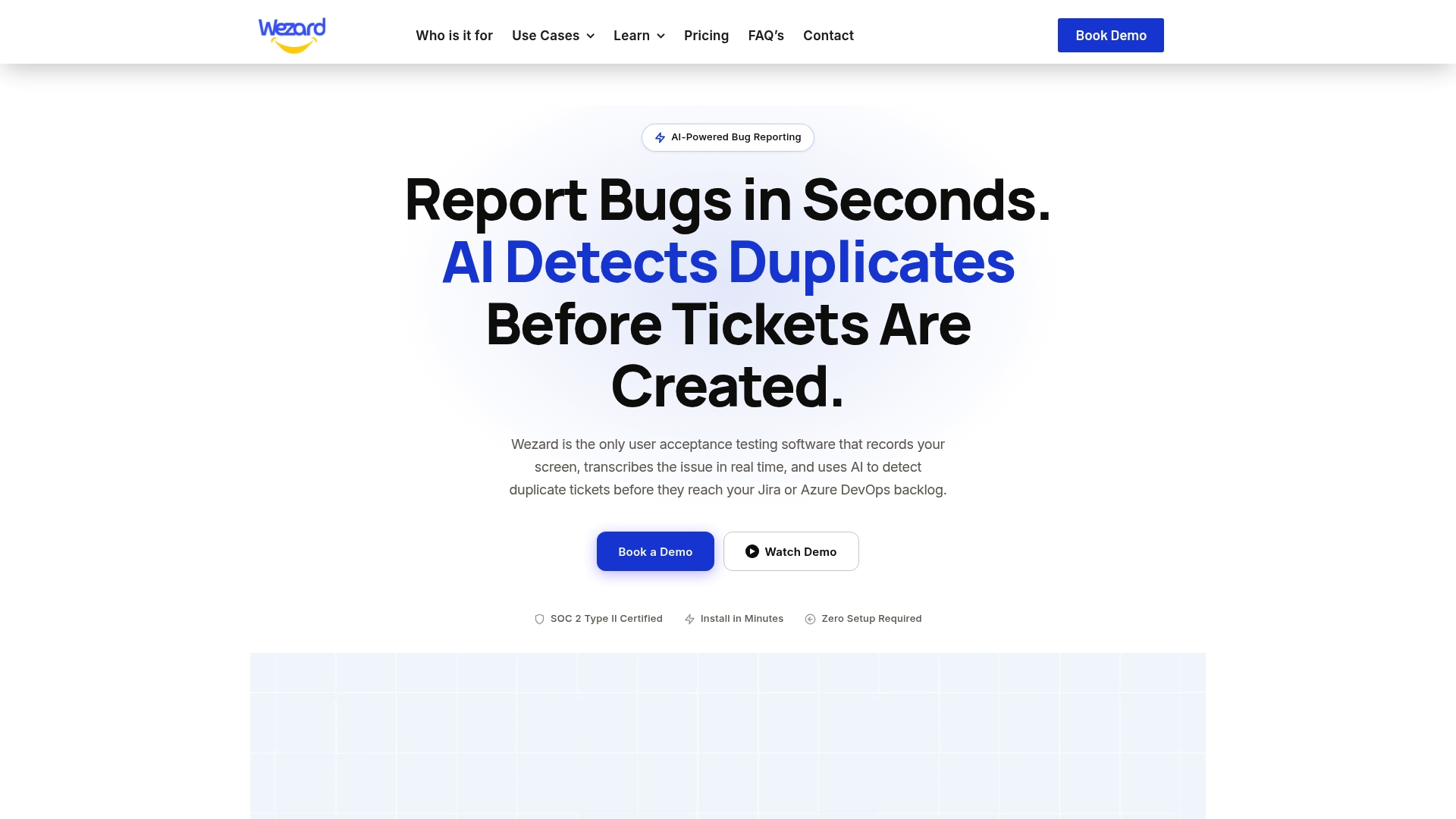
Wezard records the screen, transcribes the issue in real time, and uses AI to flag likely duplicate tickets before they reach a Jira or Azure DevOps backlog. That combination matters directly for the faithfulness problem described above: a summary grounded in a timestamped transcript and a recorded replay gives a reviewer something concrete to check a claim against, rather than trusting the model’s paraphrase of a typed report.
In practice, a reviewer can jump to the exact moment in a recording where the actual behavior diverged from what was expected, instead of guessing whether “login hangs” meant a spinner or a hard crash. That provenance link is exactly the guardrail recommended earlier: every claim in the summary tied to an evidence pointer, not left floating.

A reasonable pilot checklist for any team evaluating this approach: measure reproduction rate (can a developer reproduce the bug from the summary and recording alone), time-to-triage, and duplicate ticket reduction over a defined pilot window before and after rollout.
Data privacy and security when processing bug reports with AI
Bug reports routinely contain screenshots, logs, and session recordings that capture more than the bug itself: customer names, account identifiers, internal URLs, sometimes payment screens. Before any AI summarization step touches that content, know where the data goes, how long it is retained, and whether it leaves your infrastructure at all.
Three practical questions to settle before rollout: does the summarization model run on data your organization controls or a third-party API, is personally identifiable information redacted before or after the summarization step, and does your vendor carry a relevant security certification for your industry. Redacting sensitive frames from a recording before it ever reaches an AI pipeline, rather than after, closes off a class of exposure that after-the-fact redaction cannot fully undo. Teams evaluating this for screen recordings specifically can review a practical breakdown of pre-capture redaction approaches built for IT and compliance review.
Access control matters as much as the model itself: who can view the raw transcript behind a generated summary, and is that access logged. A summarization pipeline that produces a clean, structured ticket but leaves the unredacted source recording open to anyone with a backlog login has not actually solved the privacy problem, it has just hidden it one layer down.
Handling multilingual bug reports
Global products collect bug reports in whatever language the reporter is most comfortable writing in, and a summarization pipeline tuned only for English text will silently degrade on everything else. The practical fix is translating or jointly processing the report before the extraction step, not after, so that the QA-prompting questions and schema fields are being answered against the original meaning rather than a summary of a summary.
Large multilingual models vary in how well they preserve technical specifics like error codes or version numbers across languages, which is exactly the kind of detail a schema-based approach protects: a field like environment or steps_to_reproduce extracted directly from the source text, with translation only applied to the surrounding prose, keeps the error code itself untouched regardless of the reporter’s language.
Validation should include non-English reports in the perturbed test set described earlier, not just as a separate pass but mixed into the same hallucination and omission checks. A pipeline that performs well on English reports and poorly on translated ones is still an unreliable pipeline, it is just failing on a subset of your users you may not be sampling often enough to notice.
Adapting summarization models across domains and project scales
A schema built for a consumer mobile app does not transfer cleanly to a backend infrastructure team or an embedded systems group. The fields that matter shift: a mobile team cares about device and OS version, an API team cares about request and response payloads, an embedded team cares about firmware version and hardware revision. The fix is not a different model for each domain, it is a different schema, built from the same extraction and QA-prompting approach but with domain-specific questions substituted in.
Project scale changes the calculus differently. A small team triaging a few dozen reports a week can tolerate a higher human-review rate since the volume is manageable; a team processing thousands of reports a day needs a tighter confidence threshold and a larger automated share just to keep the queue moving, which raises the stakes on the hallucination and omission checks covered earlier.
The practical move when adopting this across multiple teams is starting with one domain’s schema, validating it against that domain’s perturbed test set, and only then adapting the question list for the next domain rather than trying to build one universal schema that satisfies everyone from day one.
Updating and retraining summarization models over time
Bug report language drifts as a product evolves: new feature names, new error codes, new jargon that a model trained or prompted against last year’s vocabulary will not recognize. Treat the evaluation plan from earlier not as a one-time gate but as a recurring check, since a schema that validated well at launch can quietly degrade as the product and its reporters change.
For prompt-based and QA-prompting approaches, updating means revisiting the fixed question list periodically and adding new domain questions as new bug categories emerge, no retraining required. For fine-tuned approaches, it means collecting a fresh batch of human-reviewed, schema-validated summaries and retraining on that corpus rather than the original one, since a model trained on last year’s bug patterns will underperform on this year’s.
Either way, the perturbed validation set needs refreshing too. A test set built from last year’s noisy reports will not catch this year’s new failure modes, so feeding in a rolling sample of recent, real reports, including the ones your reviewers flagged as wrong, keeps the hallucination and omission checks relevant rather than stale.
The gap between what AI summarization promises and what it actually does
The most overrated claim in this space is that summarization quality alone determines whether automation is safe to trust. It does not. A fluent, well-structured summary and a faithful one are different things, and the research on hallucination and omission rates makes clear that fluency is not a proxy for accuracy. Teams that judge a pipeline by how readable its output is, rather than by how often a reviewer has to correct it, are measuring the wrong thing.
What the evidence actually supports is narrower and more useful: structured extraction beats open-ended summarization for faithfulness, question-first prompting beats direct summarization for long reports, and provenance links beat prose explanations for building reviewer trust. None of that requires a large model or a custom fine-tune to start.
What we would prioritize first, before picking a model or a vendor, is the schema and the evaluation set. A team that locks down its required fields, its NULL rules, and a perturbed test set before writing a single prompt will get more reliable automation than a team that starts with the fanciest model and backfills the checks later.
— Marketing
Try screen-backed summarization with a short pilot
The guardrails covered above, schema validation, provenance pointers, perturbed testing, all work better when the evidence behind a summary is a timestamped recording rather than a few typed sentences. That is the specific gap Wezard is built to close: screen recording, real-time transcription, and AI-powered duplicate detection running before a ticket ever reaches your Jira or Azure DevOps backlog.
A reasonable pilot to evaluate this in your own environment:
- Duration: four to six weeks, long enough to see a full triage cycle repeat several times.
- Metrics: reproduction rate, time-to-triage, and duplicate ticket volume before versus after rollout.
- Scope: one team or one product area first, so you can compare against a clean baseline.
Plans start at the Starter tier for $25 per month, with Team and Business tiers available as usage grows and an Enterprise option priced on request. If reducing duplicate noise and giving reviewers a direct link to the evidence behind a summary sounds like the gap your current intake process has, the pricing page is the place to compare plans and start a pilot.
FAQ
What fields should an AI bug report summary always include?
A reliable summary includes environment, concise steps to reproduce, expected versus actual behavior, impact level, and a link back to the source evidence like a transcript or screenshot. Leaving any of these NULL rather than guessing is safer than inventing a plausible-sounding value.
How common is hallucination in AI-generated bug summaries?
An exploratory 2026 study found a 12.3% hallucination rate and a 47.9% missing-information rate in AI-generated bug summaries. That gap is why human-in-the-loop review stays necessary for high-impact or low-confidence tickets rather than relying on automation alone.
What is QA-prompting and why does it help with long bug reports?
QA-prompting asks a model to answer a fixed set of domain questions about a report before generating the final summary, rather than summarizing directly. Research on QA-prompting showed up to a 29% ROUGE improvement on long-context tasks by keeping key facts in the model’s recent attention window.
Can AI reliably detect duplicate bug tickets?
AI can flag likely duplicates by extracting a short signature from the report and matching it against existing backlog items, but it works best presenting candidates for a human to confirm rather than auto-merging. This extract-search-present-decide pattern is how most practical triage agents are built.
How much does Wezard cost for teams adopting AI bug summarization?
Wezard’s Starter plan costs $25 per month, with Team at $70 per month and Business at $160 per month, each adding more seats and features. Enterprise pricing is available on request directly from the pricing page.