
Closing the feedback loop in UAT means running every tester report through five stages: capture, dedupe/triage, route/fix, verify, and communicate. The operational outcome you’re after is simple to state and hard to fake: every fix gets verified by the person who originally reported it, and the backlog reflects that resolution with a traceable record. Tools like Wezard build this cycle into the reporting step itself, but the discipline matters more than the software.
TL;DR:
- Running every tester report through structured capture, deduplication, routing, verification, and communication stages is essential to close the feedback loop in UAT.
- Rapid triage and fix turnaround, ideally within the same day, are crucial to maintaining tester engagement and preventing backlog clutter from duplicate tickets.
- Human review of duplicate suggestions remains vital, as automated methods alone show a high error rate and risk missing critical signs of unresolved issues.
- Structured bug reports with detailed evidence and clear titles significantly improve deduplication accuracy and streamline developer handoff.
- Weekly monitoring of key metrics like fix-to-verification time and duplicate rates helps identify bottlenecks and opportunities for process improvement.
Table of Contents
- Why Closing the Loop Matters in UAT
- A Prioritized Checklist for Closing the Loop During UAT
- How Should Teams Balance Automation and Human Judgment in Deduplication?
- Standardize Bug Reports So Dedupe and Triage Actually Work
- Automation Patterns: Intake, AI Triage, Upsert, Acknowledgment
- Measuring Whether Your Loop Is Actually Closed
- Gathering Feedback Post-Resolution to Improve Future Processes
- Training and Coaching Teams Based on Feedback Loop Insights
- Integrating Feedback Loops Into Continuous Improvement Cycles
- Tools and Technologies Commonly Used to Close the Loop
- A QA Manager’s Case: What Changed When the Loop Actually Closed
- How Wezard Fits the Feedback Loop Checklist
- Sources
Why Closing the Loop Matters in UAT
Unresolved feedback loops don’t just annoy testers. They corrode the entire UAT cycle in three specific ways.
Slow fix-to-retest turnaround kills participation first. When testers file a bug and hear nothing for days, they stop filing bugs. Best-practice guidance on UAT cadence found that teams that require frequent (e.g., daily) fix-and-retest cycles finish UAT faster than teams where fixes take longer to turn around to turn around. That delay doesn’t stay contained. It teaches testers their reports don’t matter, and reporting rates drop right when you need volume most.
Duplicate tickets are the second failure mode. A backlog padded with five versions of the same login bug hides the one blocking defect that actually threatens your release date. Triage meetings burn time sorting near-identical reports instead of making priority calls.
The third risk is the quietest but most expensive: missing verification. If nobody confirms a fix actually resolved what the original reporter saw, sign-off becomes a guess dressed up as a decision. Auditors and release managers eventually ask who tested what, and “we assumed it worked” is not an answer that survives a post-incident review.
A Prioritized Checklist for Closing the Loop During UAT
Treat this as an operational sequence, not a menu. Skipping a step early makes every later step harder.
- Capture with structure, not prose. Require screen or video evidence alongside a handful of structured fields: test case ID, environment, expected result, actual result. A tester typing “it’s broken” gives triage nothing to work with; a 45 second clip with a transcript and a test case reference gives them everything.
- Deduplicate before it reaches the backlog. Run a quick semantic search against open items the moment a report comes in. When the match is uncertain, surface the top candidates to the tester and let them confirm or reject, rather than auto-closing anything silently.
- Triage same-day. Assign severity, an owner, and a target fix-build date within the same working day the report lands. Flag anything that blocks sign-off explicitly, so it can’t get buried under lower-priority noise. UAT process guidance recommends aligning severity with business stakeholders in the session itself rather than assigning it unilaterally after the fact.
- Route and fix through one canonical item. Upsert new evidence into the existing backlog ticket instead of spawning a parallel one. Link the reporter’s original capture directly to that item so context never gets lost in translation between QA and engineering.
- Retest and verify with the original reporter. The person who filed the bug is the person who confirms it’s fixed, in the same UAT environment where they found it. Anyone else validating a fix is a proxy, and proxies miss context.
- Communicate at both ends. Send an automated acknowledgment the moment a report is captured, and a plain closure message once it’s verified. Silence between those two points is where trust erodes fastest.
Pro Tip: Set a hard rule that no ticket closes without a named verifier and a date. It takes five seconds to fill in and it’s the single field that turns “we think it’s fixed” into a defensible sign-off record.
How Should Teams Balance Automation and Human Judgment in Deduplication?
Full automation sounds appealing until you look at how often it’s actually wrong. An industrial case study combining automated duplicate-report retrieval with human review found a 94.44% success rate in locating candidate duplicates, but testers disagreed with the system’s recommendations in approximately 39% of cases. That gap is the entire argument for keeping a human in the review step. An algorithm that’s right most of the time is still wrong often enough to cause real damage if it’s allowed to close tickets unsupervised.
The practical fix is a UI rule, not a policy memo: surface a limited number of suggested matches, often around three to six, show a confidence score next to each one, and let the tester reformulate their search if none of the suggestions fit. Research on duplicate detection and triage methods confirms that semantic and feature-augmented matching, things like embeddings and stack-trace comparison, consistently outperform simple keyword search, but no method eliminates the need for a confirming click.
Set governance around who can actually close a duplicate. Give that authority to triage leads or the original reporter, never to the algorithm alone. For safety-critical or compliance-relevant defects, require a second human sign-off before any ticket gets merged or closed, no matter how confident the similarity score looks.
Standardize Bug Reports So Dedupe and Triage Actually Work
Deduplication software is only as good as the reports feeding it. Structured feedback forms and standardized templates materially improve how well duplicate detection and developer handoff perform, and the fields don’t need to be complicated.
- Video or screenshot capture, plus a transcript of what the tester said or typed while reproducing the issue.
- A direct reference to the test case ID being executed.
- Environment details: browser, build number, device, and user role.
- Expected result versus actual result, stated as two separate fields rather than one blended sentence.
Title conventions matter more than teams expect. A ticket titled “Checkout button doesn’t work” gives a semantic search engine almost nothing to match against. “Checkout: Apply Coupon button unresponsive after cart refresh on Build 4.12” gives it real signal, and it reads faster in triage too. For teams retrofitting old habits, standardized templates that speed up developer handoff are worth adopting before you touch any tooling. Lock down edit rights so only triage leads or QA managers can merge or close duplicates, and default to linking related tickets rather than deleting them. A deleted duplicate erases the evidence trail; a linked one preserves it for the eventual audit.
Automation Patterns: Intake, AI Triage, Upsert, Acknowledgment
A working automation architecture has four stages, and each one needs a human checkpoint somewhere nearby.
- Intake: capture reports through webhooks from forms, in-app session tools, or chat, normalizing raw input into structured fields before anything else happens.
- AI triage: an AI layer classifies type, severity, a suggested title, and a confidence score. These structured outputs are what dedupe and routing logic actually run against, not the raw tester description.
- Upsert logic: search existing backlog items by suggested title and semantic similarity. Update the matching item if one exists; create a new one only when nothing matches closely enough.
- Acknowledgment: confirm receipt to the tester immediately, and log the full payload for audit purposes.
A published n8n automation template demonstrates exactly this pattern end to end: webhook intake, AI triage returning structured JSON, Notion-based dedupe and upsert, and a Slack or email acknowledgment closing the loop. It’s a useful blueprint precisely because it shows where automation ends and a human decision begins at every stage.
Measuring Whether Your Loop Is Actually Closed
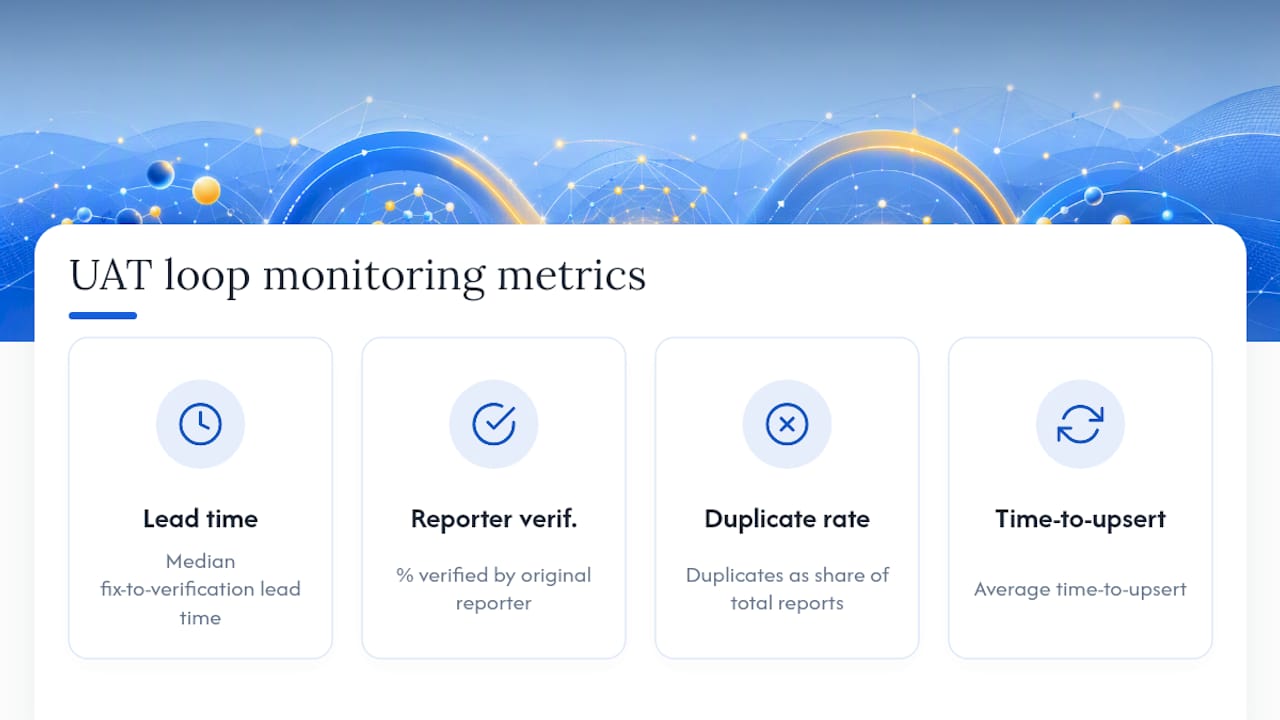
Four metrics tell you whether the process is working or just looks tidy on a dashboard: median fix-to-verification lead time, the percentage of fixes verified by the original reporter, duplicate rate as a share of total reports, and average time-to-upsert. Review them weekly during active UAT cycles. If lead time climbs or verification rate drops two cycles running, that’s your signal to add triage staffing or revisit the tooling, not to wait for the next retrospective.
Gathering Feedback Post-Resolution to Improve Future Processes
Closing a ticket isn’t the same as closing the learning loop. Once a fix is verified, ask the original reporter one more question: was the report-to-resolution process itself clear, fast, and low-friction? That’s a different question than “is the bug fixed,” and most teams never ask it.
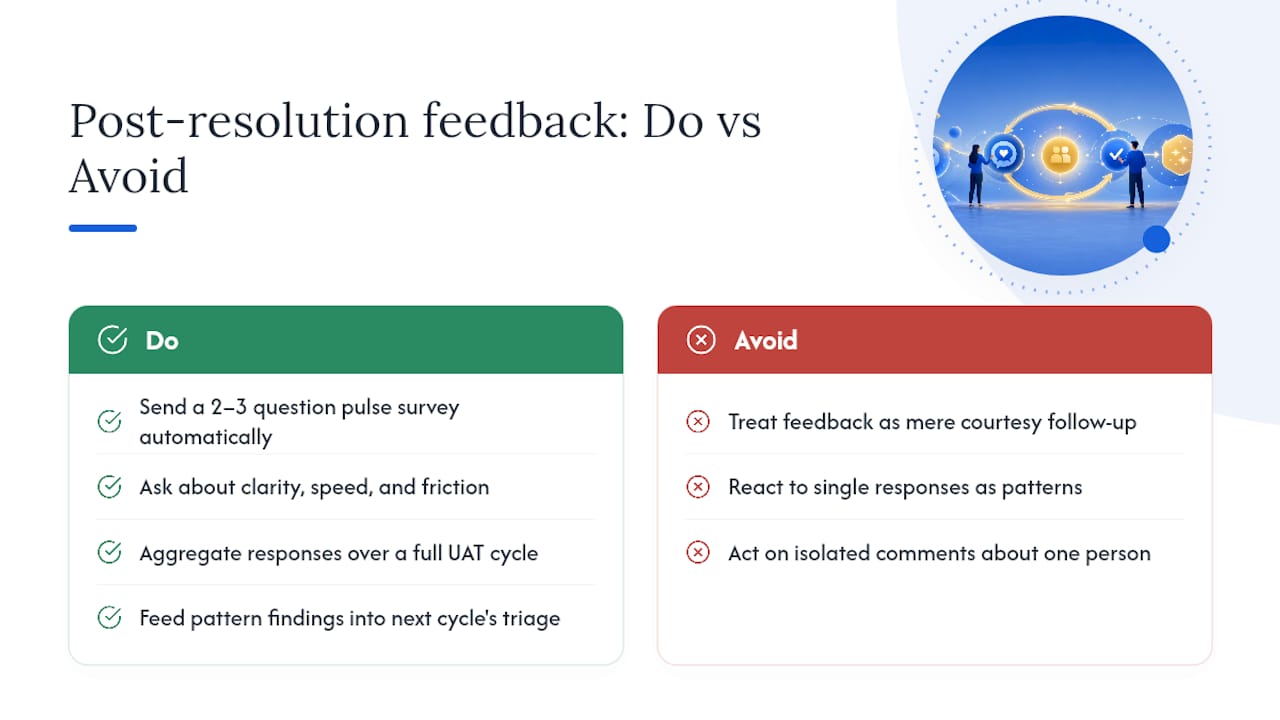
A short pulse survey, two or three questions, sent automatically at closure, captures this without adding meeting overhead. Ask whether the tester understood why a fix took the time it did, whether the acknowledgment messages felt useful or like noise, and whether they’d change anything about how they reported the issue in the first place.
Aggregate this over a full UAT cycle rather than reacting to single responses. A handful of comments about confusing severity labels or slow acknowledgment timing is useful pattern data. Two or three off-hand comments about a single developer’s communication style is noise. Feed the pattern-level findings into your triage process for the next cycle rather than the next hour. Teams that treat post-resolution feedback as input to the next UAT cycle, rather than a courtesy follow-up, tend to see reporting quality improve on its own. Testers who feel heard write clearer reports the second time around, which reduces the very deduplication burden you’re trying to solve upstream.
Training and Coaching Teams Based on Feedback Loop Insights
Feedback loop data is a coaching tool most QA leads leave unused. If your metrics show one tester’s reports get flagged as duplicates twice as often as everyone else’s, that’s not a personal failing, it’s a signal their reports lack the structured fields that make semantic matching work. A short, specific coaching conversation, showing them a well-matched report side by side with one of theirs, fixes this faster than a policy email ever will.
The same logic applies to developers. If fix-to-verification lead time is consistently longer for one component or one engineer, look at whether the incoming reports for that area lack reproduction steps or environment detail. Sometimes the bottleneck isn’t the fix, it’s the ambiguity in what was reported.
Build this into a recurring, low-stakes review rather than a performance conversation. Pull the quarter’s duplicate rate and lead time by tester and by component, and walk through outliers as a team exercise. Reward specific report quality (a clear title, a tight repro, a linked video) publicly, and treat the review as calibration, not critique. Teams that run this cadence quarterly tend to see their standardized template adoption rise without ever mandating it, because testers start copying whatever gets highlighted as a good example.
Integrating Feedback Loops Into Continuous Improvement Cycles
A single closed ticket is a transaction. A pattern of closed tickets, read together, is a diagnostic. The teams that get real value from UAT feedback treat every cycle’s dedupe rate, lead time, and verification rate as inputs to the next sprint planning session, not just a report to file away.
Fold your KPI review directly into existing retrospective or sprint-planning meetings rather than creating a separate feedback-review meeting nobody attends consistently. If duplicate rate crept up last cycle, that’s a five-minute agenda item, not a new committee. If a particular module keeps generating vague, hard-to-triage reports, that’s a prompt to revisit the acceptance criteria for that module before the next round of testing even starts, an approach covered in more depth in guidance on structuring acceptance criteria for QA teams.
The goal is a loop that feeds itself: better reports lead to faster dedupe, faster dedupe leads to faster triage, faster triage leads to faster verification, and verification data tells you exactly where the next round of report quality needs coaching. Skip any one link and the whole chain slows down, even if every individual step looks fine in isolation.
Tools and Technologies Commonly Used to Close the Loop
Most teams stitch together three categories of tooling to run this cycle end to end. Recruitment and session-management platforms handle getting the right testers into the right UAT rounds, and structured recruitment pipelines make a measurable difference in the quality of participants you get. Bug capture and reporting tools, including screen recording and voice-to-text platforms, handle the evidence-gathering stage. AI triage and workflow-automation platforms, the kind built on structured JSON outputs and webhook intake, handle classification and upsert logic once reports arrive.
One detail engineering teams often overlook: when AI triage produces structured output like severity scores or suggested titles, that output can be malformed or inconsistent in ways that quietly break your upsert logic. Guidance on validating AI-generated structured data is worth reading before you wire an AI triage step directly into automated backlog updates. Backlog platforms themselves, whether Jira, Azure DevOps, or ServiceNow, remain the system of record. The tooling layered on top exists to keep that record clean, traceable, and free of the duplicate sprawl that makes triage meetings drag.
A QA Manager’s Case: What Changed When the Loop Actually Closed
One recurring pattern worth sharing: teams that require video-plus-transcript capture and commit to daily triage, rather than weekly, tend to see fix-to-verification lead time drop sharply within a few cycles. Adding human-in-the-loop dedupe with an upsert workflow, instead of manual ticket creation, is usually the second lever. The realistic target most teams should aim for is cutting lead time by roughly half while pushing duplicate rate down at the same time, not treating those as separate wins.
— Marketing
How Wezard Fits the Feedback Loop Checklist
Every step in that checklist maps directly onto typical user acceptance testing software features. Screen recording and real-time transcription handle capture, so testers never file a vague one-line report again. Duplicate detection suggestions run before anything syncs to backlog systems, catching overlap while a human still gets the final call.
Guided ticket submission keeps required fields consistent across every tester, which is exactly the standardization that makes dedupe work in the first place. Automated acknowledgments close the communication gap on both ends, confirming intake immediately and notifying testers the moment a fix is verified. If you’re running UAT with a distributed group of testers and a backlog that keeps drifting toward duplicate sprawl, the Wezard UAT testing platform is built around this exact cycle. For teams specifically fighting Jira clutter, the AI-powered duplicate detection and auto-ticket creation features are worth a direct look. Start a trial and run your next UAT round through it before your next release freeze.
Sources
Referenced research covers duplicate detection accuracy, dedupe/triage methods, and a practical n8n automation template for intake-to-acknowledgment workflows.
- Exploring the Role of Automation in Duplicate Bug Report Detection: An Industrial Case Study
- Survey of methods for bug deduplication and triage (Applied Sciences, 2023)
- Triage product UAT feedback with OpenAI, Notion, Slack and Gmail | n8n workflow template