
AI-assisted testing is defined as the practice of embedding machine learning models into your test lifecycle to generate, execute, heal, and triage tests with minimal human intervention. The transition from manual QA to AI-assisted testing does not require scrapping your existing processes. It requires a phased, parallel approach where AI tools absorb repetitive regression work while your team retains ownership of exploratory and judgment-driven testing. Tools like self-healing selectors, agentic test authors, and automated failure analysis platforms make this shift practical today, not theoretical.
What does the transition from manual QA to AI-assisted testing actually require?
The industry term for this shift is test automation maturity progression, and it spans from Level 0 (fully manual) to Level 5 (autonomous agents). Most teams in 2026 are targeting Levels 3 to 4, where AI handles locator healing and test generation while humans govern strategy and edge cases. Understanding where your team sits on that scale is the first real step.
Before you touch a single AI tool, your infrastructure must be ready. A stable CI/CD pipeline is non-negotiable. If your current builds are flaky or your deployment process is inconsistent, AI-generated tests will inherit that instability and amplify it. Fix the foundation before adding intelligence on top.
Audit your existing manual test suite using three filters: frequency, stability, and consequence. Tests that run daily, rarely change, and protect critical user paths are your highest ROI candidates for early automation. Tests that depend on subjective visual judgment or complex business context should stay manual for now.
Team upskilling is equally non-negotiable. IBM recommends training testers to validate AI output and recognize where AI recommendations fail, rather than treating AI outputs as ground truth. Your QA engineers need to understand what a confidence-ranked locator patch means and when to reject it.

Pro Tip: Before selecting any AI testing tool, map your team’s coding proficiency honestly. No-code AI tools like selector-free execution platforms suit teams without deep scripting skills, while teams comfortable with Python or JavaScript can extract more value from agentic frameworks that require prompt engineering.
How to implement AI-assisted testing alongside your manual process
A gradual parallel integration over 4 to 6 months is the most effective pattern teams use to shift from manual to automated QA. The goal in the first six weeks is narrow and specific: get roughly 10 automated tests running reliably inside your CI pipeline. Not 100. Not a full regression suite. Ten trustworthy tests that pass consistently.
Here is a practical phased roadmap:
- Weeks 1 to 6: Select your 10 highest-value test cases using the frequency, stability, and consequence filters. Automate login flows, core user journeys, and stable API contracts first. These form your reliable baseline and build stakeholder trust.
- Weeks 7 to 12: Introduce self-healing locators. Tools that resolve test intent rather than brittle CSS selectors will immediately reduce the maintenance burden your team feels. This is the entry point that limits risk while proving AI value.
- Months 3 to 4: Add AI-powered test generation for repetitive form flows, CRUD operations, and smoke tests. Feed your product specs or user stories into an agentic test author and review the output critically before committing it to CI.
- Months 5 to 6: Activate automated failure triage. AI clustering of failure patterns cuts the time your team spends diagnosing whether a red build is a real defect or an environment issue.
Throughout every phase, manual exploratory testing continues in parallel. Over 80% of QA teams still run manual testing daily in 2026, and that is not a failure of automation adoption. It reflects the irreplaceable value of human judgment for edge cases, new features, and context-driven scenarios.
The tests worth keeping manual include:
- New feature flows where expected behavior is still being defined
- Accessibility and usability evaluations requiring human perception
- Complex multi-system workflows with high business context dependency
- Scenarios where the cost of a false negative outweighs automation speed gains
Pro Tip: Use a simple comparison table to track manual versus automated coverage weekly. Watching the automation percentage grow from 10% to 40% over three months is the single most effective way to maintain team and leadership buy-in during the transition.
| Test type | Recommended approach |
|---|---|
| Login and authentication flows | Automate from week 1 |
| Core user journeys (checkout, signup) | Automate by month 2 |
| New feature exploratory testing | Keep manual throughout |
| Visual regression and UI polish | AI-assisted with human review |
| Edge cases with high business context | Keep manual throughout |
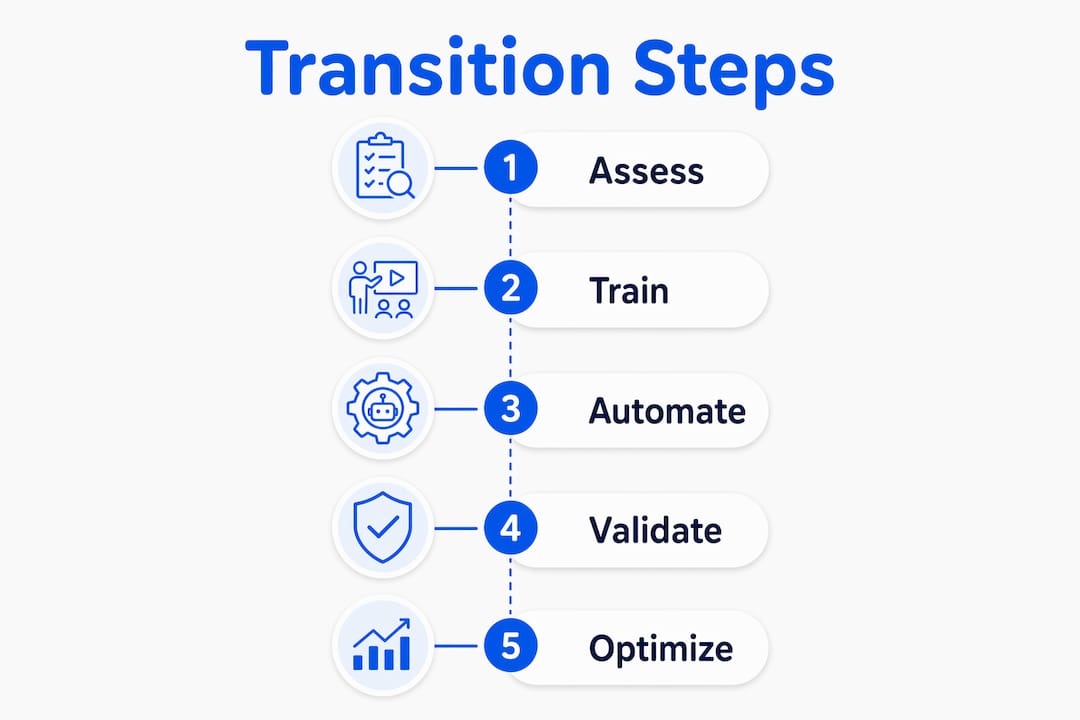
How AI transforms the automation lifecycle and cuts maintenance overhead
Traditional scripted automation hits a hard ceiling. Maintenance overhead consumes 60 to 80% of automation effort in conventional frameworks, leaving almost no capacity for expanding coverage. That is the core problem AI solves, and it solves it at every stage of the testing lifecycle.
AI augments planning, authoring, execution, healing, and failure analysis as distinct lifecycle stages. Each stage has a specific AI capability attached to it, and you do not need to adopt all of them simultaneously.
The most impactful changes AI introduces:
- Intent-based authoring: Instead of writing brittle XPath selectors, AI tools resolve test steps by understanding what the user is trying to accomplish. No-code, selector-free execution eliminates the most common source of flaky test failures.
- Self-healing locators: When a UI element changes, AI patches the locator automatically and ranks the confidence of the fix. Teams that adopt this capability reduce maintenance time to under 5% of total automation effort.
- AI test generation: Agentic test authors produce test cases from product specs, acceptance criteria, or natural language descriptions. The quality of output depends entirely on the specificity of your input. Vague prompts produce poor test cases; precise, structured descriptions produce test cases that match your actual requirements.
- Automated failure triage: AI clusters failures by root cause, separating environment issues from genuine defects and flaky tests from real regressions. This cuts post-run analysis time significantly.
The practical result is that scripted automation’s coverage ceiling breaks when agentic QA absorbs the repetitive maintenance work. Teams that previously maintained 200 tests can now govern 1,000 with the same headcount, because AI handles the upkeep.
How QA team roles evolve in an AI-assisted environment
The most important mindset shift in AI-assisted testing is this: QA engineers stop being test executors and become directors of AI agents. Transitioning manual testers become AI orchestrators who review agent outputs, assess test stability, and guide agent behavior at scale. That multiplies coverage without multiplying headcount.
The skills that matter most in this new role include:
- Prompt engineering: Writing clear, specific instructions for AI test authors. This is now a core QA competency, not an optional extra.
- AI output validation: Knowing when to accept, modify, or reject AI-generated test cases. IBM’s guidance emphasizes that human oversight becomes more critical as AI handles more execution, not less.
- Domain expertise application: Your deep knowledge of the product, its users, and its failure modes is the input that makes AI outputs useful. Without it, AI generates generic tests that miss the scenarios that actually matter.
- Cross-functional communication: QA engineers in AI-augmented teams spend more time translating quality signals to product managers and developers, because AI surfaces more data that requires interpretation.
What does not change is the value of exploratory instinct. The ability to look at a new feature and immediately identify the three scenarios most likely to break it is a human skill that no current AI replicates reliably. That instinct becomes more valuable, not less, as AI handles the mechanical regression work.
Pro Tip: Build a weekly review ritual where your team audits a sample of AI-generated test cases together. This keeps the team sharp on AI limitations, surfaces prompt engineering improvements, and prevents the gradual drift toward blind trust in AI outputs.
Key takeaways
The most effective transition from manual QA to AI-assisted testing uses a phased parallel approach, starting with 10 reliable automated tests in CI and expanding AI capabilities incrementally over 4 to 6 months.
| Point | Details |
|---|---|
| Start narrow and reliable | Get 10 high-value tests running in CI within 6 weeks before expanding coverage. |
| Self-healing first | Adopt self-healing locators before AI test generation to limit risk and prove value quickly. |
| Keep exploratory testing | Manual testing handles edge cases and new features that AI cannot reliably cover. |
| Upskill for AI oversight | QA engineers need prompt engineering and AI validation skills, not just scripting ability. |
| Maintenance overhead drops sharply | AI self-healing can reduce maintenance effort from 60 to 80% of automation time to under 5%. |
Why patience is the most underrated skill in this transition
Most teams I have watched struggle with AI-assisted testing adoption share one failure pattern: they try to automate everything at once. They invest in a full AI testing platform, attempt to migrate their entire manual suite in a sprint, and then spend the next quarter debugging flaky AI-generated tests that nobody fully understands. The big-bang approach consistently underdelivers.
The teams that succeed treat this as a 6-month learning process, not a 2-week migration. They pick one pain point, usually brittle locators or slow regression cycles, and solve it completely before moving to the next. That incremental approach builds genuine team confidence and produces a test suite that people actually trust.
The uncomfortable truth about AI in software testing is that it amplifies whatever quality your existing processes have. If your manual test suite is poorly organized, your AI-generated tests will be poorly organized at scale. If your team cannot articulate clear acceptance criteria, AI test authors will generate tests that miss the point. The quality of AI output depends on the clarity of your inputs, and that is a human responsibility that does not get automated away.
The other pitfall worth naming directly is overreliance on AI failure triage. AI clustering of failures is genuinely useful, but it is a starting point for investigation, not a conclusion. I have seen teams mark AI-triaged failures as “environment issues” without verifying, only to ship a real defect because the AI’s confidence score looked convincing. Human judgment at the triage stage is still the last line of defense.
AI is an enabler. The teams that get the most from it are the ones that stay curious, stay skeptical, and keep their exploratory testing instincts sharp even as automation coverage grows.
— Marketing
How Wezardapp supports your QA transition
Teams making the shift to AI-assisted testing still need reliable UAT feedback and bug reporting to close the loop between automation and human validation. Wezardapp is the only UAT testing tool that records your screen, transcribes issues in real time, and uses AI to detect duplicate tickets before they reach your Jira or Azure DevOps backlog.
When your QA team runs exploratory sessions alongside automated regression, Wezardapp captures every finding instantly and routes it without duplication. That means your backlog stays clean, your developers get clear context, and your AI-assisted workflows are not undermined by noisy, redundant tickets. Explore practical use cases to see how QA teams are combining automated bug reporting with AI-powered duplicate detection to accelerate their testing transformation.
FAQ
What is AI-assisted testing?
AI-assisted testing is the practice of using machine learning to automate test generation, execution, self-healing, and failure analysis within a software QA lifecycle. It augments manual testing rather than replacing it entirely.
How long does the transition from manual to AI-assisted testing take?
A phased parallel integration typically takes 4 to 6 months. Teams start with roughly 10 reliable automated tests in CI within the first 6 weeks, then expand coverage progressively.
What tests should you automate first?
Automate login flows, core user journeys, and stable API contracts first. These meet the frequency, stability, and consequence criteria that produce the highest return on automation investment.
Does AI testing eliminate the need for manual testers?
No. Over 80% of QA teams still run manual testing daily in 2026. Manual testers shift into AI orchestration roles, focusing on exploratory testing, AI output validation, and quality strategy rather than repetitive execution.
What skills do QA engineers need for AI-assisted testing?
QA engineers need prompt engineering, AI output validation, and domain expertise to direct AI agents effectively. IBM identifies human oversight of AI recommendations as the most critical skill in this transition.