
Signing off on test cases after successful UAT is a formal, documented business decision that confirms a system meets its agreed acceptance criteria and is ready for production release. The industry term for this process is “UAT acceptance sign-off,” and it carries legal and operational weight that a simple thumbs-up never could. UAT sign-off is a formal, evidence-based decision documented with signatures from named business process owners, not IT staff or project managers. Getting this right protects your organization from audit failures, post-release disputes, and the kind of “who approved this?” conversations that derail careers.
What does it mean to sign off on test cases after successful UAT?
The sign-off question every team must answer is whether all in-scope test cases executed, exit criteria were met, defects fell within agreed thresholds, and formal acceptance was given. That four-part test separates a real sign-off from a verbal agreement that evaporates the moment something breaks in production. Only business stakeholders can provide accountable sign-off, because QA engineers validate test execution while business stakeholders confirm the system actually meets business needs. These are two different jobs, and confusing them is the root cause of most sign-off disputes.
The distinction matters in practice. A QA lead can confirm that 98% of test cases passed. Only the head of accounts payable can confirm that the invoice approval workflow actually works the way the finance team needs it to work. Both confirmations are necessary. Only one of them constitutes a valid UAT acceptance sign-off.

Essential prerequisites for a valid UAT sign-off
A sign-off without documented prerequisites is an opinion, not a decision. Setting clear exit criteria before UAT begins protects against subjective approvals and rushed decisions made under deadline pressure. Exit criteria define acceptable defect thresholds, minimum pass rates, and the specific conditions under which a business stakeholder can legitimately approve release. Agreeing on these criteria upfront removes the pressure to negotiate standards after results come in.
The core documents you need
A complete UAT sign-off package contains three categories of documentation:
- Test execution summary: Total test cases in scope, number executed, number passed, number failed, and percentage pass rate against the agreed threshold.
- Defect log: Every defect found during UAT, classified by severity, with current status, assigned owner, and any agreed workaround or deferral plan.
- Risk acceptance statements: Formal written acknowledgment of any known issues being accepted into production, signed by the business stakeholder taking responsibility.
A comprehensive sign-off document also references the specific build version tested, the test environment configuration, and any data migration runs completed during the cycle. Without these references, the document cannot be verified during an audit. Version control and dated signatures are not bureaucratic overhead. They are the difference between a document that holds up in a post-incident review and one that does not.
| Document component | Purpose |
|---|---|
| Test execution summary | Proves coverage and pass rate against exit criteria |
| Defect log with severity | Tracks open issues and their business impact |
| Risk acceptance statement | Documents informed consent for known issues |
| Build and environment reference | Enables traceability and audit verification |
| Dated stakeholder signature | Establishes legal and operational accountability |
Good UAT test case writing upstream makes this documentation far easier to compile. When test cases are written with clear pass/fail criteria from the start, the execution summary practically writes itself.
Step-by-step process for final approval of test cases
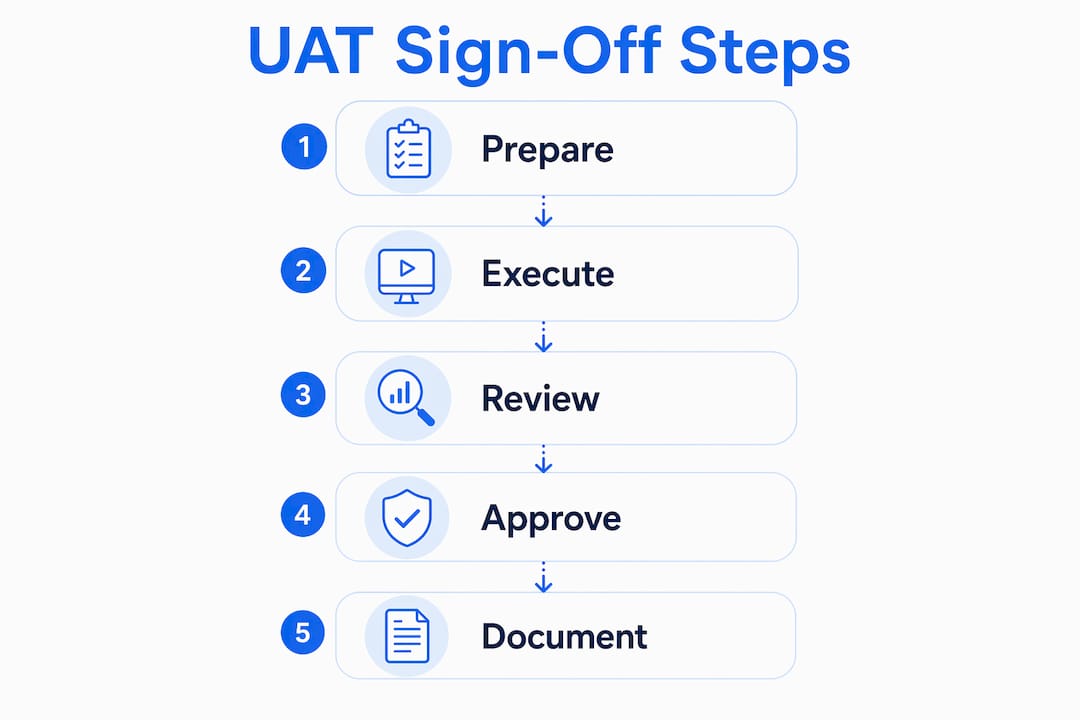
A structured process prevents the two most common failures: approving too early and approving without evidence. Follow these steps in order.
-
Confirm test execution is complete. Every in-scope test case must have a recorded result: pass, fail, or blocked. Untested cases cannot be assumed to pass. If a test case was blocked by an environment issue, document the reason and decide whether it requires re-execution or a formal risk acceptance.
-
Calculate pass rate against exit criteria. Compare the actual pass rate to the agreed threshold. ERP implementations, for example, commonly require a ≥95% pass rate on critical and high-priority test cases before sign-off is permitted. If the pass rate falls short, the team must resolve failures before proceeding, not after.
-
Review and classify all open defects. Every open defect needs a severity classification and a disposition decision: fix before go-live, defer with documented workaround, or accept with a signed risk statement. No defect should remain in an ambiguous “we’ll deal with it later” state.
-
Prepare the sign-off document. Compile the test execution summary, defect log, and risk acceptance statements into a single versioned document. Reference the exact build number and test environment. Include the date the document was prepared.
-
Obtain formal signatures from authorized business stakeholders. The authority signing off must be a named business stakeholder responsible for the requirements being tested. Project managers and IT directors do not qualify unless they also own the business process. Collect physical or digital signatures with timestamps.
-
Archive the signed document with version control. Store the completed sign-off package in a system that preserves version history and access logs. Jira and Azure DevOps both support document attachments with audit trails. This archive becomes your primary defense in any post-release incident review.
Pro Tip: Schedule the sign-off meeting before UAT ends, not after. Stakeholders who know the meeting is coming prepare their questions in advance, which speeds up the approval conversation and reduces last-minute surprises.
How to manage open defects and conditional approvals
Not every defect blocks release. The classification of a defect by severity determines whether it must be fixed, deferred, or formally accepted before the team can approve test cases and proceed to go-live.
Critical defects that prevent core business processes from functioning must be resolved before any sign-off is valid. High-severity defects require a documented workaround and a signed risk acceptance statement before a conditional approval can be granted. Medium and low-severity defects can typically be deferred to a post-release sprint with a documented remediation plan and a target date.
| Defect severity | Sign-off eligibility | Required documentation |
|---|---|---|
| Critical | Blocks sign-off | Must be resolved before approval |
| High | Conditional sign-off | Workaround + signed risk acceptance |
| Medium | Deferral allowed | Remediation plan with target date |
| Low | Deferral allowed | Logged in backlog with owner assigned |
Risk acceptance statements for known issues must be signed and documented to prevent future disputes about release decisions. This protects both the business and any vendor or development team involved. A conditional sign-off without a signed risk statement is just a verbal agreement with extra steps.
Treating sign-off as a checklist item fosters a “good enough” culture that undermines UAT’s entire purpose. The goal is confirming production readiness, not clearing a bureaucratic hurdle. When stakeholders understand they are taking personal accountability for the release decision, the quality of their review improves immediately.
Conditional sign-offs with formally documented risks and remediation plans prevent disputes and clarify exactly what the business accepted and what it did not. The remediation plan should name an owner, a fix date, and a verification method. Vague commitments like “we’ll fix it next sprint” do not belong in a sign-off document.
Common mistakes that undermine UAT sign-off validity
The most frequent errors in the UAT acceptance sign-off process are not technical. They are organizational and procedural.
- Wrong person signs off. The most common pitfall is misidentifying sign-off authority. Business process owners must sign, not project managers or IT directors. If the wrong person signs, the document has no business accountability and will not hold up in an audit.
- No documented pass/fail criteria. Without predefined exit criteria agreed upfront, sign-off becomes a judgment call. Different stakeholders will have different opinions about what “good enough” means, and the process breaks down under pressure.
- Verbal agreements substituted for written records. Verbal agreements are insufficient and lack the traceability required during audits and incident investigations. A permanent record of who approved, when, and under what conditions is mandatory for any release that carries regulatory or contractual obligations.
- Missing version references. Sign-off documents must link to tested build versions and test environments. Without this, there is no way to verify that the approved build is the one that went to production.
- Defect disposition left open. Every defect in the log needs a decision. Leaving items in an unresolved state creates post-release confusion about what was known, what was accepted, and who is responsible.
Pro Tip: Use a software testing documentation template that includes mandatory fields for build version, environment, stakeholder name, and defect disposition. Mandatory fields prevent the most common omissions without requiring anyone to remember a checklist.
Understanding who owns the UAT process versus who owns the sign-off decision is the clearest way to prevent authority errors before they happen.
Key Takeaways
A valid UAT acceptance sign-off requires documented evidence, named business stakeholder authority, and formal defect disposition before any release decision is final.
| Point | Details |
|---|---|
| Sign-off is a business decision | Only named business process owners can provide valid UAT acceptance sign-off. |
| Exit criteria must be set upfront | Predefined pass rate thresholds prevent subjective or pressured approvals. |
| Every defect needs a disposition | Critical defects block release; high-severity defects require signed risk acceptance statements. |
| Documents must reference build versions | Version and environment references make sign-off documents verifiable during audits. |
| Verbal agreements have no validity | Written, dated, and signed records are mandatory for audit readiness and post-release accountability. |
The uncomfortable truth about UAT sign-off pressure
The hardest part of the UAT acceptance sign-off process is not the paperwork. It is the organizational pressure to approve on schedule even when the evidence does not support it. I have seen teams where the sign-off document was treated as a formality, something to be completed after the go-live decision was already made in a hallway conversation. That approach transfers all the risk to the people who had no say in the decision.
What actually works is making the exit criteria non-negotiable before UAT begins. When stakeholders agree in writing that a ≥95% pass rate on critical test cases is the threshold, there is no room for a “close enough” conversation at the end. The criteria do the hard work so the people do not have to fight about it under deadline pressure.
The other thing I have found is that conditional sign-offs, done properly, are not a sign of weakness. They are a sign of maturity. A team that formally documents a known issue, assigns an owner, sets a remediation date, and gets a signed risk acceptance statement is operating at a higher level than a team that delays go-live indefinitely waiting for perfection. The key word is “formally.” Informal conditional approvals are just verbal agreements with a more optimistic name.
Clear acceptance criteria defined before testing is the single best investment a team can make in the sign-off process. Everything downstream gets easier when the standards are written down and agreed upon before anyone runs a single test case.
— Marketing
How Wezardapp supports audit-ready UAT sign-off
Wezardapp is built for teams that need their UAT process to hold up under scrutiny. The platform records your screen during testing, transcribes issues in real time, and uses AI to detect duplicate tickets before they reach your Jira or Azure DevOps backlog. That means your defect log arrives at the sign-off stage clean, classified, and traceable, without manual cleanup.

For teams managing UAT bug tracking across multiple stakeholders, Wezardapp captures timestamped evidence automatically, so the documentation required for a valid sign-off is built during testing rather than assembled after the fact. The result is a sign-off package that reflects what actually happened, not what someone remembers happening. Teams using Wezardapp spend less time reconstructing evidence and more time making confident release decisions.
FAQ
What is UAT sign-off?
UAT sign-off is a formal, documented decision by named business stakeholders confirming that a system meets its agreed acceptance criteria and is ready for production release. It requires written evidence, dated signatures, and defect disposition records.
Who has the authority to sign off on UAT?
Only business process owners responsible for the requirements being tested have the authority to sign off on UAT. QA engineers and project managers validate execution but cannot provide business acceptance.
What should a UAT sign-off document include?
A valid sign-off document includes a test execution summary, a defect log with severity classifications, risk acceptance statements for any deferred issues, the tested build version, the test environment reference, and dated stakeholder signatures.
Can you sign off on UAT with open defects?
Yes, with conditions. Critical defects must be resolved before sign-off. High-severity defects require a documented workaround and a signed risk acceptance statement. Medium and low-severity defects can be deferred with a formal remediation plan.
Why are verbal sign-offs insufficient?
Verbal agreements lack the traceability required during audits and incident investigations. A permanent written record of who approved, when, and under what conditions is mandatory for any release with regulatory or contractual obligations.


