
The fastest way to prevent duplicate Jira tickets is to catch them before creation, not after. Tools like Wezard record the tester’s screen, transcribe the issue in real time, and run AI similarity checks against open tickets, so a human confirms a true duplicate before it ever syncs to Jira. The result is a backlog with fewer redundant tickets and less time spent untangling them.
TL;DR:
- Using real-time speech transcription and detailed screen recordings significantly improves duplicate detection accuracy over text-only reports because of richer contextual signals.
- Threshold calibration based on risk category and staged pilot rollouts help optimize detection sensitivity while minimizing false positives and workflow disruption.
- Human review must verify mid-confidence matches to prevent incorrect merges, especially in high-impact areas like payments or security, preserving valuable detail from duplicates.
- Integrating structured, searchable Jira fields for environment details and reproduction steps enhances downstream duplicate identification and reduces reliance on user diligence.
- Early, intake-based detection with AI and human review reduces duplicate Jira issues by over 42 percent, making backlog management more efficient and less prone to bloating.
Table of Contents
- How Does AI-Powered Duplicate Detection Actually Work?
- How Do You Roll Out Duplicate Prevention Without Disrupting QA?
- What Human-in-the-Loop Rules Prevent Bad Merges?
- What Metrics Prove Duplicate Prevention Is Working?
- What Research Actually Backs This Approach?
- How Do You Train Testers to Stop Submitting Duplicates?
- How Should You Configure Jira Fields to Capture Unique Identifiers?
- Can Jira Add-Ons Catch Duplicates After Ticket Creation?
- How Do You Manage Duplicates That Slip Through After Creation?
- What Usually Causes Duplicate Jira Tickets in the First Place?
- What The Research Actually Tells Us About Fixing This
- Ready to Pilot AI Duplicate Detection on Your Own Backlog?
- Sources
- FAQ
How Does AI-Powered Duplicate Detection Actually Work?
Duplicate detection starts with better inputs, not better algorithms. A UAT tester who narrates while recording their screen produces a screen video, a voice transcript, screenshots, and runtime metadata like browser version, URL, and timestamp, all in one capture session. That combination gives a matching model far more to work with than a tester typing three lines into a text box.
The pipeline runs in four stages. Real-time transcription converts the spoken narration into text as the session happens. That text gets cleaned and normalized, then converted into embeddings, numerical representations that capture meaning rather than exact wording. The system compares those embeddings against existing open tickets using cosine similarity, and where stack traces or error logs exist, it layers in fingerprinting to catch technical matches that wording alone would miss.
At scale, exact-match comparison against thousands of tickets is too slow, which is why production systems use approximate methods like locality-sensitive hashing (LSH) or vector search libraries such as FAISS to narrow candidates before running the finer semantic comparison. Research on bug deduplication and triage methods confirms that combining semantic embeddings with stack-trace fingerprinting and hashing techniques consistently outperforms single-method approaches.
Three factors matter most in practice:
- Speed versus precision. A model tuned for fast matching flags more candidates but risks more false positives.
- Threshold tuning. Similarity scores need calibration per project, since a UI typo report and a payment-failure report tolerate very different sensitivity levels.
- Signal richness. Screen recording plus voice narration resolves ambiguity that text-only reports leave unsolved, since two testers rarely describe the same bug in identical language, but they will still show the same broken screen.
Continuous querying methods can prevent a substantial share of duplicate reports in studies that compared matching against tickets submitted at intake time versus after the fact, a strong argument for catching duplicates at the point of capture rather than during a weekly backlog review, according to the survey on bug deduplication methods.
How Do You Roll Out Duplicate Prevention Without Disrupting QA?
Rolling out AI-assisted deduplication works best as a staged pilot, not an org-wide switch. Here’s the sequence that keeps disruption low while you tune the system to your own bug patterns.
- Build a guided reporter flow. Require or strongly encourage a short spoken narration alongside the screen capture. Testers who talk through what they’re seeing generate cleaner transcripts and richer context than those who type a one-line summary after the fact.
- Turn on real-time transcription and embedding generation at capture. The transcript and fingerprint should exist before the tester finishes the session, not as a batch job hours later.
- Pick a deduplication policy. Suggest-and-hold is the safer default: the system flags a likely duplicate and pauses ticket creation for a quick human check. Auto-merge only makes sense for high-confidence matches in low-severity categories, like repeated cosmetic typos.
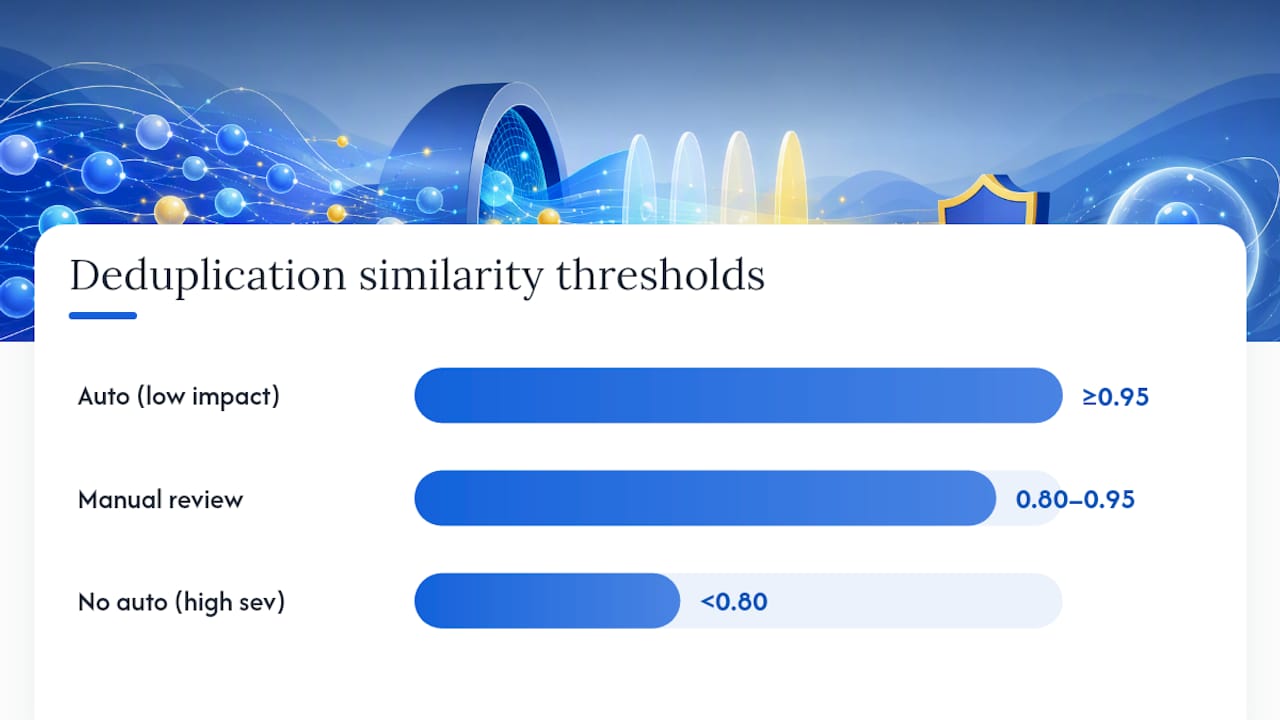
- Set starting thresholds by risk category. A common structure treats anything above roughly 0.95 similarity for low-impact UI issues as auto-blockable, holds 0.80 to 0.95 for manual review, and never auto-merges below 0.80 in high-severity areas like payments or authentication.
- Gate ticket creation on Jira or Azure DevOps so a flagged report doesn’t sync to the backlog until a reviewer confirms it’s genuinely new. This is where the Jira integration or an Azure DevOps sync needs to sit logically downstream of the matching step, not upstream of it.
- Pilot on one project first. Measure your baseline duplicate rate before turning anything on, then tune thresholds against real false-positive numbers instead of guessing.
Industrial case studies on automated duplicate detection found that teams had historically relied on keyword search and tribal knowledge to catch duplicates, and adoption only stuck once the tooling fit inside the reviewer’s existing workflow rather than adding a new one, per the industrial case study on automation in duplicate detection.
Pro Tip: Run your pilot on the noisiest project you have, not the calmest one. A quiet project won’t generate enough duplicate volume to tell you whether your thresholds are actually working.
What Human-in-the-Loop Rules Prevent Bad Merges?
Automated matching is only as trustworthy as the review step behind it. Skip that step and you risk merging two genuinely different bugs into one ticket, losing the second one entirely.
Require manual confirmation whenever a match falls in the mid-confidence band, or when the ticket touches a high-impact area like billing, data loss, or security. A reviewer checklist should cover:
- Reproduction steps and whether they actually match, not just the summary text
- Environment details: browser, OS, app version, and network conditions
- Timestamps, since two reports minutes apart on the same screen are more likely duplicates than ones weeks apart
- Attachments and stack traces, compared directly rather than assumed identical
- Any unique detail in the “duplicate” that the original report doesn’t mention
When two reports do turn out to be the same bug, preserve both. Append the second reporter’s notes to the master ticket and carry over its attachments, because research on duplicate issue reports found that duplicates frequently contain complementary reproduction detail or environment context the original reporter missed. Discarding a duplicate outright can throw away the exact clue a developer needed.
Set a reviewer SLA, too. A same-day response on flagged matches keeps triage from stalling; anything slower and testers start creating tickets manually to work around the queue.
What Metrics Prove Duplicate Prevention Is Working?
Three numbers tell you whether the system is earning its place: the percentage reduction in duplicate-created Jira issues, the average triage time saved per ticket, and the false-positive merge rate. Track all three together, because optimizing one against the others is where pilots go wrong.
Instrument three events at minimum: a “suggested duplicate” event when the system flags a match, a “confirmed duplicate” event when a reviewer accepts it, and a “blocked creation” event when a ticket never reaches Jira at all. That event trail is what lets you calculate a real false-positive rate instead of guessing.
| Metric | What it tells you | Target direction |
|---|---|---|
| Duplicate-created issue rate | Share of new Jira tickets that turn out to be duplicates | Trending down each sprint |
| Triage time saved per ticket | Minutes reviewers save not manually searching for matches | Trending up |
| False-positive merge rate | Confirmed duplicates that were actually distinct bugs | As close to zero as possible |
Continuous querying at intake has prevented a substantial share of duplicates in controlled studies comparing early detection against post-hoc review, a useful baseline when setting your own pilot targets, according to the bug deduplication survey. Run A/B pilots across two similar projects, one with thresholds tightened and one left looser, to see which balance of catch rate and false positives your reviewers actually tolerate.
What Research Actually Backs This Approach?
Human-in-the-loop deduplication is not a marketing concept. An industrial case study on automated duplicate detection found that a tool combining automated retrieval with tester review located the correct duplicate 94.44% of the time, while testers themselves achieved 75% accuracy picking the right duplicate from a ranked list, disagreeing with the system in roughly 4 out of 10 cases. That gap is the whole argument for keeping a human in the review loop instead of trusting the algorithm alone.
- Semantic embedding and stack-trace fingerprinting methods both improve match accuracy, and combining them beats either alone
- Duplicates often carry reproduction detail the original report lacks, so merging should preserve rather than discard
- A practitioner report on backlog cleanup found an AI intake agent cut a 847-ticket Jira backlog to 312 by flagging duplicate sets for human review, according to the Jira backlog case study
Automated retrieval can locate the right duplicate with strong reliability, but testers and reviewers still disagreed with the system’s top suggestion in a meaningful share of cases, which is exactly why the confirmation step exists rather than full auto-merge.
Wezard’s approach follows this same principle: screen recording and real-time transcription feed the matching engine richer signal than text alone, but a reviewer still confirms before a ticket reaches the backlog. The tooling narrows the search; it doesn’t replace judgment.
How Do You Train Testers to Stop Submitting Duplicates?
Most duplicate tickets aren’t a tooling failure, they’re a habit problem. Testers under deadline pressure skip the search step and file first, ask questions never. Training has to address that directly.
Set a simple house rule: no new ticket without a quick check against open issues first, ideally surfaced automatically by the AI-suggested-match panel rather than left to memory. Testers rarely search thoroughly on their own, which is why the earlier industrial case study found teams leaning on keyword search and personal recall before automation existed, an approach that scales poorly past a handful of testers.
Teach testers to narrate what they see, not just what they clicked. “Clicking submit throws a 500 error on the checkout page after adding a discount code” gives the matching model far more to work with than “checkout broken.” Specificity in the spoken report directly improves match quality downstream.
Build a short onboarding checklist for new UAT participants: record screen and voice together, wait for the duplicate check to run before finalizing, and review any suggested matches before dismissing them. New testers who skip this step are disproportionately responsible for repeat tickets, since they haven’t yet learned which bugs are already known.
Reinforce it with visibility. Share duplicate-rate numbers with the testing team monthly.
How Should You Configure Jira Fields to Capture Unique Identifiers?
Duplicate detection upstream still needs matching support downstream, inside Jira itself. Fields and forms should capture enough unique context that even a human scanning the backlog can spot a likely duplicate without running the AI check again.
Add a required custom field for environment details (browser, OS, app version) rather than burying that information in the description. Standardized fields are searchable and filterable; free text buried in a paragraph is not.
Capture a session or fingerprint ID from the intake tool as a hidden custom field. This lets you trace a Jira ticket back to its original capture session, which matters when a reviewer wants to check the source recording rather than rely on a written summary.
Use a component or label taxonomy tied to actual application areas (checkout, login, reporting) rather than generic tags like “bug” or “UI issue.” Vague labels make duplicate scanning by area nearly impossible, since two checkout bugs filed under “UI issue” and “frontend” will never surface as related in a filtered search.
Add a required “steps to reproduce” field with a minimum character count. Short-circuiting this field is one of the most common reasons two reports of the same bug read as unrelated. Configuring intake forms to demand this detail, whether inside Jira’s native create screen or through a tool that feeds structured tickets in automatically, closes a gap that duplicate-detection software alone can’t fully solve.
Can Jira Add-Ons Catch Duplicates After Ticket Creation?
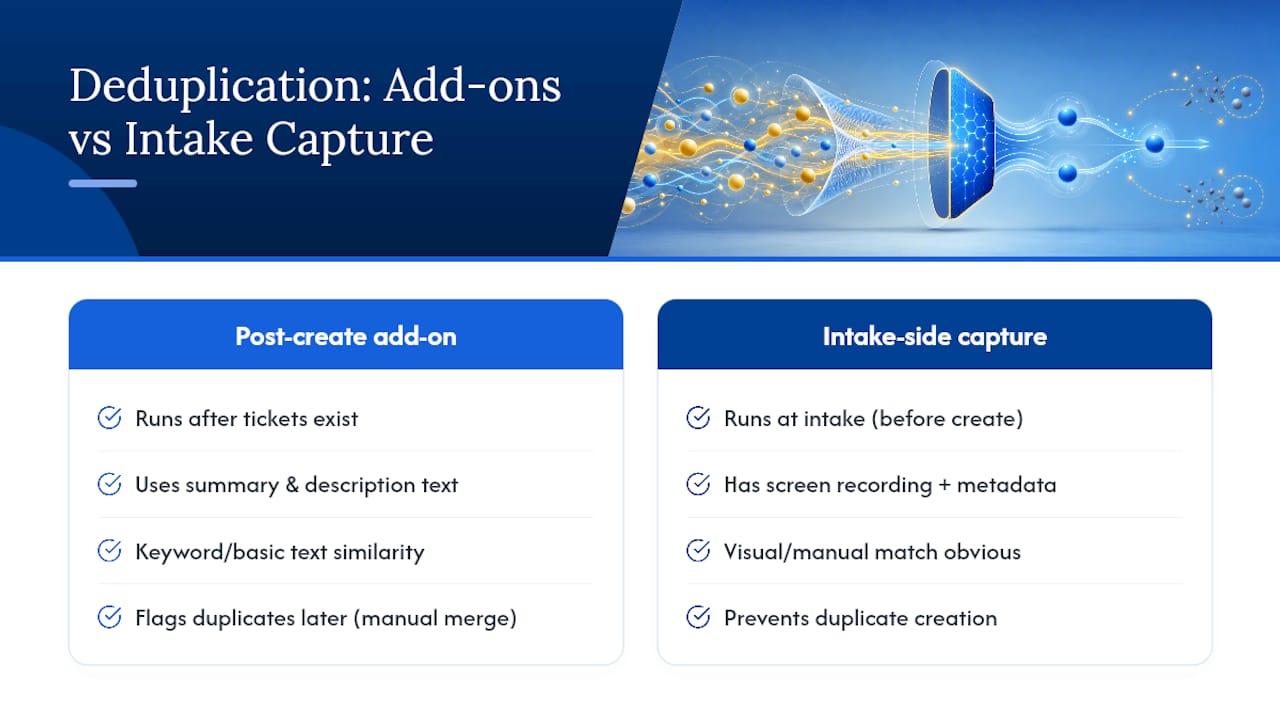
Yes, but they’re a safety net, not a first line of defense. Marketplace add-ons that scan existing Jira issues for text similarity can catch duplicates that slipped through intake, typically by comparing summary and description fields against the existing backlog using keyword or basic similarity matching.
The limitation is timing. By the time an add-on flags a match, both tickets already exist, already have watchers, already may have been triaged separately, and someone still has to manually merge them and reconcile any comments or attachments split across the two. That’s hours of QA management time an intake-side check would have avoided entirely.
Add-ons also tend to work on text alone, since they don’t have access to the screen recording, voice narration, or runtime metadata that a UAT-first capture tool generates. Two reports that use different wording for the same visual bug can slip past a text-similarity plugin even when a human glancing at both screen recordings would spot the match instantly.
That’s the practical case for pushing deduplication earlier in the pipeline rather than later. An add-on scanning the backlog after the fact is solving the same problem an intake-side check already solved, just with less context and after the damage of a bloated backlog is already done. Treat add-ons as backup coverage for tickets that entered Jira through channels outside your UAT tool, such as customer support escalations or manual reports, not as your primary defense.
How Do You Manage Duplicates That Slip Through After Creation?
Some duplicates will still reach the backlog, especially from channels outside your UAT process like support tickets or manual bug reports. Managing them well keeps the backlog searchable instead of letting old duplicates rot at the bottom of a backlog nobody scrolls to.
Run a recurring backlog audit, weekly or biweekly depending on ticket volume, specifically looking for clusters of similar summaries filed within the same sprint. Clustering by component and date range narrows the search fast.
When you find a genuine duplicate, don’t just close it silently. Link it to the master ticket using Jira’s “duplicate of” link type, so the relationship stays visible to anyone who searches later. Copy over any unique reproduction detail or attachment first, since research on duplicate issue value found duplicates often hold context the master ticket lacks.
Track a running duplicate-rate metric by intake source. If support-ticket-originated duplicates run three times higher than UAT-tool-originated ones, that’s a strong argument for routing more report types through the tool that catches duplicates before creation instead of after.
What Usually Causes Duplicate Jira Tickets in the First Place?
Most duplicate tickets trace back to one of four root causes, and each one has a fix that goes beyond “search before you file.”
The most common cause is siloed reporting channels. When bugs come in through Slack, email, a support inbox, and a UAT tool simultaneously, no single search catches all of them, because no one system sees every report. Consolidating intake through one guided flow, ideally one that syncs directly to Jira or Azure DevOps, closes that gap structurally rather than relying on tester diligence.
The second cause is vague or inconsistent bug descriptions. “App is broken” and “checkout throws an error” might describe the identical bug, but neither text-matching software nor a human skimming titles will connect them. This is a training and forms problem as much as a tooling one.
The third cause is time pressure during crunch periods, like right before a release, when testers file fast and skip the duplicate check entirely. Automated blocking at intake matters most exactly when human diligence is weakest.
The fourth is organizational: multiple teams testing the same build without visibility into each other’s reports. A shared, searchable intake pipeline with AI-assisted matching solves this better than any policy memo, since it catches the overlap automatically instead of depending on teams to coordinate manually.
What The Research Actually Tells Us About Fixing This
The conventional advice on duplicate tickets is “search before you file” and “write better descriptions.” Both are true and both fail constantly, because they ask overworked testers to be more disciplined at exactly the moment they have the least bandwidth to be careful. That’s not a training gap. It’s a workflow design failure.
What the research actually supports is different: catch duplicates automatically at the point of capture, using richer signal than text alone, and keep a human in the loop for anything ambiguous. The case study data showing testers disagreed with automated matches nearly 4 times out of 10 is the part most teams overlook when they get excited about AI deduplication. Full automation without review isn’t a shortcut, it’s a new failure mode.
If you take one thing from this, prioritize intake design over backlog cleanup. A quarterly backlog audit treats a symptom. A guided capture flow with real-time matching and a lightweight confirmation step treats the cause. Teams that fix intake stop needing the audit almost entirely.
— Marketing
Ready to Pilot AI Duplicate Detection on Your Own Backlog?
Wezard is the UAT tool built around this exact workflow: it records the screen, transcribes the session in real time, and runs AI duplicate detection before anything reaches your Jira or Azure DevOps backlog, so your team reviews a filtered set of genuinely new issues instead of sifting duplicates out of a growing pile.
A pilot doesn’t need to be complicated. Pick one project, define your success metrics upfront (duplicate rate, triage time saved, false-positive rate), loop in your QA lead and one or two active testers, and run it for two to three sprints before deciding whether to expand. Wezard’s Jira integration and Azure DevOps sync both support this gated rollout, so ticket creation stays paused until a reviewer confirms the match. For teams evaluating fit against other UAT platforms, the Jira alternatives comparison is a useful starting point.
Plans start with a Starter plan and offer team and business options for larger QA organizations; enterprise pricing is available on request. Check the full breakdown on the pricing page and start your pilot this sprint.
Sources
- Exploring the Role of Automation in Duplicate Bug Report Detection: An Industrial Case Study
- A Survey on Bug Deduplication and Triage Methods from Multiple Points of View
- Are All Duplicates Value-Neutral? An Empirical Analysis of Duplicate Issue Reports
- Our Jira Backlog Had 847 Tickets. An AI Agent Cut It to 312.
FAQ
What is the best way to prevent duplicate Jira tickets?
The most reliable method is catching duplicates at intake, before a ticket ever reaches Jira, using a UAT tool that combines screen recording, real-time transcription, and AI similarity matching with a human confirmation step.
Does AI duplicate detection replace manual review?
No. Research on automated duplicate detection found testers disagreed with the system’s top suggestion in a meaningful share of cases, which is why a suggest-and-hold review step matters more than full automation.
How much can duplicate prevention actually reduce backlog noise?
Studies on continuous querying methods found they can prevent over 42% of duplicate reports when matching runs at intake rather than after tickets are already filed, according to research on bug deduplication.
What does Wezard cost for a small QA team?
Wezard’s Starter plan is $25 per month and Team is $70 per month; full plan details are on the pricing page.
Should duplicate tickets always be merged and closed?
Not blindly. Research on duplicate issue reports found duplicates often contain unique reproduction detail, so reviewers should copy that context into the master ticket before closing the duplicate.