
UAT test case writing best practices define a set of business-focused, scenario-driven methods that translate acceptance criteria into clear, repeatable scripts any non-technical tester can execute with confidence. User acceptance testing (UAT) is the final validation gate before production deployment, and the quality of your test cases determines whether that gate catches real problems or waves them through. Sophron’s guidance confirms that effective UAT scripts must be verifiable, traceable, and written in simplified language with consistent terminology. Get this right and you reduce defect escape rates, accelerate sign-off, and give stakeholders genuine confidence in the release.
1. what makes an effective UAT test case?
Every effective UAT test case contains six non-negotiable components. Miss any one of them and testers either skip steps, guess at outcomes, or produce results you cannot defend in a sign-off meeting.
- Clear objective. State what business goal the test validates in one sentence.
- Preconditions and setup. List the system state, user role, and data required before step one.
- Step-by-step instructions. Write each action in plain business language. Use consistent verbs: “select,” “click,” “enter.” Never write “navigate to the relevant screen.”
- Expected result. Describe exactly what the system should display or do after each step.
- Acceptance criteria linkage. Map every test case to the user story or requirement it validates.
- Evidence and status fields. Include columns for actual result, pass/fail status, screenshot reference, and defect ID.
e2eAgent’s practical guide identifies user identity, goal, context, success criteria, and evidence requirements as the core elements that prevent guesswork during execution. That structure forces testers to record what they actually observed, not what they expected to see.
Pro Tip: Add a “business impact” field to your test case template. When a step fails, testers can immediately flag whether the defect blocks a core workflow or affects a minor edge case. That single field cuts triage time in half.

2. write scenarios in business language, not QA language
The biggest mistake UAT teams make is copying system test cases directly into their UAT suite. StackLesson’s scenario design guide is direct on this point: converting acceptance criteria into business-level, flexible scenarios with failure flows yields richer feedback than recycled QA scripts.
A QA test case might read: “Verify that the POST /api/orders endpoint returns HTTP 200 with a valid payload.” A UAT test case for the same feature reads: “As a purchasing manager, place an order for 50 units of Product X and confirm the order confirmation email arrives within two minutes.” The second version tells a business user exactly what to do and what success looks like.
| QA/System Test Language | UAT Business Language |
|---|---|
| “Verify API response code 200” | “Confirm order confirmation email is received” |
| “Check database record insertion” | “Verify the new customer appears in the customer list” |
| “Validate form field validation logic” | “Attempt to submit the form without a required field and confirm the error message” |
| “Test session timeout parameter” | “Leave the screen idle for 15 minutes and confirm you are prompted to log in again” |
Include both positive paths (the happy path where everything works) and negative paths (what happens when a user enters invalid data or skips a required step). e2eAgent warns that weak, generic scenarios produce checkbox behavior where testers click through without genuine engagement. Realistic, goal-driven scenarios produce the kind of feedback that actually improves the product.
Pro Tip: Involve at least one actual end user in writing the scenario descriptions. They will flag unrealistic steps that your team has normalized after months of working with the system.
3. cover multiple user roles and data variations
A single test case written for one user type misses an entire category of defects. Permissions, data visibility, and workflow options differ by role, and those differences surface real bugs.
Write separate test cases for each distinct user role that interacts with the feature. An admin user, a standard user, and a read-only user will each experience the same screen differently. Test the same core scenario with each role and document the expected behavior for each. Then vary the test data. Use edge-case values like maximum character counts, zero quantities, and past dates alongside standard inputs.
StackLesson’s approach recommends incorporating realistic variations and exceptions directly into the scenario design. This is not about writing more test cases for the sake of coverage metrics. It is about replicating the actual diversity of your user base so that defects hiding in role-specific or data-specific conditions cannot survive to production.
4. prepare your environment before writing a single test
Environment and test data preparation is not a pre-UAT task you hand off to a developer. It is a UAT test case writing concern because your test cases are only as reliable as the environment they run in.
TestFiesta’s 2026 UAT checklist stresses that UAT environments must mirror production configurations, data, and integrations to produce trustworthy results. An environment mismatch is not a minor inconvenience. It means a defect that exists in production may not appear in UAT, and a false failure in UAT may delay a release unnecessarily.
Follow these steps before finalizing your test cases:
- Confirm the build deployed to UAT matches the version scheduled for production release.
- Verify all third-party integrations (payment gateways, email services, ERP connections) are active and configured identically to production.
- Populate the environment with realistic test data that reflects actual user volumes, data formats, and edge cases.
- Assign user accounts with the correct roles and permissions for each tester persona.
- Resolve all critical defects from the previous testing phase before UAT begins.
Yuri Kan’s 2026 documentation guide adds that entry criteria must cover stable builds and resolved critical defects, not just environment existence. Skipping this step produces false failures that waste tester time and erode stakeholder confidence. For teams testing mobile or web applications across different network conditions, mobile proxy configurations can replicate real-world connectivity scenarios that a standard office network will never expose.
5. define entry and exit criteria explicitly
Entry and exit criteria are the formal boundaries that tell your team when UAT can start and when it is complete. Without them, UAT either starts too early on an unstable build or drags on indefinitely without a clear finish line.
Entry criteria confirm readiness. They include a stable build, a complete set of approved test cases, prepared test data, a configured environment, and trained testers. Exit criteria confirm completion. They define the acceptable defect threshold: typically zero open critical or high-severity defects, and an agreed percentage of medium-severity defects resolved or formally accepted as known issues.
Write your entry and exit criteria into the UAT test plan before execution begins. This document becomes the formal agreement between the development team, the business, and any external stakeholders. When a sign-off dispute arises, the exit criteria are the objective standard everyone agreed to in advance.
6. build a complete UAT documentation package
UAT documentation is the evidence trail that transforms test results into a defensible acceptance decision. Yuri Kan’s complete guide defines the full package as a test plan, test scripts, entry and exit criteria, a defect log, and a formal sign-off document.
Each component serves a specific purpose:
- Test plan. Defines scope, objectives, schedule, roles, and entry/exit criteria.
- Test scripts. The individual test cases with all required fields completed before execution.
- Defect log. A tracked record of every issue found, including severity, reproduction steps, business impact, and resolution status.
- Sign-off form. A formal document signed by authorized stakeholders confirming acceptance of the release.
| Document | Owner | Purpose |
|---|---|---|
| Test Plan | UAT Lead | Defines scope, schedule, and criteria |
| Test Scripts | Business Analyst | Guides tester execution step by step |
| Defect Log | UAT Lead / Testers | Tracks issues from discovery to resolution |
| Sign-off Form | Business Stakeholder | Formally authorizes production deployment |
Yuri Kan also highlights that defect logs must include business impact alongside reproduction steps and severity. That combination enables daily triage meetings to prioritize fixes by business consequence, not just technical complexity. Never deploy to production without a completed sign-off form. That document is your legal and operational protection if a post-release issue surfaces.
7. use templates that match how testers actually work
A UAT test case template is only useful if testers fill it in accurately under real conditions. Templates that require too many fields get abandoned. Templates with too few fields produce incomplete evidence.
TestMuai’s template structure includes fields for test case ID, title, objective, preconditions, steps, expected result, actual result, status, and defect ID. That set covers everything a tester needs to execute and record without requiring technical knowledge. Use a shared spreadsheet, a dedicated UAT tool, or a structured document that all testers can access simultaneously.
The UAT testing checklist approach works well for teams running parallel test cycles. Assign test cases to specific testers by name, track completion status in real time, and flag blocked cases immediately so the UAT lead can intervene before the schedule slips.
Pro Tip: Run a 30-minute walkthrough of the template with all testers before execution begins. Show them exactly how to record a failure, attach a screenshot, and log a defect. Teams that skip this step produce inconsistent evidence that delays sign-off.
8. leverage modern tools for faster, cleaner UAT
Manual spreadsheet-based UAT works, but it creates friction at every step. Evidence collection is inconsistent, defect descriptions are vague, and duplicate tickets pile up in your backlog before anyone notices.
Wezardapp addresses this directly. It records your screen during test execution, transcribes the issue in real time, and uses AI to detect duplicate tickets before they reach your Jira or Azure DevOps backlog. That combination eliminates the two biggest time sinks in UAT: writing defect descriptions from memory and deduplicating the backlog after a testing cycle.
Modern UAT tools also support the UAT vs. system testing distinction by keeping business-user feedback separate from technical QA logs. When a business analyst reviews UAT results, they see business-language defect descriptions tied to specific test cases, not raw technical error logs. That clarity accelerates triage and keeps stakeholders engaged in the process.
Key takeaways
Effective UAT test case writing requires business-focused scenarios, explicit acceptance criteria, production-like environments, and complete documentation to produce defensible sign-off decisions.
| Point | Details |
|---|---|
| Write in business language | Replace technical QA steps with user-focused scenarios that non-technical testers can execute without help. |
| Cover positive and negative paths | Include failure and exception scenarios to surface defects that happy-path testing misses entirely. |
| Mirror production environments | Use production-like data, integrations, and permissions to prevent defects from surviving into release. |
| Document the full UAT package | Maintain a test plan, test scripts, defect log, and sign-off form as a complete acceptance evidence trail. |
| Use tools that reduce manual work | AI-powered tools like Wezardapp cut defect logging time and eliminate duplicate tickets before they reach the backlog. |
What i’ve learned writing UAT test cases across dozens of releases
The most common failure I see is not a missing field in a template. It is a team that writes test cases in isolation and then hands them to business users who have never seen the system from a tester’s perspective. The scenarios feel foreign, the steps feel mechanical, and the feedback you get back is “it works” or “it doesn’t work” with no useful detail.
The fix is simple but requires discipline. Pull business stakeholders into the scenario design session before you write a single test case. Let them describe the workflows they care about in their own words. Then translate those descriptions into structured test cases. The scenarios will be more realistic, the testers will recognize their own work in the scripts, and the feedback will be specific enough to act on.
The other lesson I keep relearning is that thoroughness and usability are in constant tension. A 40-step test case covering every edge case is technically complete and practically useless. Testers lose focus, skip steps, and produce unreliable results. Break long scenarios into focused test cases of 8–12 steps each. Cover the edge cases in separate, clearly labeled scripts. Your exploratory testing sessions will catch what the structured cases miss.
Tools matter more than most teams admit. When testers can record their screen and auto-generate a defect ticket in one click, they log more issues with better evidence. That is not a convenience feature. It is a quality multiplier.
— Marketing
How Wezardapp supports your UAT workflow
Writing great UAT test cases is half the work. Executing them efficiently and capturing clean evidence is where most teams lose time.
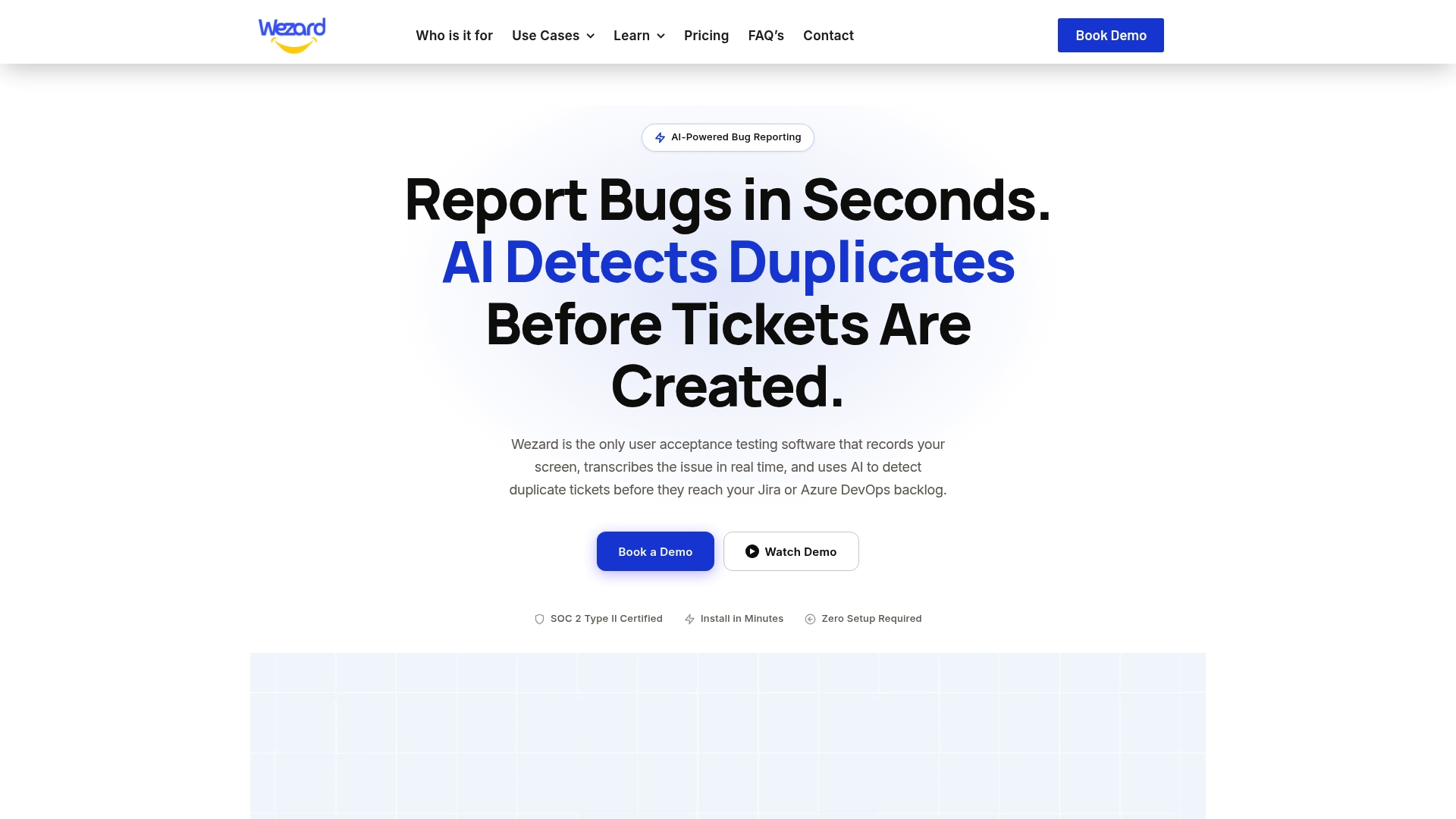
Wezardapp records your screen during UAT execution, transcribes issues in real time, and uses AI to flag duplicate tickets before they clutter your Jira backlog or Azure DevOps board. Every defect arrives with a description, screenshot, and reproduction context already attached. Your team spends less time writing tickets and more time resolving the issues that matter. If you are building out your UAT process from scratch or tightening an existing one, the UAT bug tracking features in Wezardapp give you the evidence trail your sign-off process requires.
FAQ
What is a UAT test case?
A UAT test case is a documented scenario that validates a specific business function against agreed acceptance criteria. It includes preconditions, step-by-step instructions in business language, expected results, and fields for recording actual outcomes and defect references.
How many test cases does a UAT cycle need?
The number depends on the scope of the release, not a fixed target. Cover every user story in scope with at least one positive and one negative scenario. Prioritize end-to-end workflows over isolated feature checks.
What is the difference between UAT and system testing?
UAT validates business requirements from the user’s perspective, while system testing validates technical functionality against system specifications. UAT is executed by business users; system testing is executed by QA engineers.
What should a UAT defect log include?
A complete defect log includes defect ID, severity, reproduction steps, expected versus actual results, business impact, and resolution status. That detail supports rapid triage and provides the evidence needed for a defensible sign-off decision.
When is UAT complete?
UAT is complete when all exit criteria are met: zero open critical or high-severity defects, an agreed resolution or acceptance of lower-severity issues, and a signed sign-off form from authorized business stakeholders.