
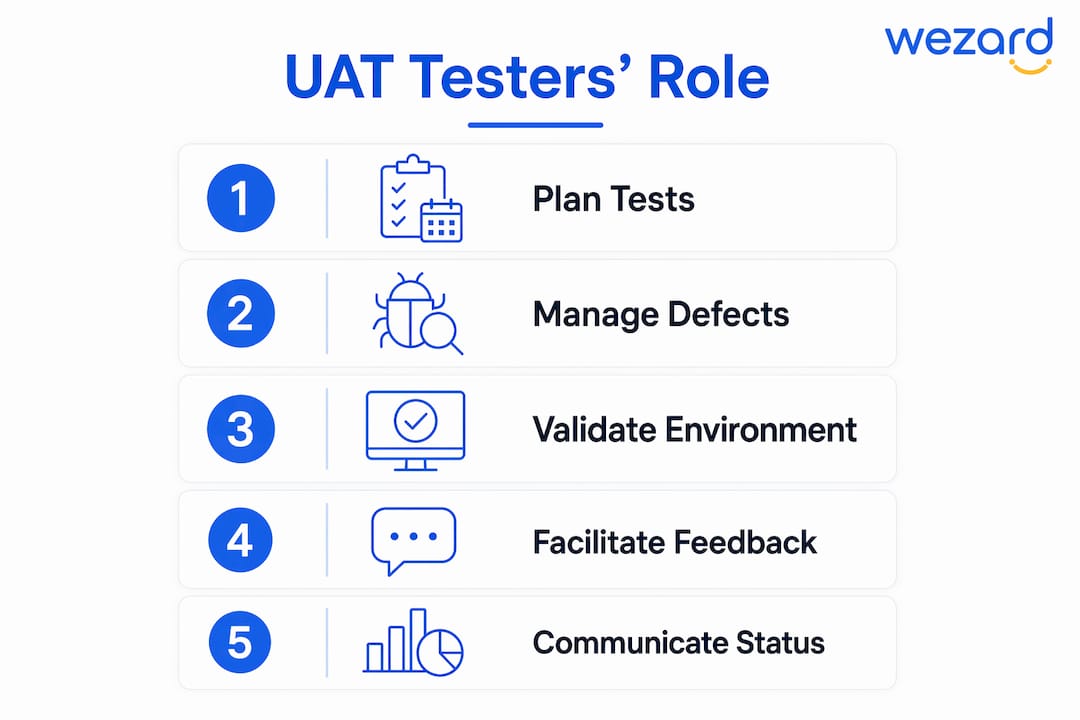
Testers in UAT cycles are defined as facilitators who organize execution, manage defect triage, and maintain test environments so that business stakeholders can perform the actual validation. User acceptance testing (UAT) is the industry term for this final verification phase, where the goal is confirming that software meets real business requirements before release. The role of testers in UAT cycles is not to approve the software. That authority belongs exclusively to business stakeholders. What testers do is build the infrastructure, coordinate the participants, and keep the process moving. Five key roles define the UAT process: Product Owner, Business Analyst, QA lead, end users, and Engineering lead. Each role has a distinct function, and confusing them is the most common reason UAT cycles fail.
What are the primary responsibilities of testers during UAT cycles?
Testers carry the operational weight of UAT. They do not validate business fit, but they make validation possible by handling every logistical and technical task that surrounds it.
The core responsibilities break down into five areas:
- Test plan and traceability matrix development. Testers write the UAT test plan, map each test case to a business requirement, and maintain a traceability matrix that proves coverage. Without this mapping, stakeholders cannot confirm which requirements have been tested.
- Environment setup and validation. Testers configure the UAT environment to mirror production as closely as possible. A test environment that behaves differently from production produces misleading results and wastes everyone’s time.
- Defect triage coordination. When business stakeholders report issues, testers classify, prioritize, and route defects to the engineering lead. They do not fix bugs, but they prevent the backlog from becoming a pile of vague, duplicate reports.
- Test execution evidence. Testers capture screenshots, session recordings, and logs that document what happened during each test run. This evidence supports sign-off decisions and protects the team if disputes arise later.
- Communication facilitation. Testers translate technical findings into language business stakeholders understand, and business feedback into precise defect reports developers can act on.
Pro Tip: Build your traceability matrix before the UAT environment is ready. Waiting until setup is complete compresses the time available for actual testing and forces testers into reactive mode.
QA professionals build test plans, manage defect triage, and validate environments while business stakeholders retain sign-off authority. That division of labor is what gives UAT its accountability structure.

How do testers coordinate with business stakeholders and developers during UAT?
Testers sit at the center of a three-way communication flow between business stakeholders, developers, and the QA function. Managing that flow without creating bottlenecks is the hardest part of the job.
A structured coordination approach works best:
- Brief stakeholders on acceptance criteria before testing begins. Stakeholders who understand the scope test more efficiently and report defects more clearly. A 30-minute kickoff session prevents hours of back-and-forth later.
- Establish a single defect reporting channel. When stakeholders report issues through multiple channels (email, chat, verbal), testers lose control of the defect log. One channel means one source of truth.
- Prioritize defects with the engineering lead daily. Daily triage keeps developers focused on blockers first. Testers who wait until the end of a sprint to hand over defects create a last-minute crunch that delays release.
- Provide stakeholders with status updates at fixed intervals. Uncertainty about test progress causes stakeholders to disengage or escalate unnecessarily. A short daily update prevents both.
- Document every decision. When a stakeholder accepts a known defect or changes a requirement mid-cycle, testers record it. Undocumented decisions become disputed decisions at sign-off.
Pro Tip: Create a shared defect dashboard that both business stakeholders and developers can view in real time. Visibility reduces the number of status questions testers have to field and keeps all parties aligned without extra meetings.
Tester roles in Agile are about facilitating rapid feedback cycles, organizing test evidence, and closing communication gaps between teams. That facilitation function is what separates effective UAT coordination from chaotic, last-minute testing.
What is the difference between testers’ roles in UAT and QA testing?
The distinction between QA testing and UAT is one of objective, not just process. Confusing the two produces invalid results and unclear accountability.
UAT focuses on validating business requirements, real-world usability, and workflows rather than technical correctness. QA focuses on technical tests. That difference shapes everything about how each role operates.
| Dimension | QA testing | UAT |
|---|---|---|
| Primary objective | Technical correctness | Business requirement validation |
| Who executes tests | QA engineers | Business stakeholders (facilitated by testers) |
| Who approves results | QA lead | Business stakeholders only |
| Test design basis | Technical specifications | Business workflows and acceptance criteria |
| Defect focus | Code bugs, integration failures | Workflow gaps, usability issues |
Only business stakeholders can approve features as meeting business requirements. Mixing QA and business sign-off roles creates a lack of genuine accountability. A QA engineer can confirm that the code executes correctly but cannot confirm that it supports the way a claims processor or loan officer actually works.
“QA professionals must resist performing UAT themselves. Their high-value role is building the infrastructure and managing the process that allows business validation to happen.”
This is not a criticism of QA professionals. It is a recognition that their skills are most valuable in setup, triage, and coordination, not in substituting for the business judgment that only end users can provide. For a deeper look at where these two disciplines diverge, the UAT vs QA differences guide covers the full breakdown.
How do testers effectively run UAT cycles in Agile sprint environments?
Running UAT in Agile sprints requires a fundamentally different mindset from traditional waterfall UAT. The biggest mistake teams make is treating UAT as a phase that happens after development. In Agile, UAT is embedded in the Definition of Done and runs continuously rather than as a terminal event.
Practical steps for running UAT in Agile sprints:
- Start preparation in parallel with development. Mapping requirements and preparing test plans should not wait until development finishes. Testers who begin environment setup and participant onboarding during the sprint avoid the bottleneck that kills sprint velocity.
- Keep UAT sessions short and focused. Agile recommends UAT cycles of 3–5 days to preserve sprint velocity. Shorter sessions with a narrow scope produce cleaner feedback than long, unfocused testing marathons.
- Embed UAT acceptance criteria in sprint planning. When acceptance criteria are defined at the start of the sprint, testers can build test cases before the feature is complete. This cuts the time between development handoff and UAT execution.
- Run quick defect resolution loops. In Agile, a defect reported on monday should be fixed and retested by wednesday. Testers who batch defect reports lose the speed advantage that Agile is designed to provide.
- Avoid UAT displacement. Squeezing UAT toward the sprint end causes bottlenecks. Testers should coordinate early, confirm stakeholder availability at sprint start, and flag scheduling conflicts before they become blockers.
The role of UAT testers in Agile sprints is to keep the feedback loop tight. Every day of delay between a defect being found and a developer receiving a clear, reproducible report is a day of sprint velocity lost.
What challenges do testers face in UAT, and how can they be mitigated?
UAT presents a specific set of challenges that differ from those in standard QA work. Most of them stem from the human and organizational complexity of the process rather than its technical demands.
- Wrong testers in the room. Relying on internal QA team members instead of real end users undermines testing validity. Business stakeholders who represent actual workflows catch defects that QA engineers simply cannot anticipate. Testers must push for the right participants, even when scheduling them is inconvenient.
- Vague defect reports. When business stakeholders report issues without context (“it doesn’t work”), testers spend more time investigating than fixing. Providing stakeholders with a simple defect template before testing begins cuts this problem significantly.
- Scope creep during UAT. Stakeholders sometimes use UAT as an opportunity to request new features rather than validate existing ones. Testers must enforce the boundary between defect reporting and change requests, escalating scope additions to the Product Owner.
- Stakeholder disengagement. Business users have day jobs. UAT competes with their regular workload. Testers who schedule sessions in advance, keep them short, and communicate clear expectations get better participation than those who treat stakeholder time as infinitely available.
Pro Tip: Send stakeholders a one-page testing guide before each UAT session. Cover what to test, how to report issues, and what counts as a defect versus a feature request. Five minutes of preparation saves hours of confusion.
Early risk mitigation through proactive stakeholder engagement is the single most effective way to prevent sprint delays caused by last-minute UAT failures.
Key Takeaways
Testers in UAT cycles succeed by facilitating business validation, not by performing it themselves. Clear role separation between testers and business stakeholders is the foundation of every effective UAT process.
| Point | Details |
|---|---|
| Testers facilitate, not validate | Business stakeholders hold sign-off authority; testers build the process that makes validation possible. |
| Role separation prevents invalid sign-off | Mixing QA and UAT roles removes accountability and produces approvals that do not reflect real business needs. |
| Agile UAT requires parallel preparation | Test plans, environments, and participants must be ready before development finishes to preserve sprint velocity. |
| Defect triage is a core tester function | Testers classify and route defects daily to keep developers focused on blockers and prevent end-of-sprint bottlenecks. |
| Right participants determine UAT validity | Real end users must perform UAT; internal QA substitutes miss workflow defects that only business users can identify. |
The part of UAT that most teams get wrong
The most persistent mistake I see in UAT cycles is not a process failure. It is a role confusion problem. Teams assign QA engineers to perform UAT because they are available, technically skilled, and already embedded in the project. The result looks like UAT. It produces a sign-off document. But it is not UAT. It is a second round of QA with a different name.
The tester’s job in UAT is to make it easy for business stakeholders to do their job. That means writing test cases in plain language, not technical syntax. It means setting up an environment that behaves like production, not a sandbox that requires IT support to access. It means being present during sessions to capture evidence and answer process questions, not to run the tests yourself.
I have also seen the opposite failure: testers who are so hands-off that business stakeholders have no structure to work within. They report issues in chat messages, skip steps because no one explained the scope, and sign off on features they never actually tested. Both extremes produce the same outcome: a release that fails in production.
The teams that run UAT well treat testers as the operational backbone of the process. Testers own the plan, the environment, the defect log, and the communication flow. Business stakeholders own the verdict. When those boundaries are clear, UAT works. When they blur, it does not.
— Marketing
How Wezardapp supports testers through every UAT cycle
UAT coordination breaks down fastest at the defect reporting stage. Stakeholders describe issues verbally or in vague emails, testers spend time reconstructing what happened, and developers receive incomplete reports that require follow-up before they can act.
Wezardapp is the only UAT tool that records the tester’s screen, transcribes the issue in real time, and uses AI to detect duplicate tickets before they reach your Jira or Azure DevOps backlog. That means testers spend less time chasing down reproduction steps and more time coordinating the cycle. For teams preparing to run UAT, the acceptance testing entry criteria guide covers exactly what needs to be in place before a single test session begins. Wezardapp also integrates directly with Jira bug tracking and Azure DevOps, keeping defect workflows connected to the tools your team already uses.
FAQ
What is the role of testers in UAT cycles?
Testers in UAT cycles organize test execution, manage defect triage, validate environments, and facilitate communication between business stakeholders and developers. They do not approve the software. That authority belongs to business stakeholders.
Should QA engineers perform UAT?
QA engineers should not perform UAT as business validators. Their role is to build the infrastructure and manage the process. Only business stakeholders can confirm that software meets real business requirements, making their participation in sign-off non-negotiable.
How long does a UAT cycle take in Agile sprints?
Simple projects take 2–3 days; complex sprints typically require 3–5 days of UAT. Agile teams keep UAT cycles short to preserve sprint velocity, which requires parallel preparation rather than waiting until development is complete.
What is the biggest risk in UAT coordination?
The biggest risk is UAT displacement, where testing gets pushed to the final days of a sprint. Testers who confirm stakeholder availability at sprint start and prepare environments in parallel with development prevent this bottleneck before it forms.
How do testers prevent vague defect reports during UAT?
Testers prevent vague reports by providing business stakeholders with a simple defect template before sessions begin. The template should require a description, reproduction steps, and the expected versus actual result, giving developers everything they need to act immediately.