
The most reliable duplicate bug detection setup pairs a retrieval baseline like BM25 or REP with semantic sentence embeddings, then routes every candidate match through a human confirmation step. Skip full automation. A benchmarking study on duplicate bug report detection found that retrieval methods often match or beat deep learning models once age and issue-tracking-system bias are controlled for, and the systems that hold up in production never auto-close a report without a person looking at it first.
TL;DR:
- Retrieval-based methods like BM25 and REP often outperform deep learning models when biases are properly controlled, emphasizing testing against strong baselines.
- Embedding fine-tuning improves semantic similarity detection, but off-the-shelf models combined with retrieval are effective for real-time suggestions without extensive training data.
- A human-in-the-loop workflow significantly reduces false positives and maintains trust, with suggested matches presented to triagers for final confirmation.
- Automated deduplication should never auto-close reports; instead, it should suggest, flag, or queue for review, especially for critical or security issues.
- Scaling to large backlogs requires fast approximate nearest-neighbor indexing, incremental updates, and deterministic filters like token overlap checks to prevent false positives.
Table of Contents
- What Is Duplicate Bug Detection and Why Retrieval Still Wins
- Comparing Retrieval, Embeddings, Deep Learning, and LLM Hybrids
- How Do You Build a Human-in-the-Loop Duplicate Workflow?
- Preprocessing and Feature Extraction That Cut False Positives
- Choosing and Tuning Embeddings for Production
- What Metrics and Datasets Should You Trust for Evaluation?
- The Real Risk: Auto-Closing and How to Avoid It
- Scaling Duplicate Detection Without Slowing Down Your Backlog
- Deployment Challenges Teams Underestimate
- Can Duplicate Detection Transfer Across Projects?
- Handling Bug Report Data Responsibly
- Why Responsible Duplicate Detection Matters
- How Wezard Reduces Duplicate Noise Before It Reaches Your Backlog
- Key Papers and Datasets to Consult Next
- Sources
- FAQ
What Is Duplicate Bug Detection and Why Retrieval Still Wins
Duplicate bug report detection (DBRD, in the research literature) is the task of flagging when a newly filed issue describes the same underlying defect as one already sitting in the tracker. It sounds simple until you try to build it. Two testers can describe the same crash in completely different vocabulary, one calling it “app freezes on save” and the other “UI unresponsive after file write,” and a naive keyword match will miss the connection every time.
That’s the gap retrieval-based methods were built to close, and it’s worth understanding why they still lead the field. TF-IDF and BM25 rank candidate duplicates by term overlap, weighted by how rare and how frequent each term is across the corpus. REP (Retrieval-based duplicate bug report detection) extends that with structured fields like product, component, and version. None of this involves neural networks, and that’s the point: these methods are cheap, explainable, and fast to deploy.
The arXiv benchmarking study is the one every team building a duplicate detector should read before writing a line of model code. It found that once researchers corrected for two systematic biases, the performance gap between simple retrieval and sophisticated deep learning narrowed sharply, and in several projects retrieval baselines came out ahead by a wide margin on RR@10. That’s not an argument against modern methods. It’s an argument for testing modern methods against a real baseline instead of a weak one, which is a step a surprising number of published systems skip.
The two biases matter enough to name directly. Age bias happens when a dataset’s temporal ordering leaks information, letting a model “cheat” by learning that a newer report is more likely to duplicate a recent one rather than actually understanding semantic similarity. ITS bias comes from the quirks of a specific issue-tracking system, meaning a model tuned on Bugzilla data can look brilliant on Bugzilla and fall apart on a Jira export with different field conventions.
For a team evaluating tools or building in house, this changes the buying question. Instead of asking “does this use AI,” ask “what’s the RR@10 against a strong retrieval baseline, on a dataset that controls for age and ITS bias.” That single question filters out a lot of marketing.
Comparing Retrieval, Embeddings, Deep Learning, and LLM Hybrids
Four method families dominate the current landscape, and each has a distinct cost and failure profile.
Retrieval baselines (TF-IDF, BM25, REP) score candidates by lexical overlap and structured field matches. They need no training data beyond the corpus itself, run in milliseconds, and are trivial to explain to a tester asking “why did it suggest this match.” Their weakness is paraphrase blindness. If two reports share zero meaningful vocabulary, a pure retrieval model has almost nothing to work with.
SBERT sentence embeddings map each report into a dense vector space where semantic similarity, not just word overlap, drives the match score. A study on duplicate bug detection with sentence embeddings found that fine-tuning SBERT on domain-specific bug report text, and modeling title and description as separate signals rather than one blob of text, improved detection meaningfully over TF-IDF and topic-modeling baselines like LDA. Off-the-shelf sentence transformers work reasonably well out of the box; fine-tuned ones work better, at the cost of needing a labeled set of confirmed duplicate pairs to train on.
Deep-learning pairwise classifiers (CNN-based feature extractors, siamese networks, and similar architectures) treat duplicate detection as a binary classification problem over report pairs. Research on deep learning techniques for duplicate bug report detection describes pipelines combining CNN feature extraction, clustering, and cosine similarity thresholds on learned embeddings. These models can outperform simpler methods on the right dataset, but they demand more labeled duplicates, more retraining as your codebase and vocabulary shift, and more infrastructure to serve at low latency. That maintenance tax is real and rarely shows up in a benchmark paper’s headline number.
LLM-augmented hybrids are the newest entrant, and they solve a different problem than you might expect. Rather than asking a large language model to compare every pair of reports at runtime, which would be prohibitively slow and expensive at scale, the smarter pattern uses the LLM as a preprocessing step. The Cupid approach has an LLM extract or compress the essential keywords from a noisy report, then feeds that distilled query into a standard retrieval backbone.
The practical takeaway: LLM prompting is best used as a query-cleaning step ahead of retrieval, not as a pairwise comparison engine. Comparing every new report against thousands of open tickets with an LLM call per pair burns budget and time for marginal gain over a well-tuned embedding index.
Here’s how the trade-offs stack up for teams deciding where to start:
- Retrieval baselines: lowest cost, no training data required, weak on paraphrases, best first deployment.
- SBERT embeddings: moderate cost, needs labeled pairs for fine-tuning, strong semantic recall, good second step.
- Deep pairwise classifiers: highest maintenance burden, needs the most labeled data, can win on accuracy but rarely by enough to justify the overhead for smaller teams.
- LLM-augmented hybrids: moderate cost if used for query compression only, meaningful recall gains, avoids the latency trap of pairwise LLM comparison.
How Do You Build a Human-in-the-Loop Duplicate Workflow?
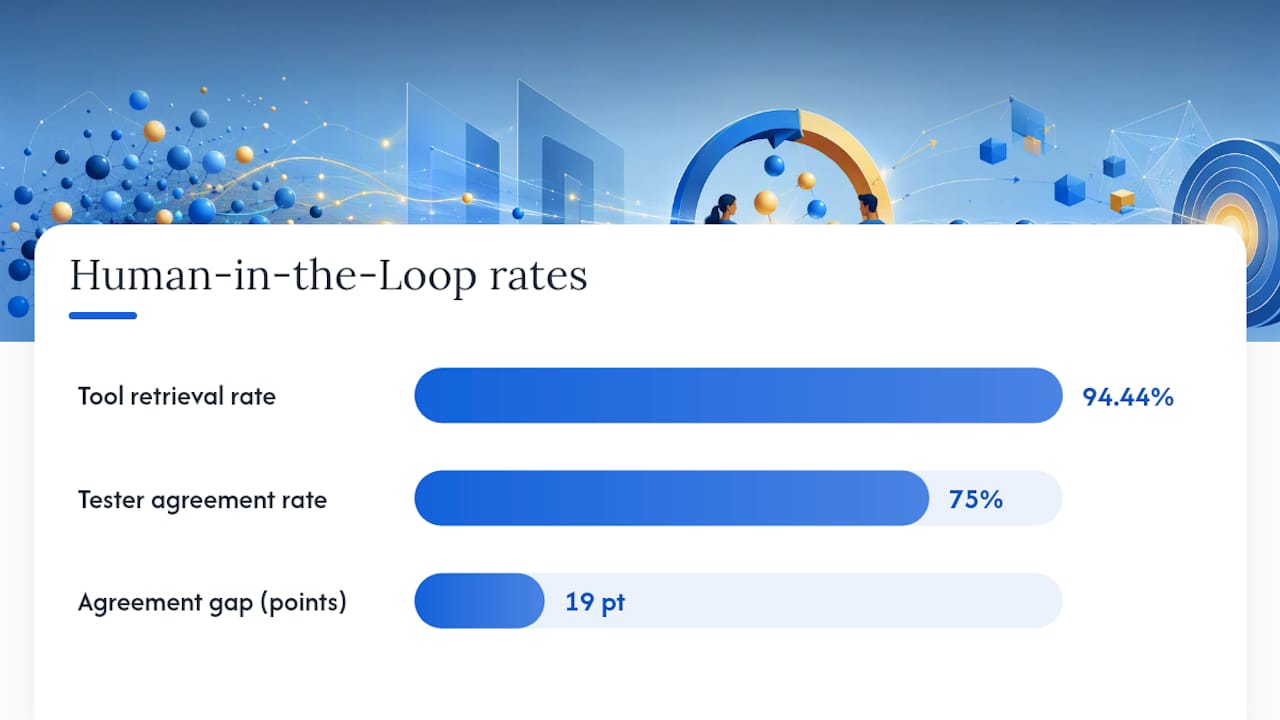
Automation should suggest. A person should decide. That’s the operating principle behind every DBRD system that has survived contact with a real bug tracker, and it’s backed by direct evidence: an industrial human-in-the-loop tool called Bugle retrieved true duplicates at a 94.44% success rate, yet testers only agreed with the tool’s top recommendation 75% of the time. That 19-point gap is the whole argument for keeping a person in the loop. The tool found the right answer far more often than testers accepted it outright, largely because of semantic gaps and missing context that only a human reviewer could catch.
Here’s a workflow that respects that gap instead of fighting it:
- Pre-submission suggestion. As a tester types a new report, the system searches the existing backlog and surfaces two or three likely matches before the report is even filed. This is the cheapest place to catch a duplicate, because nothing has entered the tracker yet.
- Post-submission ranked candidates for triage. If the tester submits anyway, the report lands in a triage queue with its top-K candidate matches attached, each carrying a similarity score and the specific evidence behind it (matched title, matched stack trace, matched component field).
- One-click confirm or reject. The triager sees the evidence, not just a score, and can accept the merge, reject it, or ask the tool to reformulate the query with adjusted terms.
- Severity exemption check. Before any merge finalizes, a rule checks report severity. Critical and security-tagged issues get flagged for manual review even at a high similarity score, because a false merge on a high-severity bug is far more costly than one on a cosmetic issue.
- Log and audit. Every accept, reject, and reformulation gets logged with a timestamp and reviewer ID, building the trail you’ll need when someone asks six months later why a bug got merged.
Integration matters as much as the model. For Jira, this typically means a webhook that fires on issue creation, enriches the payload with a candidate list, and writes suggestions back as a comment or linked-issue field. For Azure Boards, the OData and Power Automate pattern lets you query the work item store, run similarity scoring externally, and push results back without touching the core pipeline. Both platforms support enough hooks that you don’t need to fork your tracker to get advisory suggestions flowing.
Pro Tip: Give the triager a query reformulation box right next to the candidate list. When a tester rejects every suggested match, letting them retype two or three keywords and re-run the search catches duplicates the original phrasing missed, and it takes the interface about ten seconds to add.
Preprocessing and Feature Extraction That Cut False Positives
Raw bug report text is noisy, and most of that noise has nothing to do with whether two reports describe the same defect. Cleaning it up before scoring similarity is one of the highest-leverage steps in the whole pipeline.
Start by splitting title and description into separate signals instead of concatenating them into one blob. The SBERT duplicate detection research found that weighting title similarity more heavily, then combining it with content similarity through something like a maximum or weighted sum, outperformed treating the whole report as undifferentiated text. Titles tend to be short and specific; descriptions ramble, and giving them equal weight dilutes the signal.
Canonicalization removes the parts of a report that vary for reasons unrelated to the bug itself. That means:
- Stripping timestamps and log line numbers, which change on every run of the same bug.
- Normalizing stack traces to their structural shape rather than exact memory addresses or thread IDs.
- Removing volatile phrases like to build numbers or session identifiers that differ between two reports of the identical crash.
- Lowercasing and stemming consistently, so “Cannot Save” and “cannot save” don’t score as dissimilar.
Beyond text cleanup, extract structured fields as their own categorical features. Named entity recognition can pull out error codes, file paths, and function names, turning “NullPointerException in OrderProcessor.java line 214” into three distinct tokens you can match exactly rather than fuzzily. An exact match on an error code is a much stronger duplicate signal than a high cosine similarity score on prose.
The strongest pipelines combine both signal types in a hybrid scoring function: categorical matches (same component, same error code, same file path) get combined with text similarity scores rather than replacing them. A report that matches on error code but has a moderately different description should still rank higher than one with similar prose but no structural overlap at all.
Choosing and Tuning Embeddings for Production
The first decision is whether to fine-tune or use an off-the-shelf model. Fine-tuning SBERT on your own confirmed duplicate pairs produces measurably better ranking, according to the SBERT fine-tuning research, because it teaches the model your project’s specific vocabulary, error patterns, and phrasing conventions rather than general-purpose English semantics. The catch is you need enough labeled duplicate pairs to fine-tune on, and most teams only have that after months of manually tagged triage history.
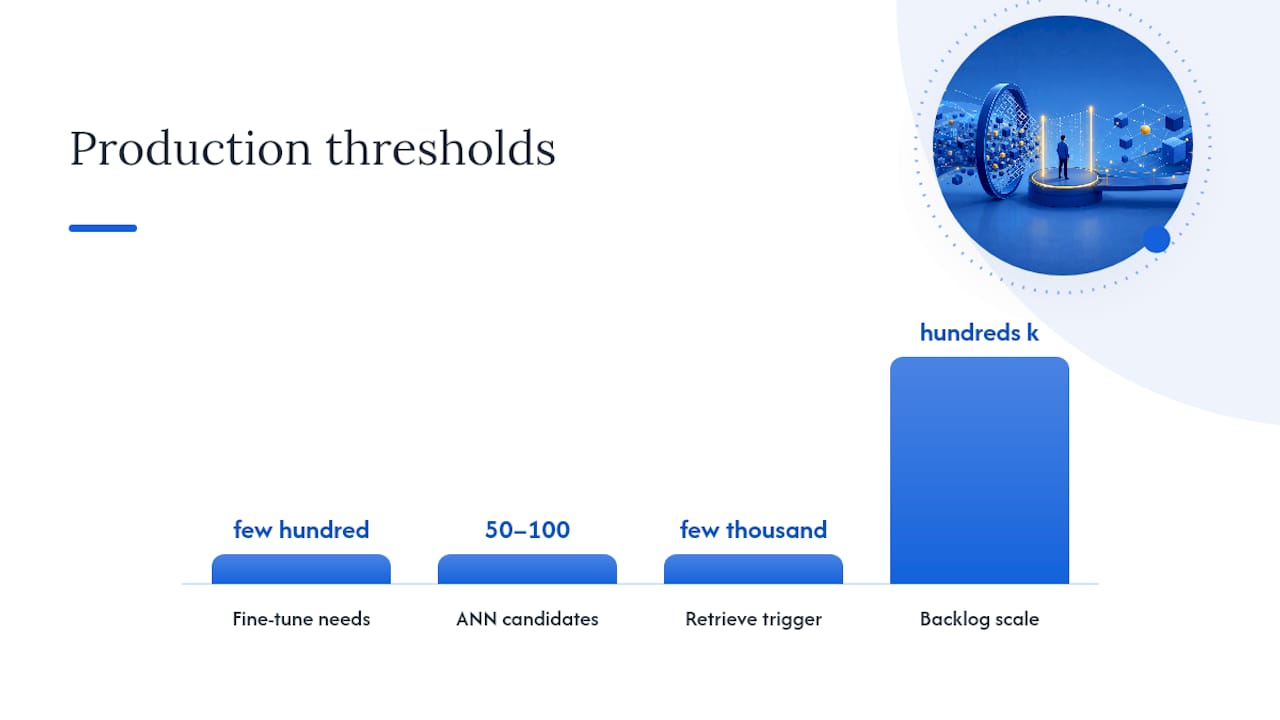
If you don’t have that history yet, start with an off-the-shelf sentence transformer and plan to fine-tune once you’ve accumulated a few hundred confirmed pairs. Don’t wait for a perfect dataset before shipping something useful.
Latency and accuracy pull against each other, and the right balance depends on where in the workflow the model runs. A pre-submission suggestion needs to return results in well under a second, or testers will ignore it and submit anyway. A distilled, smaller embedding model trades a little accuracy for speed here, and that trade is almost always worth it. Post-submission triage has more slack. A batch job scoring overnight can afford a larger, slower model.
For scale, don’t compare every new report against every ticket in the backlog with a full similarity computation. A retrieval-plus-re-ranking pipeline handles this cleanly: a fast approximate nearest-neighbor index (FAISS or similar) pulls the top 50 or 100 candidates cheaply, and only those go through a more expensive re-ranking model. This is the same pattern search engines use, and it scales to backlogs with hundreds of thousands of tickets without a proportional increase in compute per query.
- Fine-tune when you have labeled duplicate pairs; otherwise start off-the-shelf and revisit later.
- Use distilled models for real-time, pre-submission suggestions.
- Use retrieval-plus-re-ranking, not brute-force pairwise comparison, once your backlog passes a few thousand tickets.
- Add deterministic guards, like a minimum token overlap check, before finalizing any merge, even one with a high embedding score.
Pro Tip: Set a hard minimum-token-overlap floor as a sanity check on top of embedding scores. A pair can score high on semantic similarity due to shared boilerplate language (both reports mention “login page,” “error message,” “unable to”) while describing completely different bugs. A deterministic overlap check on specific nouns catches that failure mode cheaply.
What Metrics and Datasets Should You Trust for Evaluation?
Report Recall@K and Precision@K as your primary metrics, broken down by severity, not just as one blended number. Recall@10 tells you how often the true duplicate appears somewhere in your top 10 suggestions; RR@5 and RR@10 (reciprocal rank variants) tell you how close to the top it lands, which matters because a triager rarely scrolls past the first handful of candidates. A model with strong Recall@10 but weak RR@5 is putting the right answer in the list, just not near the top, which still costs triage time.
Per-severity breakdowns matter because a model can look excellent in aggregate while quietly failing on the reports that matter most. A duplicate detector that nails cosmetic UI bugs but misses critical crash reports has a dangerous blind spot that a single averaged metric will hide.
Dataset choice deserves the same scrutiny as model choice. Public datasets built from BugHub or extracted from Eclipse and Bugzilla issue histories give you reproducibility and let you compare against published benchmarks. But the benchmarking research on age and ITS bias found these biases statistically significant enough to swing performance rankings, so validating purely on an aging public dataset can give you a false sense of how a model performs on your live backlog.
The fix is straightforward even if it takes discipline: benchmark on public datasets for comparability, then validate again on a recent sample pulled from your own tracker, ideally one that includes reports filed in the last few months rather than a historical snapshot. Skipping this second step is how teams end up deploying a model that looked great in the paper and mediocre in production.
- Report Recall@K and Precision@K, broken down by severity level, not one overall number.
- Use RR@5 and RR@10 to measure how close true duplicates land to the top of the ranking.
- Control for age bias and ITS bias by testing across more than one issue-tracking system and time window.
- Validate public-dataset benchmarks against a recent, held-out sample from your own live backlog.
- Track operational metrics alongside accuracy: triage time saved, false-positive reopen rate, and how often a legitimate report gets buried by a bad match.
The Real Risk: Auto-Closing and How to Avoid It
Automated deduplication without human review has already caused damage at scale, and the record on this is not theoretical. A public GitHub bot incident auto-closed many thousands of issues before an audit caught it, and the review found many of them were false positives, including critical bugs shut down without anyone looking at them. That’s the cautionary case every team should keep in mind before flipping any duplicate detector into fully automated mode.
The mitigations are practical, not exotic:
- Never auto-close. Suggest, flag, or queue for review, but let a human make the final merge decision every time.
- Tune thresholds conservatively for paraphrase cases. Semantic matches that rely on loose vocabulary overlap deserve a lower confidence weighting than matches with strong structural or exact-token overlap.
- Prefer reinforcement over replacement. When two reports likely describe the same bug, merge the new information into the existing ticket rather than discarding the new report outright. Details lost in a hasty close are hard to recover later.
- Surface explainability at the point of decision. Show the triager exactly which fields, tokens, or embedding similarity drove the suggestion, not just a bare confidence score.
- Exempt critical and security-tagged issues from automated logic entirely, routing them straight to manual review regardless of similarity score.
- Audit closed-as-duplicate decisions periodically. A quarterly sample review catches drift before it becomes a 15,000-issue problem.
Scaling Duplicate Detection Without Slowing Down Your Backlog
A duplicate detector that works cleanly on a thousand-ticket backlog can fall apart at a hundred thousand. The fix is architectural, not just throwing more compute at the problem. Approximate nearest-neighbor indexes, the same technology behind large-scale search engines, let you retrieve the top candidates from a huge embedding index in milliseconds instead of comparing a new report against every existing ticket one by one.
Batching matters too. Real-time, pre-submission suggestions need a lightweight, fast-responding model, while deeper re-ranking and cross-checking can run asynchronously against a nightly or hourly batch job. Splitting the workload this way keeps the tester-facing experience snappy without sacrificing thoroughness where it counts.
Index freshness is an underrated bottleneck. If your embedding index only updates once a day, reports filed in the last few hours won’t show up as candidates, which defeats the purpose of catching duplicates early. Incremental index updates, where new tickets get embedded and added to the index within minutes of creation, close that gap.
Caching helps more than teams expect. Recomputing embeddings for the same unchanged tickets on every query wastes cycles. Store computed vectors alongside the ticket and only recompute when the ticket’s text actually changes.
Finally, watch your candidate pool size. Retrieving the top 100 candidates before re-ranking is usually enough for high recall; retrieving the top 1,000 rarely improves results but multiplies your re-ranking compute cost for no real gain.
Deployment Challenges Teams Underestimate
The gap between a duplicate detector that works in a notebook and one that works in a live Jira instance is wider than most teams expect. Data quality is the first wall. Bug reports written by rushed testers, non-native English speakers, or automated crash reporters vary wildly in structure, and a model tuned on clean, well-written tickets will stumble on terse or garbled ones.
Team buy-in is the second wall, and it’s often the harder one. Testers who’ve seen a bad automated merge lose trust in the tool fast, and once trust erodes, they stop trusting even accurate suggestions. Rolling out in advisory-only mode first, and being transparent about the tool’s current accuracy, protects that trust better than a confident launch that overpromises.
Integration friction shows up in unexpected places. A test management tool comparison is worth reviewing if you’re evaluating how duplicate detection fits into a broader tracker migration, since swapping platforms mid-rollout resets a lot of the tuning work you’ve already done.
Best practice here is incremental exposure: start with pre-submission suggestions only, measure acceptance rate for a month, then expand to post-submission triage candidates once testers trust the signal. Skipping straight to automated merging is the single most common deployment mistake teams make, and it’s the one the GitHub auto-close incident illustrates directly.
Can Duplicate Detection Transfer Across Projects?
A model trained on one project’s bug history often degrades when pointed at a different project, even within the same organization, because vocabulary, component names, and bug patterns shift. This is where cross-project transfer learning becomes relevant, and it’s a less mature area than single-project detection but a practically important one for organizations running dozens of repositories.
The pragmatic approach borrows from general transfer learning: start with a base sentence embedding model trained broadly, then fine-tune a lightweight adapter layer on each project’s specific data rather than training a fully separate model per project from scratch. This keeps the shared semantic understanding while adapting to project-specific terminology.
Retrieval baselines transfer more gracefully than deep classifiers, because term-frequency methods don’t encode project-specific assumptions the way a trained neural network does. That’s another point in favor of keeping a retrieval baseline in the pipeline even after adding embeddings, since it acts as a stable fallback when a fine-tuned model meets an unfamiliar project.
For organizations managing multiple products, a shared candidate-retrieval layer with per-project re-ranking tends to work better than either a single global model or fully isolated per-project models. It lets common bug patterns (login failures, timeout errors, null reference exceptions) get recognized everywhere, while still respecting the specific vocabulary of each codebase.
Handling Bug Report Data Responsibly
Bug reports routinely contain sensitive material that has nothing to do with the defect itself: customer names in screenshots, internal URLs, stack traces exposing file system paths, and sometimes credentials pasted accidentally into a log excerpt. Any duplicate detection pipeline that stores, embeds, or indexes this text needs to treat it with the same care as any other sensitive customer data.
Embedding vectors themselves carry re-identification risk that’s easy to overlook. Sentence embeddings can sometimes be partially reconstructed or matched against known text, so treating a vector index as automatically “safe” because it’s not plain text is a mistake. Access controls on the embedding index deserve the same scrutiny as access controls on the raw report database.
Redaction before indexing is worth building in as a standard step, not an afterthought. Stripping obvious personal identifiers, credentials, and internal hostnames from a report before it enters the similarity index reduces exposure without meaningfully hurting duplicate detection accuracy, since most duplicate signals live in error descriptions and stack traces, not in personal data.
For organizations under enterprise security requirements, SSO integration and role-based access to the duplicate suggestion interface matter as much as the model’s accuracy. A duplicate detector that surfaces sensitive report content to triagers who shouldn’t see it is a compliance problem regardless of how good its Recall@10 is.
Why Responsible Duplicate Detection Matters
The research is consistent on one point: automation should recommend, not decide. We think that’s not a compromise position, it’s the correct one, because the cost of a wrongly auto-closed critical bug almost always outweighs the triage minutes saved by full automation.
Enriched reports change the equation for the better. A report that includes a session replay or a real-time transcription of what the tester was doing gives a duplicate-detection model far more signal than a two-line text description ever could, which is exactly why detection precision improves when reports carry more than just prose.
If a tool marks something a duplicate, the person who filed it deserves a way to contest that call, and the organization deserves an audit trail proving the decision was reasonable. Anything less erodes the trust that makes triage automation worth building in the first place.
— Marketing
How Wezard Reduces Duplicate Noise Before It Reaches Your Backlog
Most duplicate detection tools work with whatever thin text a tester bothers to type, and thin input produces thin matches. Wezard changes what goes into the detector in the first place: it records the tester’s screen, transcribes the issue in real time as they describe it out loud, and uses that richer, more structured report to flag likely duplicates before the ticket ever reaches your Jira or Azure DevOps backlog.
That extra signal, video context plus a live transcript instead of a rushed two-sentence summary, is what lets Wezard’s AI-powered duplicate detection cut duplicate noise by up to 40% compared to manual triage or basic feedback tools, according to Wezard’s own product claims. The Azure Boards integration uses OData and Power Automate to push enriched, deduplicated tickets straight into your existing workflow, and the Jira integration syncs in a single click, so triagers aren’t copying context between tools by hand.
If you’re currently relying on testers to manually search the backlog before filing, or on a bot that auto-closes without a human check, it’s worth comparing that against a workflow that catches the duplicate at the source. Wezard’s plans start at $25 a month for the Starter tier, scaling up through Team and Business for larger QA organizations. Start a trial or check the pricing page for the tier that fits your team’s backlog size.
Key Papers and Datasets to Consult Next
For deeper technical grounding, start with the benchmarking study on retrieval versus deep learning approaches, which controls for age and ITS bias and is the closest thing this field has to a reproducibility standard. The Bugle human-in-the-loop case study is essential reading for anyone designing the tester-facing side of a triage tool. For hybrid architectures, the Cupid paper on LLM-augmented retrieval and the SBERT fine-tuning research cover the two dominant modern approaches side by side.
Sources
- Duplicate Bug Report Detection: How Far Are We?
- Exploring the Role of Automation in Duplicate Bug Report Detection (Bugle)
- Duplicate Bug Report detection with SBERT
FAQ
How Many Bugs Are There per 1,000 Lines of Code?
Industry estimates vary widely by codebase maturity, language, and testing rigor, and no single number applies universally across projects. Rather than chase a specific figure, focus on tracking your own defect density over time, since that trend line tells you more than any published industry average.
Which Tool Is Used for Bug Tracking?
Jira and Azure DevOps (Azure Boards) are the two most widely used platforms for logging and tracking bugs in software teams. Tools like Wezard sit in front of these trackers, capturing richer bug reports through screen recording and real-time transcription before syncing enriched, deduplicated tickets into Jira or Azure Boards.
What Does “Reproduce Bug” Mean?
Reproducing a bug means following the exact steps that triggered the original defect to confirm it happens consistently, not just once by chance. This step is critical for duplicate detection because two reports describing reproducible steps that lead to the same failure are strong duplicate candidates, even if their wording differs completely.
Why Is a Software Glitch Called a “Bug”?
The term predates modern computing and was popularized after a moth was found causing a malfunction in an early relay-based computer, though the word “bug” for a mechanical defect was already in informal use before that. Today it refers to any flaw in code that causes unexpected behavior, unrelated to actual insects.
What’s the Difference Between Duplicate Detection and Deduplication?
Duplicate detection identifies candidate matches and presents them for review, while deduplication implies actually merging or closing the matched reports. The distinction matters operationally: research on human-in-the-loop duplicate detection shows detection accuracy consistently outpaces automated deduplication accuracy, which is why advisory detection with human confirmation outperforms fully automated merging in practice.