
Quality assurance in performance testing is the systematic process of validating that software performs reliably and efficiently under expected and peak workloads, protecting both user experience and business continuity. The role of QA in performance testing extends far beyond running a few load tests before release. QA engineers own the entire performance validation lifecycle: defining acceptance criteria, scripting realistic test scenarios, analyzing bottlenecks, and communicating findings to developers, DevOps teams, and business stakeholders. Fixing performance bugs post-deployment costs up to 30 times more than catching them during early validation. That single fact explains why QA involvement in software testing is no longer optional. It is the financial and operational backbone of every serious release process.
What are the core QA responsibilities in performance testing?
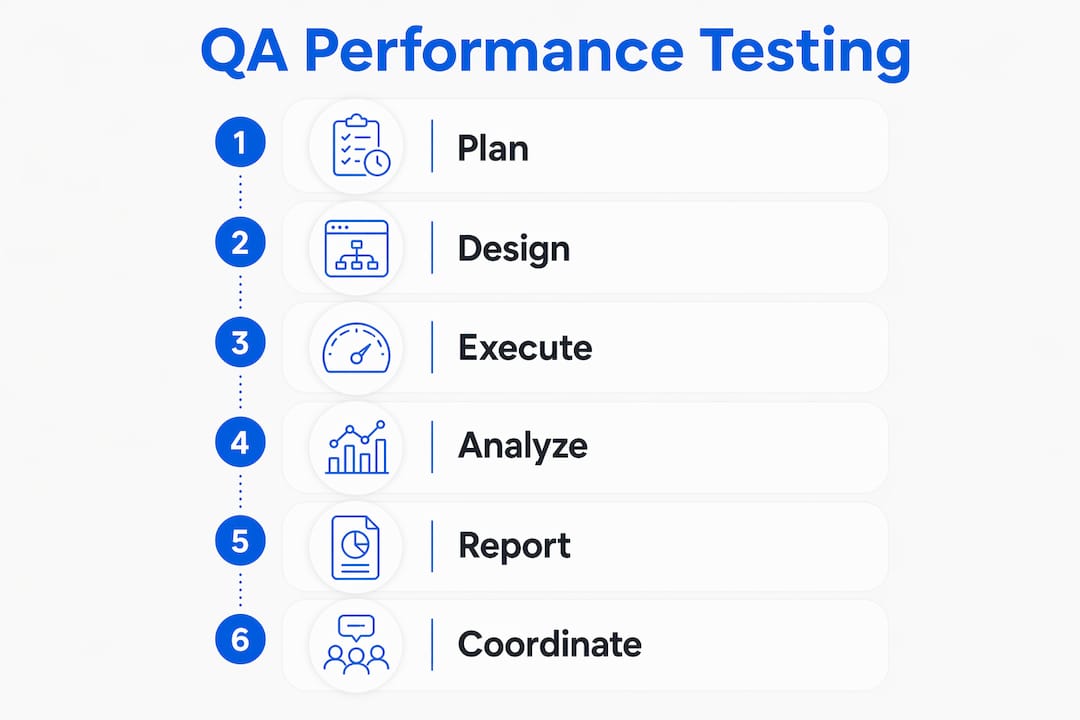
QA’s responsibilities in performance testing span four distinct phases: planning, execution, analysis, and reporting. Each phase requires a different skill set, and skipping any one of them produces incomplete results that mislead the entire team.
1. Define performance SLAs and acceptance criteria. Before a single test runs, QA engineers establish what “good” looks like. In 2026, performance SLAs typically require P95 latency under 200ms and error rates below 0.1% for defined concurrent user loads. Without these benchmarks, test results are just numbers with no pass or fail verdict.
2. Design realistic test scenarios and scripts. QA engineers model real user behavior, not theoretical traffic. A checkout flow under Black Friday load is a fundamentally different scenario than a steady-state API call, and the scripts must reflect that difference.

3. Execute load, stress, spike, and endurance tests. Each test type answers a different question. Load tests confirm normal-capacity behavior. Stress tests find the breaking point. Spike tests simulate sudden traffic surges. Endurance tests expose memory leaks that only appear after hours of sustained use. Performance testing detects issues like slow database queries, memory leaks, and bad configuration before they ever reach production.
4. Analyze results and identify bottlenecks. Raw metrics mean nothing without interpretation. QA engineers correlate response times with CPU spikes, memory consumption, and database query logs to pinpoint the actual root cause.
5. Prepare detailed bug reports. Effective performance bug reports include test configurations, failed metrics, comparison to baseline, profiler logs, and hypotheses on root causes. A vague report saying “the app is slow” wastes developer time. A report showing “P95 latency jumped from 180ms to 620ms after commit #4421, correlated with a 300% increase in database connection pool wait time” gets fixed in hours.
6. Coordinate across teams. QA engineers translate technical findings into business impact for stakeholders while simultaneously providing developers with the technical depth they need to reproduce and fix issues. This dual communication role is what separates a strong performance QA engineer from a script runner.
Pro Tip: Always review your QA test reports against the original acceptance criteria before presenting findings. Stakeholders respond to pass/fail verdicts, not raw percentile data.
How does QA integrate performance testing into CI/CD workflows?
Embedding performance tests into CI/CD pipelines is the single most effective way to prevent regressions from accumulating undetected across sprints. Automated performance tests in CI/CD detect regressions early and maintain release speed without sacrificing quality. The key is matching test depth to pipeline stage.
Here is how a well-structured pipeline looks in practice:
- Every pull request: Run a 1-2 minute smoke test that validates core endpoints under minimal load. This catches obvious regressions before code merges.
- Nightly builds: Execute medium-load tests covering the top 10 user journeys. Results feed directly into a Grafana dashboard that the team reviews each morning.
- Pre-release gates: Run full stress, spike, and endurance tests. These are the final performance gatekeeping checkpoint before any code reaches production.
- Post-deployment monitoring: Use New Relic or Dynatrace to confirm that production behavior matches test predictions. Divergence signals either a test environment mismatch or an infrastructure configuration issue.
The tools that make this work include Jenkins and GitHub Actions for pipeline orchestration, JMeter or Gatling for test execution, and Grafana for results visualization. The combination gives QA engineers a continuous feedback loop rather than a one-time pre-release scramble.
Pro Tip: Establish a performance baseline under normal conditions at the very start of the project. Without a baseline, you cannot distinguish a regression from expected behavior change.
What tools and skills do QA engineers need for performance testing?
Performance QA is a technically demanding specialty. The skill set spans scripting, monitoring, networking, and data analysis. Gaps in any area produce blind spots in your test coverage.
| Category | Tools and Technologies |
|---|---|
| Test execution | JMeter, LoadRunner, Gatling, NeoLoad |
| Monitoring and observability | Grafana, New Relic, Dynatrace |
| CI/CD integration | Jenkins, GitHub Actions, GitLab CI |
| Programming languages | Java, Python, C#, JavaScript |
| Networking fundamentals | HTTP, TCP/IP, DNS, TLS handshake analysis |
Key QA skills for performance testing include programming in Java, Python, or C#, tool expertise in JMeter and LoadRunner, networking knowledge, and strong analytical ability. This combination is non-negotiable because scripting a realistic test requires programming, diagnosing a bottleneck requires networking knowledge, and communicating findings requires analytical clarity.
Beyond the technical stack, QA engineers need to understand environment configuration. A test that runs against an underpowered staging server with a single database replica will produce results that bear no resemblance to production behavior. Matching test environment specifications to production is a QA responsibility, not a DevOps afterthought.
The monitoring layer deserves special attention. Tools like Dynatrace and New Relic provide distributed tracing that shows exactly where latency originates in a microservices architecture. Without that visibility, you know a service is slow but not which downstream dependency is causing it.
What challenges do QA professionals face in performance testing?
Performance testing generates more ambiguous results than any other testing discipline. The challenges are real, and understanding them in advance is the difference between a team that acts on findings and one that debates them for weeks.
- Interpreting unexpected capacity limits. When a system handles 5,000 concurrent users instead of the expected 10,000, bridging that technical and business gap for stakeholders requires both technical depth and communication skill. The QA engineer must explain not just what happened but what it costs the business in lost revenue or degraded experience.
- Maintaining test scripts as systems evolve. A microservices architecture that deploys 15 services independently can invalidate a performance script within days of its creation. QA engineers need a script maintenance strategy, not just a test creation strategy.
- Avoiding false positives and negatives. A test environment with a misconfigured connection pool will generate alarming latency numbers that disappear in production. Conversely, a test that does not simulate realistic think times will show artificially optimistic throughput. Both outcomes erode trust in the QA function.
- Establishing reliable test environments. Shared staging environments contaminated by other teams’ test traffic produce results that cannot be reproduced. Dedicated, production-equivalent environments are the standard, even when they are expensive.
- Translating metrics into release decisions. Performance QA engineers act as bridges between developers, DevOps, and business teams, converting complex metrics into decisions stakeholders can act on. Understanding software acceptance criteria before testing begins makes this translation far cleaner.
How is QA’s role in performance testing evolving in 2026?
The most significant shift in performance QA is the move from reactive defect detection to proactive quality enforcement. QA’s role is shifting left to integrate performance requirements during design and development, preventing bottlenecks rather than discovering them the week before launch. This is not a minor process adjustment. It changes when QA engineers get involved, what artifacts they produce, and how much influence they have over architectural decisions.
“QA engineers should act as Performance Gatekeepers, using empirical test results to block unsafe software releases and protect business outcomes.” — Load / Performance Test in Software QA as Gatekeeper
The Performance Gatekeeper model gives QA engineers formal authority to block a release when performance SLAs are not met. This is a significant organizational shift from the traditional model where QA findings were advisory and developers could override them under deadline pressure. Teams that adopt this model report higher release confidence and fewer production incidents.
Unified automation is another trend reshaping the role. QA teams are consolidating functional and performance test automation into shared frameworks, reducing duplication and making it easier to run performance assertions alongside functional checks. This approach also makes performance testing accessible to engineers who are not performance specialists, distributing the responsibility across the team.
The cross-functional collaboration aspect is intensifying. In 2026, the most effective QA engineers participate in architecture reviews, sprint planning, and post-incident retrospectives, not just test execution cycles. Their value comes from preventing problems at the source, not just measuring them after the fact.
Key takeaways
QA’s role in performance testing is the systematic process of validating software reliability under load, and it requires early involvement, technical depth, and cross-functional communication to deliver real business value.
| Point | Details |
|---|---|
| Early involvement reduces cost | Fixing performance bugs post-deployment costs up to 30 times more than catching them during validation. |
| SLAs define pass/fail criteria | Establish P95 latency and error rate thresholds before testing begins to make release decisions objective. |
| CI/CD integration prevents regression | Smoke tests on every pull request and full stress tests pre-release create a continuous performance safety net. |
| Cross-team communication is core | QA engineers translate technical metrics into business impact for stakeholders and actionable data for developers. |
| Shift-left strategy changes QA’s scope | QA involvement during design prevents architectural bottlenecks that no amount of late-stage testing can fix. |
Why QA’s performance role is more strategic than most teams realize
Most organizations still treat performance testing as a final checkpoint. Run the tests, check the numbers, ship the software. That model produces teams that are perpetually surprised by production incidents and perpetually behind on fixes.
What I have seen work consistently is treating performance QA as a design input, not a delivery gate. When QA engineers participate in architecture discussions and flag performance risks before a single line of code is written, the entire development cycle changes. Developers make different choices. Architects consider scalability earlier. Product managers build performance requirements into acceptance criteria from day one rather than retrofitting them under deadline pressure.
The other thing most articles will not tell you: the communication skill matters as much as the technical skill. A QA engineer who can explain why a system supports 5,000 users instead of 10,000, and what that means for the business during a peak sales event, has more organizational influence than one who produces technically perfect reports that no one reads. Invest in that translation ability. It is what turns performance data into decisions.
The tools and methodologies matter, but they are learnable. The harder skill is building the credibility and relationships that get QA engineers a seat at the table before the architecture is locked. That is where the real performance work happens.
— Marketing
How Wezardapp helps QA teams manage performance testing feedback
Performance testing generates a flood of bug reports, and without the right system, duplicate tickets pile up in your Jira or Azure DevOps backlog before anyone notices.
Wezardapp is the only UAT testing tool that records your screen, transcribes the issue in real time, and uses AI to detect duplicate tickets before they reach your backlog. For QA teams running performance cycles, that means every reported bottleneck is captured with full context, no duplicates, and no manual triage overhead. Wezardapp connects directly to Jira and Azure DevOps, so your performance findings move from test session to developer queue in one click. Explore QA testing approaches and see how Wezardapp fits your workflow.
FAQ
What is the role of QA in performance testing?
QA engineers plan, execute, analyze, and report on performance tests to validate that software meets defined SLAs under expected and peak workloads. Their role spans the full lifecycle from defining acceptance criteria to blocking unsafe releases as performance gatekeepers.
What tools do QA engineers use for performance testing?
The most widely used tools include JMeter, LoadRunner, Gatling, and NeoLoad for test execution, paired with Grafana, New Relic, and Dynatrace for monitoring and observability.
Why is shift-left important for performance QA?
Shift-left integration means QA engineers participate in design and architecture reviews to identify performance risks before code is written, which prevents bottlenecks that late-stage testing cannot fix and reduces the cost of remediation significantly.
How does performance testing fit into CI/CD pipelines?
Quick smoke tests run on every pull request to catch immediate regressions, while deeper stress and spike tests run pre-release. Automated execution through Jenkins or GitHub Actions keeps performance validation continuous rather than periodic.
What makes a good performance bug report?
A strong performance bug report includes the test configuration, failed metrics, a comparison to the established baseline, profiler logs, and a hypothesis on the root cause. This level of detail cuts resolution time and prevents developers from reproducing the issue from scratch.