
User acceptance testing (UAT) failures are defined by a predictable set of errors that repeat across projects, teams, and industries. Common UAT tester mistakes include starting testing too late, using the wrong testers, writing vague defect reports, and treating a test pass as proof of business readiness. Each of these errors creates delays, missed defects, and post-launch failures that cost far more to fix than they would have cost to prevent. This article names every major pitfall, explains why it happens, and gives you the tools to avoid it.
1. What are the top common UAT tester mistakes?
The most damaging UAT testing errors are not random. They follow patterns that QA professionals can learn to recognize and stop before they cause real harm.

Starting UAT too late
Full-product UAT execution typically requires one to two weeks, with preparation steps taking equal time. Teams that treat UAT as a final checkbox compress both phases into days. The result is rushed sign-offs, missed edge cases, and defects that surface in production.
Using the wrong testers
UAT is a business activity, not a QA activity. When developers or QA engineers run UAT alone, the business perspective disappears. Technical pass rates do not guarantee that the system works the way real users need it to work.
Skipping formal entry and exit criteria
Starting UAT without clear entry and exit criteria leads to release delays and post-launch failures. Without defined thresholds, teams cannot agree on what “done” means. Every pass or fail decision becomes a negotiation instead of a fact.
Pro Tip: Write your acceptance criteria types before test case design begins. Criteria defined after the fact almost always reflect what the system does, not what the business needs.
Writing vague defect reports
A bug report without steps to reproduce, environment details, and expected versus actual outcomes is nearly useless. Developers cannot fix what they cannot replicate. Vague reports create back-and-forth cycles that burn time and erode trust between testers and development teams.
Testing transactions instead of end-to-end flows
Testing only individual transactions misses failures that only appear when processes run end to end. A purchase order might pass in isolation, but fail when it triggers inventory updates, approval workflows, and financial postings together. End-to-end flow failures occur even when every individual transaction succeeds.
Treating all feedback as equal
Not every issue raised in UAT is a blocking defect. Treating all issues as simple bugs significantly increases resolution time and creates backlog chaos. Usability complaints, training gaps, and scope mismatches each require a different response. Lumping them together stalls the project.
Using spreadsheets for tracking
Spreadsheets create audit trail problems that prevent real-time visibility into test progress. Version control breaks down, duplicate entries multiply, and no one has a single source of truth. Structured tracking tools solve this problem directly.
Ignoring environment and data readiness
UAT environments must reflect production data and integrations to avoid false positives and irrelevant noise. Testing against incomplete or synthetic data produces results that do not predict real-world behavior. Teams that skip this step discover the gap only after go-live.
Misaligning test cases with business requirements
Governance gaps before testing cause hidden interpretive misalignments between what testers check and what the business actually needs. Test cases written without formal acceptance criteria often validate the wrong outcomes. The system passes UAT and still fails the business.
Assuming a UAT pass means release readiness
A UAT pass does not guarantee business readiness without parallel validation of support materials, training, and rollback plans. Business readiness must be tracked separately from test execution. Sign-off based solely on test case completion ignores the gaps that cause production incidents.
2. How to ensure proper test coverage and meaningful defect reporting
Incomplete coverage and poor defect documentation are two of the most frequent testing mistakes in UAT. Both are preventable with the right practices.
Strong test coverage starts with end-to-end scenario design that mirrors how real users move through the system. Isolated transaction checks do not expose integration failures. Scenarios must follow actual business workflows from start to finish.
Defect reports need four elements to be useful:
- Steps to reproduce: numbered, specific, and repeatable
- Environment details: browser version, OS, data set used, and build number
- Expected outcome: what the system should do according to the acceptance criteria
- Actual outcome: exactly what happened, with a screenshot or screen recording attached
Structured acceptance criteria give testers a measurable target for each scenario. Without them, testers default to subjective judgment, and defect reports reflect personal opinion rather than business requirements.
Pro Tip: Use a UAT test case writing template that forces testers to link every test case back to a specific acceptance criterion. This one habit eliminates most vague feedback before it reaches the backlog.
Test environments deserve the same rigor as test cases. A UAT environment missing key integrations or running on sanitized data will produce results that diverge from production behavior. Validate environment readiness as a formal entry criterion before testing begins.
3. What communication breakdowns commonly occur during UAT?
Common UAT communication breakdowns follow a consistent pattern. Roles are unclear, feedback is untriaged, and no one agrees on what the acceptance criteria actually mean.
The most damaging breakdowns include:
- Unclear ownership: When testers, QA engineers, and business owners all have overlapping responsibilities, critical issues fall through the gaps. Define who raises defects, who triages them, and who has sign-off authority before testing starts.
- Untriaged feedback: Mixing functional defects, usability issues, and training mismatches in a single backlog creates prioritization chaos. Triaging findings into categories prevents project stall and keeps the team focused on blocking issues.
- Requirement interpretation gaps: Business users and QA teams often read the same requirement differently. A pre-test alignment session where both groups walk through acceptance criteria together catches these gaps before they become defects.
- Missing formal entry and exit criteria: Without defined thresholds, pass and fail decisions are subjective. Teams argue about whether a known defect is blocking or acceptable, and the release decision becomes political rather than data-driven.
The fix is a formal triage framework applied at the start of every UAT cycle. Categorize every finding as a functional defect, a usability issue, or a scope mismatch. Route each category to the right owner. Communicate status through a shared tracking tool, not email threads.
Preparing your team before sessions begin reduces the volume of communication breakdowns significantly. Alignment before testing is faster and cheaper than rework after it.
4. Which overlooked preparation and governance mistakes undermine UAT success?
The deepest UAT failures are not execution errors. They are governance failures that make correct execution impossible.
UAT planning must begin at business requirement definition, not after technical testing ends. Pre-UAT preparation time equals execution time. Teams that start planning late have no buffer for the inevitable surprises that surface during testing.
Governance gaps show up in three specific ways. First, test cases get written without a formal review of the business intent behind each requirement. Second, sign-off is treated as a formality rather than a data-driven gate. Third, edge cases covering performance, accessibility, and security acceptance are excluded from scope because no one formally assigned ownership.
The table below contrasts weak and strong governance practices across the key decision points in UAT:
| Governance area | Weak practice | Strong practice |
|---|---|---|
| Planning start point | After technical testing ends | At business requirement definition |
| Sign-off basis | Test case execution complete | Business readiness validated |
| Triage method | All issues logged as bugs | Findings categorized by type |
| Edge case coverage | Excluded unless raised | Formally scoped and assigned |
| Environment readiness | Assumed ready | Validated as entry criterion |
Early collaboration between business and QA prevents the interpretive misalignments that cause hidden failures. When both groups build test cases together, the scenarios reflect true business needs rather than technical assumptions.
Sign-off must measure business readiness, not test completion. A release gate that checks only test execution ignores training readiness, updated procedures, and rollback strategy. All three influence whether the system actually works in production.
Key takeaways
The most damaging UAT tester mistakes share a root cause: testing is treated as a technical activity rather than a business-owned process with formal governance, real users, and measurable readiness criteria.
| Point | Details |
|---|---|
| Start planning early | UAT preparation takes as long as execution; begin at requirement definition, not after technical testing. |
| Use real business users | QA engineers alone cannot replicate the business perspective that UAT requires. |
| Define entry and exit criteria | Formal thresholds make pass and fail decisions objective and defensible. |
| Triage all findings | Categorize defects, usability issues, and scope mismatches separately to prevent backlog chaos. |
| Separate pass from readiness | A UAT pass does not confirm business readiness without validating training, support, and rollback plans. |
What I’ve learned from watching UAT go wrong
Most UAT failures I’ve seen were not caused by bad testers. They were caused by good testers working inside a broken process. The team ran the right test cases, logged the right defects, and got a formal sign-off. Then production broke within a week.
The pattern is almost always the same. UAT started too late, so preparation was compressed. Business users were not involved, so the test cases reflected QA assumptions rather than real workflows. Sign-off happened because the deadline arrived, not because the system was ready.
The uncomfortable truth is that UAT belongs to the business. QA can facilitate it, design the framework, and manage the tracking. But the people who validate whether the system works are the people who will use it every day. When that group is absent, UAT produces a false sense of confidence that is more dangerous than no testing at all.
The fix is not more test cases. The fix is earlier involvement, clearer criteria, and a sign-off process that asks “Is the business ready?” rather than “Did we finish the test plan?” That shift in framing changes everything about how UAT runs and what it actually delivers.
— Marketing
How Wezardapp reduces UAT testing errors at the source
UAT defect reports that lack steps to reproduce, environment details, or screen recordings slow every team down. Wezardapp records your screen and transcribes the issue in real time, so every bug report arrives with the context developers need to act immediately.
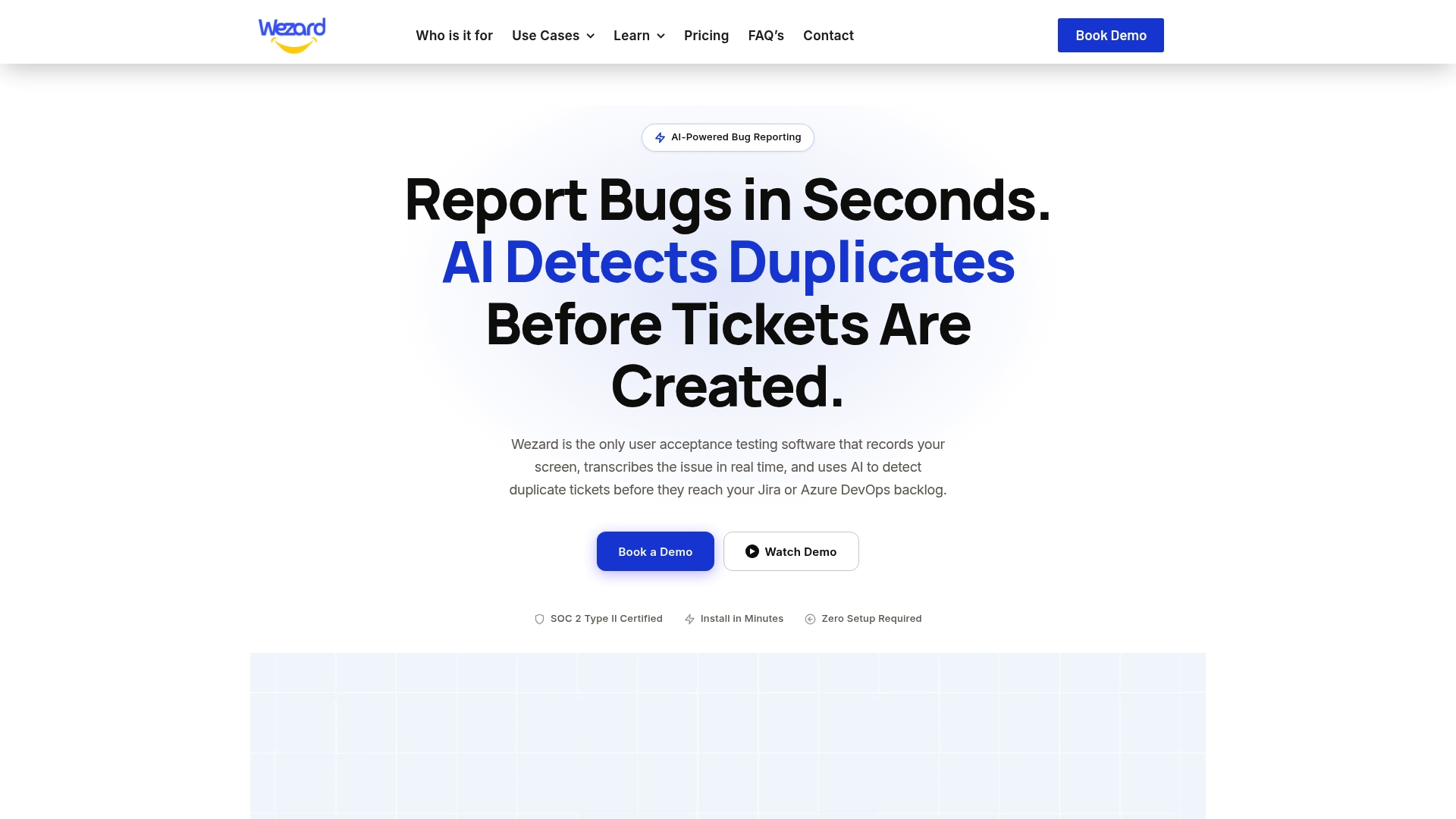
Wezardapp’s AI detects duplicate tickets before they reach your Jira or Azure DevOps backlog, which keeps triage clean and prevents the prioritization chaos that comes from redundant reports. Teams using Wezardapp can enforce formal entry and exit criteria as part of their UAT workflow, replacing spreadsheet chaos with a structured, auditable process. The result is faster releases, fewer production incidents, and a UAT cycle that actually measures business readiness. See how it works on the UAT bug tracking page.
FAQ
What is the most common UAT tester mistake?
Starting UAT too late is the most common mistake. Compressed timelines force rushed sign-offs and leave no time to address defects before release.
Why should business users run UAT instead of QA?
UAT is a business activity. Technical pass rates do not guarantee that the system meets real user needs, so business users must validate the workflows they own.
What makes a UAT defect report effective?
An effective defect report includes numbered steps to reproduce, environment details, expected outcome, and actual outcome with a screenshot or recording attached.
How do you avoid common UAT requirement gaps?
Define formal acceptance criteria before test case design begins. Walk business users and QA through each requirement together to catch interpretation gaps before testing starts.
When does a UAT pass confirm release readiness?
A UAT pass confirms release readiness only when it is accompanied by validated training materials, updated procedures, and a tested rollback plan.