
If you need a Jam.dev alternative right now, here are the top picks by persona:
- Developers who want fast, extension-based bug capture with console and network logs: Wezardapp (low migration effort) or BetterBugs.io (low migration effort).
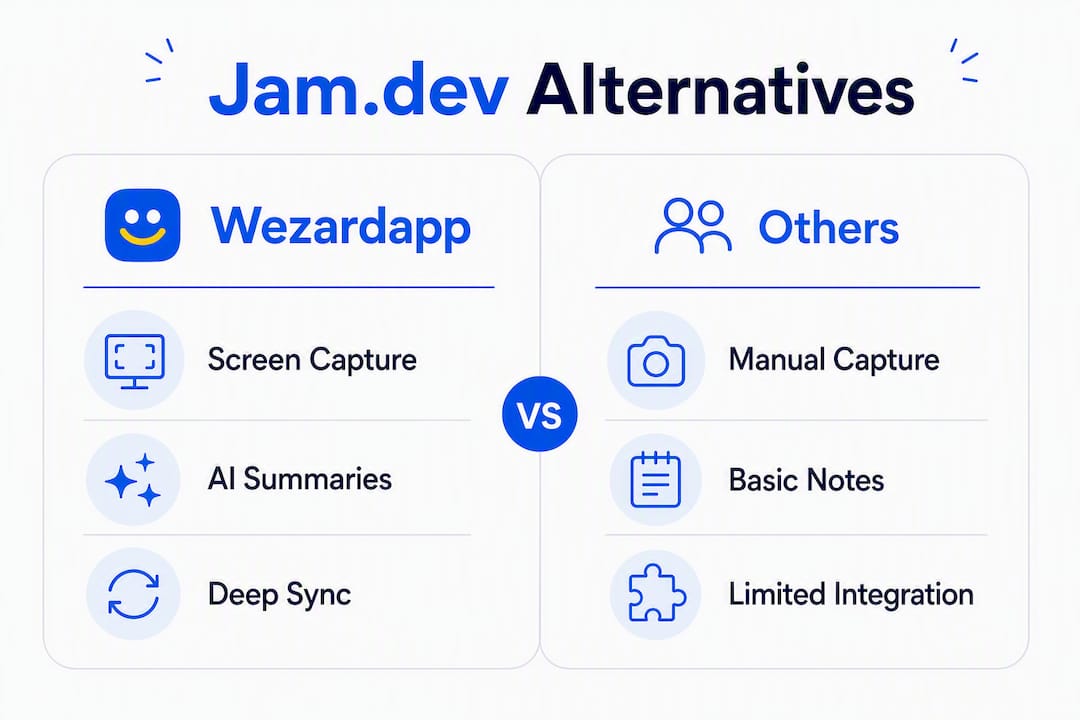
- QA and UAT teams running structured acceptance cycles with Jira or Azure DevOps: Wezardapp is the strongest fit, with real-time AI transcription, voice/video ticket creation, and automatic duplicate detection before anything hits your backlog (low-to-medium migration effort).
- Product managers and non-technical stakeholders who need polished, shareable reports: Userback or Marker.io (low migration effort for both).
- Teams with strict data residency requirements: Crikket (self-hostable, open-source; medium migration effort due to ops setup).
- Client-facing or enterprise feedback workflows: Usersnap (medium migration effort).
The single best pick for UAT-heavy teams is Wezardapp, because it is the only tool in this group that combines screen recording, real-time transcription, and AI duplicate detection in one UAT-focused workflow.
Table of Contents
- How do the top Jam.dev alternatives compare at a glance?
- What actually differs between these tools: capture, context, integrations, and pricing
- How to pick the right Jam.dev alternative for your team
- Why Wezardapp is the recommended pick for UAT-heavy teams
- What should you expect from customer support across these tools?
- How reliable are these tools under real workload?
- Which tools are easiest to set up and use day-to-day?
- Key Takeaways
- The tool switch most teams get wrong
- Wezardapp: built for teams that need clean backlogs, not just more screenshots
How do the top Jam.dev alternatives compare at a glance?
Pricing pages change frequently, so treat the tiers below as a starting point and verify current limits during your trial.
| Tool | Best For | Free Tier / Starting Price | Capture Modes | Auto-Captured Context | Integrations | Deployment | AI Features | Setup Ease |
|---|---|---|---|---|---|---|---|---|
| Wezardapp | UAT teams, enterprise QA | Paid plans (trial available) | Screenshot, screen recording, voice, video | Console logs, network, browser/device metadata | Jira, Azure DevOps, ServiceNow, Slack | Cloud SaaS | Real-time transcription, AI duplicate detection | Low |
| Userback | Product teams, client feedback | Free tier available | Screenshot, annotation, screen recording | Browser/device metadata | Jira, Azure DevOps, Slack | Cloud SaaS | AI summaries | Low |
| BetterBugs.io | Developers, QA engineers | Free tier available | Screenshot, annotation, screen recording | Console logs, network, browser/device metadata | Jira, GitHub, Slack | Cloud SaaS | AI-assisted reports | Low |
| Crikket | Data-residency-sensitive teams | Free (open-source) | Screenshot, one-click capture | Console logs, network requests | Custom / self-configured | Self-host (Docker/Vercel) | None listed | Medium |
| Usersnap | Enterprise, client-facing feedback | Paid plans; free trial | Screenshot, annotation, video | Browser/device metadata | Jira, Azure DevOps, Slack, Zendesk | Cloud SaaS | AI categorization | Low-medium |
| Marker.io | Agencies, visual QA | Paid plans; free trial | Screenshot, annotation, video | Browser/device metadata | Jira, GitHub, Asana, Slack | Cloud SaaS | None listed | Low |
Key differentiators at a glance:
- Wezardapp: The only tool here with real-time AI transcription and pre-backlog duplicate detection, purpose-built for UAT cycles.
- Userback: Clean UI, strong client-facing feedback flows, good for product teams managing external users.
- BetterBugs.io: Developer-friendly extension with solid auto-capture of console and network data; free tier is genuinely useful.
- Crikket: Open-source and self-hostable via Docker or Vercel, but you own the ops burden.
- Usersnap: Wide integration list, good for enterprise feedback programs, but pricing scales quickly.
- Marker.io: Polished visual annotation with strong agency workflows; lighter on raw developer context.
Statistic callout: Industry commentary consistently identifies capture model and reporter type as the two primary axes for tool fit when evaluating Jam.dev substitutes, ahead of pricing or integration count.
What actually differs between these tools: capture, context, integrations, and pricing
Capture models: extensions vs. SDKs vs. session replay
The right capture model depends on who files the report. Browser extensions work well for internal engineering teams because they require no site integration. SDKs and embedded widgets win when you need structured reports from QA testers, clients, or production users who cannot install anything.
- SDK/widget tools — (Wezardapp, Userback, Usersnap): embedded in the product, capture richer session context, better for UAT and client feedback.
For complex production issues, pairing a lightweight visual reporter with a session-replay or frontend monitoring tool gives you the network, performance, and timeline context needed for root-cause analysis. No single tool in this list fully replaces that combination for deep production debugging.
Auto-captured context: why it matters for root-cause analysis
Manual screenshots tell you what broke. Auto-captured console logs, network requests, and browser/device metadata tell you why. Wezardapp and BetterBugs.io both capture console and network data automatically. Userback and Marker.io capture browser and device metadata but rely more on the reporter to describe the technical context. Crikket captures console logs and network requests natively, which is strong for a free tool.

Pro Tip: Before committing to any tool, file five real bugs during the trial and check whether the ticket that lands in Jira contains enough context for a developer to reproduce the issue without follow-up questions. If it does not, the tool is not saving your team time.
Integration depth: Jira, Azure DevOps, ServiceNow, Slack
A long integrations list is less useful than deep two-way sync with rich field mapping. Wezardapp syncs directly with Jira, Azure DevOps, and ServiceNow, mapping fields and routing tickets automatically. Userback and BetterBugs.io cover Jira and Slack well. Marker.io integrates with Jira, GitHub, and Asana. Crikket’s integrations depend on your self-hosted configuration.

| Tool | Jira | Azure DevOps | ServiceNow | Slack |
|---|---|---|---|---|
| Wezardapp | ✓ Deep sync | ✓ Deep sync | ✓ | ✓ |
| Userback | ✓ | ✓ | — | ✓ |
| BetterBugs.io | ✓ | — | — | ✓ |
| Crikket | Custom | Custom | Custom | Custom |
| Usersnap | ✓ | ✓ | — | ✓ |
| Marker.io | ✓ | — | — | ✓ |
Deployment and pricing patterns
Free and open-source annotation tools cover the visual half of Jam.dev, but none fully replicate automatic console and network capture at unlimited scale. The practical breakdown:
- Free tiers with real utility: BetterBugs.io and Userback both offer free tiers that cover small teams.
- Open-source / self-host: Crikket is free to use but requires ops resources and ongoing maintenance.
- Paid SaaS: Wezardapp, Usersnap, and Marker.io operate on subscription models. Wezardapp offers a trial; verify current plan limits before purchase.
Free manual workflows using DevTools and GitHub Issues are low-cost but high-effort. Once a team grows past a handful of reporters, the time spent formatting and routing bugs manually outweighs the subscription cost of an automated tool.
How to pick the right Jam.dev alternative for your team
Decision checklist by persona
Developers:
- Does the tool capture console logs and network requests automatically?
- Does it integrate with your existing issue tracker (Jira, GitHub, Azure DevOps) without manual copy-paste?
- Is the browser extension reliable across Chrome, Firefox, and Edge?
- Does it support CI pipeline hooks or API access?
QA and UAT teams:
- Can non-technical testers file a complete, reproducible bug report without training?
- Does the tool detect and suppress duplicate tickets before they reach the backlog?
- Does it support voice or video-based reporting for faster UAT cycles?
- Is there a guided submission flow that enforces required fields?
Product managers:
- Can the tool produce polished, shareable reports for stakeholders who do not read stack traces?
- Does it support feedback categorization and status tracking?
- Does it integrate with your roadmap or project management tool?
Vendor questions to ask during evaluation
- What is the data retention policy, and can you export historical reports?
- What is the SLA for uptime, and is there a public status page?
- Does the mobile SDK support both iOS and Android, and what are the session length limits?
- Is SOC 2 Type II certification available, and where is data stored?
- What happens to in-flight sessions if the extension or SDK loses connectivity?
Migration checklist: switching from Jam.dev
- Run a small pilot with two to three real testers on a non-critical project for one sprint.
- Map your current web and mobile flows to confirm the new tool’s capture model covers them.
- Integrate with one test project in Jira or Azure DevOps before migrating the full backlog.
- Export historical Jam.dev reports and store them in your issue tracker or a shared drive.
- Train stakeholders on the new submission flow, especially non-technical reporters.
- Validate mobile capture on both iOS and Android before declaring the migration complete.
Red flags to watch for during trial:
- Console and network logs are missing from submitted tickets.
- No direct sync to your backlog (copy-paste required).
- Mobile capture is broken or requires a separate app.
- Duplicate tickets pile up with no detection or suppression.
- Support takes more than 24 hours to respond during the trial period.
Why Wezardapp is the recommended pick for UAT-heavy teams
Most bug reporters solve the capture problem. Wezardapp solves the backlog noise problem, which is what actually slows UAT cycles down.
Core strengths:
- AI duplicate detection: — before a ticket reaches Jira or Azure DevOps, Wezardapp checks for existing duplicates and flags or suppresses them. During a UAT cycle with dozens of testers, this alone can cut backlog triage time significantly.
- Direct backlog integration: one-click sync to Jira and Azure DevOps, with field mapping that keeps tickets clean.
A typical UAT workflow with Wezardapp
A UAT tester encounters a payment flow bug. They click the Wezardapp widget, record a short video while narrating the issue, and submit. Wezardapp transcribes the narration, attaches the screen recording, captures browser and device metadata, and checks the existing backlog for duplicates. If a matching ticket exists, it flags the duplicate and links the new evidence to the original. If it is new, a clean, structured ticket appears in Jira within seconds, assigned to the right team, with all required fields populated.
AI duplicate detection is the feature most teams underestimate. A 30-person UAT cycle on a complex enterprise application can generate dozens of overlapping reports for the same three or four root causes. Without duplicate suppression, your developers spend the first day of a sprint triaging noise instead of fixing bugs. Wezardapp catches that before it happens.
Industry commentary confirms that AI summarization and auto-drafting of reproducible steps are increasingly decisive features when non-technical stakeholders must file useful reports. Wezardapp’s real-time transcription is the most direct implementation of that capability in this comparison.
Pro Tip: For enterprise teams evaluating Wezardapp, ask for a live demo that shows the full UAT workflow: tester submits a voice report, AI detects a duplicate, and the clean ticket lands in your Jira project. That 10-minute demo answers more questions than any feature list.
What should you expect from customer support across these tools?
Support quality varies more than feature lists suggest. Wezardapp offers dedicated support for enterprise accounts, with direct access during onboarding and integration setup. Userback and Usersnap both have documented support channels including live chat and email, with response times that reviewers generally rate as responsive for paid tiers. BetterBugs.io leans on community and documentation for its free tier, with faster support on paid plans.
Crikket, being open-source, relies on community forums and GitHub issues. If your team hits a deployment problem at 11 PM before a release, that is a real constraint. Self-hosted tools shift support responsibility to your own ops team, which is worth factoring into the total cost of ownership.
For enterprise buyers, ask specifically about SLA commitments in writing. A vendor that cannot produce a documented uptime SLA during the sales process is unlikely to prioritize it after you sign.
How reliable are these tools under real workload?
Cloud SaaS tools in this category (Wezardapp, Userback, Usersnap, BetterBugs.io, Marker.io) generally maintain high availability, but the details matter. Check whether the vendor publishes a public status page before committing. Wezardapp and Usersnap both target enterprise-grade reliability with documented uptime commitments.
Recording reliability and cross-browser extension behavior are recurring evaluation criteria when teams compare Jam.dev substitutes. An extension that fails silently on Firefox or drops recordings on slow connections is a support ticket waiting to happen. During your trial, test capture on every browser your team uses, not just Chrome.
For Crikket, uptime is entirely your responsibility. Docker and Vercel deployments are straightforward, but you need a monitoring setup and a plan for updates.
Which tools are easiest to set up and use day-to-day?
Ease of use splits along the same lines as capture model. Extension-based tools (BetterBugs.io, Marker.io) are the fastest to deploy: install the extension, connect your Jira project, and you are capturing bugs in under 10 minutes. SDK/widget tools require a short integration step, but the payoff is a smoother experience for non-technical reporters.
Wezardapp’s onboarding is designed for QA managers and product teams, not just developers. The guided submission flow means a business analyst or UAT tester can file a complete bug report on day one without training. That matters when your reporter pool includes people who have never opened a browser console.
Usersnap has a polished interface and good documentation, but its configuration options can slow initial setup for teams that want everything customized before going live. Marker.io is the cleanest visual experience in the group, particularly for agencies doing client-facing QA.
Key Takeaways
Wezardapp is the strongest Jam.dev alternative for UAT-heavy teams because it combines screen recording, real-time AI transcription, and pre-backlog duplicate detection in a single workflow that non-technical testers can use on day one.
| Point | Details |
|---|---|
| Match tool to reporter type | Extension-first tools fit internal dev teams; SDK/widget tools fit UAT testers and non-technical stakeholders. |
| Auto-captured context is non-negotiable | A ticket without console logs and network data forces a follow-up conversation; verify this during your trial. |
| Deep integration beats a long list | Two-way Jira or Azure DevOps sync with field mapping reduces triage time more than a dozen shallow connectors. |
| Self-hosting has a real ops cost | Crikket is free and powerful, but your team owns deployment, updates, and support. |
| Wezardapp for UAT cycles | AI duplicate detection and real-time transcription make Wezardapp the recommended pick for enterprise UAT and backlog hygiene. |
The tool switch most teams get wrong
The most common mistake when switching bug-reporting tools is treating it as a technical migration rather than a behavioral one. You can connect a new tool to Jira in 20 minutes. Getting 30 UAT testers to file reports that are actually useful takes longer, and that gap is where most tool switches quietly fail.
The second mistake is choosing a tool based on the developer experience and ignoring the reporter experience. A developer can work around a clunky interface. A business analyst who encounters friction on the first report will revert to emailing screenshots, and you will never get the structured data you need.
The third thing teams underestimate is duplicate noise. In a large UAT cycle, the same three bugs can generate 40 tickets from different testers describing the same symptom from different angles. Without AI duplicate detection, your developers spend their first sprint day sorting that pile instead of fixing anything. That is the specific problem Wezardapp was built to solve, and it is the reason it sits at the top of this list for UAT-heavy teams rather than tools with longer feature lists.
A final warning: retention policies are rarely discussed during sales calls. Ask every vendor how long session recordings and report data are retained on their servers, and what happens to your data if you cancel. Some tools delete everything within 30 days of churn. That matters if you need historical UAT records for compliance or audit purposes.
Wezardapp: built for teams that need clean backlogs, not just more screenshots
Every tool in this comparison captures bugs. The difference is what happens after the capture. Wezardapp is purpose-built for UAT cycles where non-technical testers file dozens of reports per sprint and duplicate noise is the real bottleneck. Real-time transcription means testers narrate the issue instead of writing it. AI duplicate detection means your developers open Jira and see clean, actionable tickets instead of 40 variations of the same payment bug.

For QA managers and product teams running structured acceptance testing, Wezardapp connects directly to Jira and Azure DevOps with full field mapping, supports enterprise SSO and security requirements, and works for both technical and non-technical reporters from day one. If you are evaluating UAT testing tools and want to see the AI duplicate detection and voice reporting in a live workflow, request a demo at wezardapp.com and ask specifically to see the UAT cycle from tester submission to clean Jira ticket.
Useful sources and vendor docs
The following sources informed this comparison. Verify all pricing and plan limits directly with each vendor before purchase. Last verified: July 2026.
- Top 5 Jam.dev Alternatives in 2026 | Medium (Selim Enes)
- Is Jam.dev Still the Best Bug Reporting Tool? 6 Alternatives We Tested | ngram.com
- Wezardapp UAT Testing Feedback Tool
- Wezardapp Jira Integration Docs
- Wezardapp Azure DevOps Integration Docs


