
AI in bug detection is the use of machine learning and large language models to automatically find, classify, and predict software bugs before they reach production. The industry term for this practice is “AI-augmented static and dynamic analysis.” It goes far beyond traditional linting, which only catches syntax errors and style violations. AI systems analyze code semantically, spotting logic flaws, security vulnerabilities, and behavioral anomalies that rule-based tools miss entirely. Meta reported a 4x increase in bug detection efficiency using Just-in-Time AI testing, and 81% of development teams now use AI in testing workflows. Wezardapp applies this same intelligence to user acceptance testing, detecting duplicate tickets before they pollute your Jira or Azure DevOps backlog.
What is AI in bug detection, and why does it matter?
AI in bug detection replaces static rule sets with models that learn from millions of code patterns. Traditional linting tools check whether your code follows a fixed set of rules. AI tools ask a different question: does this code behave the way it should?
AI-powered tools catch 30–50% more bugs pre-production than traditional linting. That gap exists because AI can reason about intent, not just syntax. A linter flags a missing semicolon. An AI model flags a race condition buried in an async callback that only triggers under specific load conditions.

The cost argument is equally compelling. Fixing a bug during development costs about 1 hour, but the same bug costs 15–30x more in production due to incident response and customer impact. Catching defects earlier is not just a quality win. It is a direct financial decision.
AI in software testing also changes the economics of test coverage. Manual testing scales linearly with headcount. AI-generated test cases scale with compute, which means your team can cover more edge cases without hiring more engineers.
How does AI improve bug detection compared to traditional methods?
The core advantage of AI over traditional methods is pattern recognition at scale. Rule-based tools apply the same check to every line of code. Machine learning models build a probabilistic model of correct behavior and flag deviations from it.
Here is what that difference produces in practice:
- Semantic bug detection: AI identifies when code does the wrong thing logically, even if it compiles and passes syntax checks.
- Security vulnerability scanning: Models trained on CVE databases recognize patterns that precede common exploits, such as SQL injection setups or buffer overflow conditions.
- Logic flaw discovery: AI can trace execution paths across multiple functions to find bugs that only appear when two distant code sections interact.
- Duplicate ticket filtering: Tools like Wezardapp use AI to detect when a newly reported bug matches an existing ticket, preventing backlog noise before it starts.
Integrating AI in testing workflows increases defect discovery by over 20% compared to teams using only manual review and linting. That number compounds over a release cycle. More bugs caught early means fewer critical incidents post-deployment.
Pro Tip: Use AI bug detection as your first pass, not your only pass. AI excels at surface area coverage. Your senior engineers excel at interpreting what a flagged pattern means in your specific business context. Combine both.
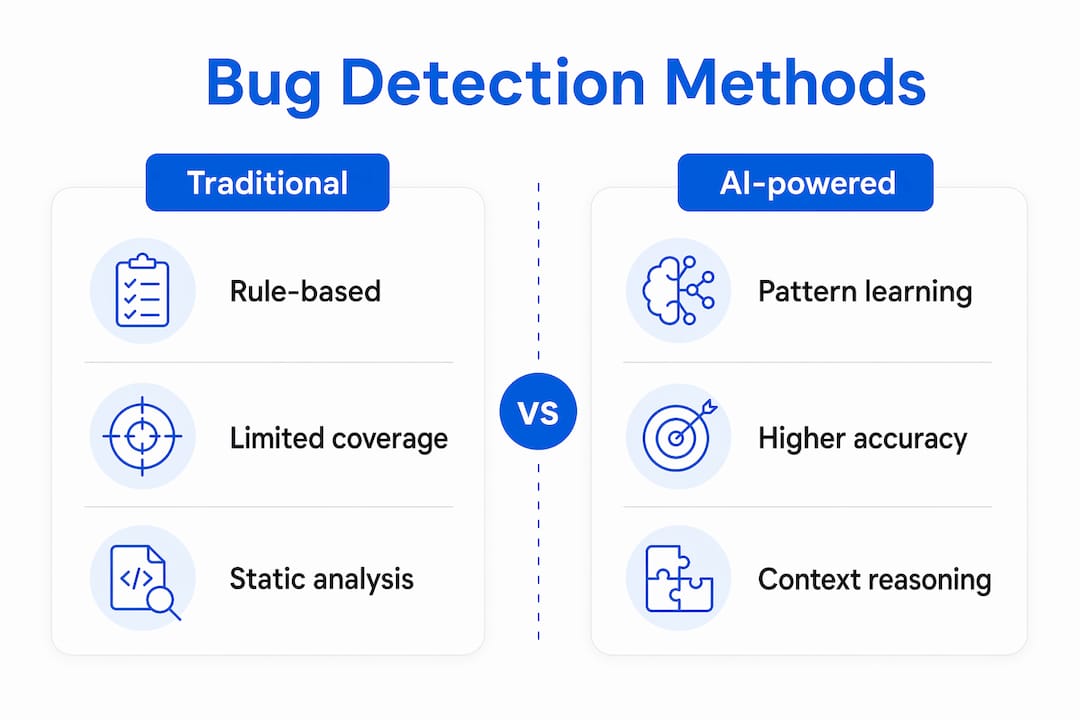
The benefits of AI in bug analysis extend beyond raw defect counts. AI tools generate explanations alongside findings, which accelerates triage. A developer reviewing an AI-flagged issue sees not just “this is broken” but “this is broken because X calls Y before Z is initialized.” That context cuts resolution time significantly.
What AI techniques and technologies power modern bug detection?
Several distinct techniques drive AI bug finding, and they serve different purposes in the testing pipeline.
| Technique | Purpose | Accuracy profile | Best use case |
|---|---|---|---|
| LLM-based static analysis | Semantic and logic bug discovery | High precision, context-aware | Code review, PR scanning |
| ML pattern matching | Recurring bug classification | High recall on known patterns | Large codebases, kernel-level code |
| AI test generation | Edge case coverage | ~72.5% valid test cases | Unit and integration test authoring |
| Debunker agents | False positive reduction | Eliminates negated bugs | Security auditing, logic flaw hunting |
| Adversarial agents | Deep vulnerability discovery | Finds multi-step logic flaws | Security-critical systems |
IBM’s BUGSTONE framework demonstrates what LLMs can do at scale. BUGSTONE identified over 22,000 potential Linux kernel bugs with 92.2% precision and 79.1% accuracy in recurring pattern detection. A manual audit confirmed 246 valid critical bugs from a sample. That is a volume no human team could process in the same timeframe.
The Model Context Protocol (MCP) standard connects AI agents directly to testing tools and IDEs. MCP allows an AI agent to generate a test, run it, interpret the result, and suggest a fix, all within your existing development environment. That integration removes the friction of switching between tools and dramatically lowers the barrier to daily AI use.
Debunker agents represent one of the more sophisticated advances in the field. Canonical’s Redhound agent uses iterative attack hypotheses and debunker agents to filter false positives by independently searching for runtime guards that would negate a supposed bug. Logic flaws discovered by Redhound had survived years of manual review. The debunker architecture is why modern AI tools report far fewer false positives than first-generation static analyzers.
There is also a meaningful distinction between autonomy levels. Assistive copilots suggest findings and wait for a human decision. Autonomous agents act on findings and then present results for human review. The right choice depends on your team’s risk tolerance and the criticality of the codebase.
Pro Tip: Start with an assistive copilot in your IDE before deploying autonomous agents in CI. The copilot phase teaches your team how to interpret AI findings, which makes the autonomous phase far more productive.
What challenges and nuances shape AI bug detection’s effectiveness?
AI bug detection is not a solved problem. Several real limitations affect how teams should deploy and trust these tools.
- False positives still occur: First-generation tools produced so many false positives that developers learned to ignore them. Modern agentic systems use self-validation to reduce this, but no tool reaches zero false positives.
- Training data dependency: A model trained on general open-source code may miss domain-specific bugs in financial, medical, or embedded systems code. Context gaps produce blind spots.
- Brittle test maintenance: QA teams spend 60–80% of their effort maintaining brittle test scripts. AI’s real value often lies in stabilizing those scripts, not just finding new bugs.
- AI-generated test assertions: AI-generated test cases carry approximately 72.5% validity, meaning roughly one in four generated assertions needs correction. Shipping unreviewed AI tests risks locking in false behaviors.
- Governance gaps: Autonomous agents that push fixes without review can introduce regressions. Human review gates are not optional in production pipelines.
“Mozilla researchers highlight that new AI tools implement self-validation to reduce false positives by independently vetting bug reports. Previous generation tools had high false positives, but agentic systems have changed that — increasing reliability for production use.”
Mozilla research via TechCrunch
The human review requirement is not a weakness of AI. It reflects the correct mental model: AI is a first draft, not a final authority. A skilled QA engineer reading an AI-flagged logic flaw brings business context, user behavior knowledge, and system architecture understanding that no model currently replicates. The combination of AI coverage and human judgment outperforms either alone.
How to integrate AI bug detection into software development and QA workflows?
Effective integration follows a progression from low-risk assistive tools to higher-autonomy agents. Jumping straight to fully autonomous agents without building team familiarity first is the most common adoption mistake.
Follow these steps to build a reliable AI-augmented testing pipeline:
- Install an IDE plugin. Start with an AI-powered code analysis plugin in your development environment. This gives developers real-time feedback during coding, before any code reaches review.
- Add AI to pull request review. Configure your CI pipeline to run AI static analysis on every pull request. Flag findings as comments, not blockers, while your team calibrates trust.
- Automate test generation for new code. Use AI to generate unit test scaffolding for new functions. Review and edit the generated assertions before committing them.
- Deploy flaky test detection. Run AI analysis on your existing test suite to identify tests that fail intermittently. Stabilizing these tests recovers significant CI pipeline time.
- Implement root-cause analysis on failures. Use AI to analyze CI failure logs and suggest probable causes. This cuts the time developers spend reading stack traces.
- Add duplicate bug detection at the reporting layer. Tools like Wezardapp detect duplicate tickets at the moment of submission, keeping your backlog clean before triage even begins. Explore Wezardapp’s use cases to see how this works across different team structures.
- Establish human review gates. Define which AI actions require human approval before merging or closing. Autonomous agents should propose, not finalize, in most production contexts.
The MCP standard enables AI agents to interact directly with codebases and testing infrastructure in context, which makes steps 4 and 5 significantly easier to implement. Teams using MCP-compatible tools report that AI can generate, run, heal, and explain tests within a single workflow.
For teams transitioning from manual QA to AI-assisted testing, the key is incremental adoption. Each step above builds the team’s ability to interpret and trust AI output before expanding its autonomy.
Pro Tip: Track the ratio of AI-flagged bugs confirmed versus dismissed by your team each sprint. A confirmation rate below 50% signals a calibration problem with your tool or its configuration, not a reason to abandon AI testing altogether.
Key Takeaways
AI in bug detection delivers its highest value when teams combine broad AI coverage with disciplined human review at defined checkpoints.
| Point | Details |
|---|---|
| AI catches more bugs earlier | AI tools find 30–50% more pre-production bugs than traditional linting, at a fraction of the fix cost. |
| LLMs operate at massive scale | IBM’s BUGSTONE identified 22,000+ Linux kernel bugs at 92.2% precision, confirming 246 critical issues. |
| Debunker agents reduce noise | Adversarial and debunker agent architectures filter false positives before findings reach developers. |
| Test maintenance is the hidden win | AI stabilizes brittle test suites, recovering the 60–80% of QA effort spent on script maintenance. |
| Human review gates are non-negotiable | AI-generated test cases carry ~72.5% validity, making expert review a required step, not an optional one. |
The part of AI testing most teams get wrong
The conversation around AI in bug detection focuses almost entirely on defect counts. Teams ask: how many more bugs will AI find? That is the wrong first question.
The more important question is: how much time is your team losing to test maintenance, duplicate tickets, and false positive triage? In my experience working with QA teams, the answer is almost always “more than we realize.” AI’s biggest return comes from reclaiming that time, not from adding more items to an already overloaded backlog.
The teams that get the most from AI testing are not the ones who deployed the most powerful autonomous agent. They are the ones who identified their biggest friction point, whether that was brittle tests, duplicate bug reports, or slow root-cause analysis, and applied AI precisely there. Broad deployment without a specific problem to solve produces noise, not signal.
The future of AI in this space points toward self-healing tests and logic flaw detection that reasons across entire system architectures. Those capabilities are emerging now. But the teams best positioned to use them are the ones who have already built the discipline of human-AI collaboration at the workflow level. Start there.
— Marketing
Wezardapp and AI-powered bug reporting
AI bug detection does not stop at the code level. The reporting layer matters just as much. When testers submit duplicate bugs, your backlog fills with noise that slows down every sprint.
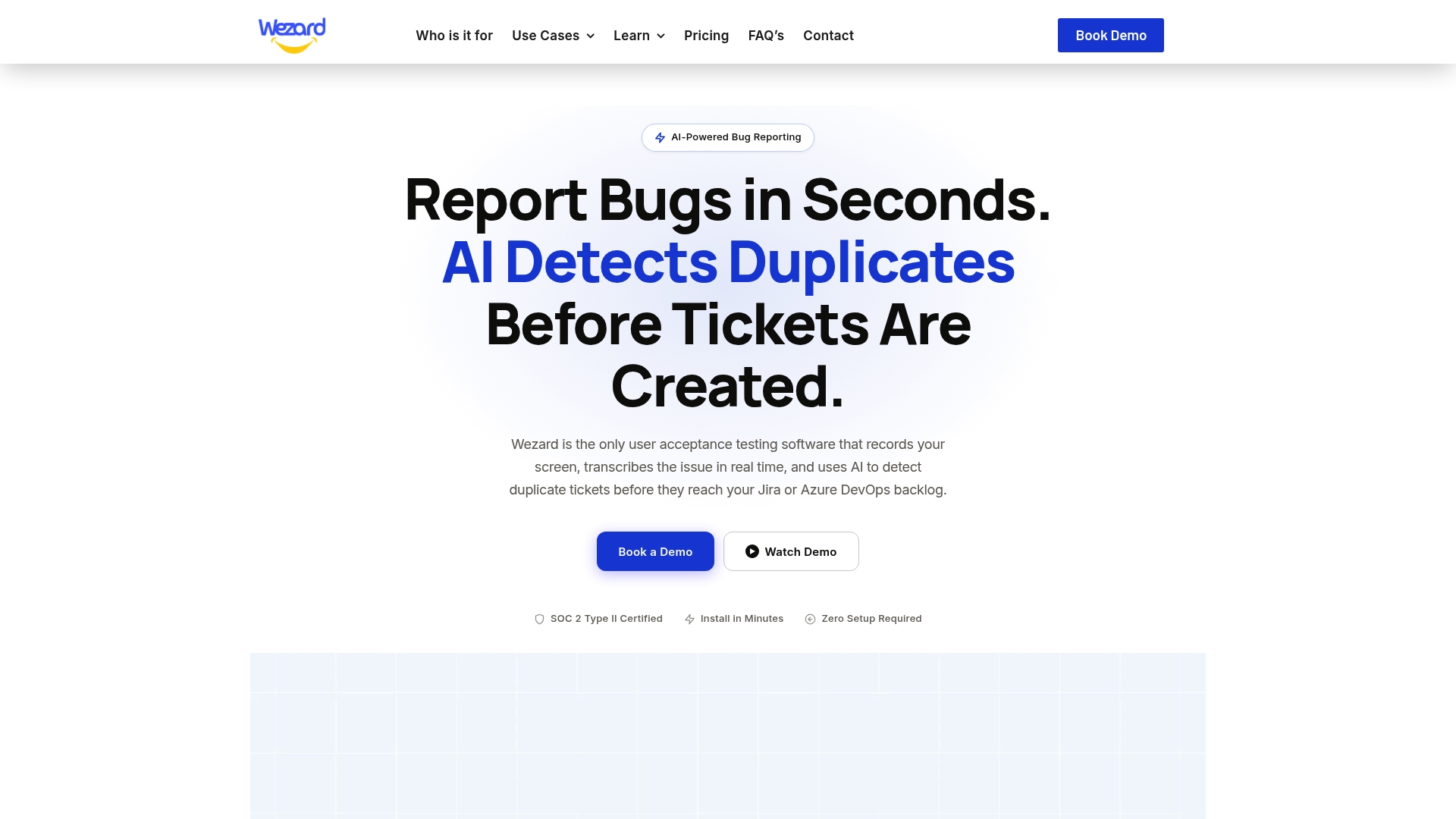
Wezardapp is the only user acceptance testing tool that records your screen, transcribes the issue in real time, and uses AI to detect duplicate tickets before they reach your Jira or Azure DevOps backlog. That means your developers spend time fixing real bugs, not sorting through redundant reports. The AI bug tracking system automates ticket creation and syncing with a single click. For teams looking to sharpen their UAT process alongside AI detection, the guide on UAT test case writing covers the practices that make AI-assisted reporting most effective.
FAQ
What is AI in bug detection?
AI in bug detection is the use of machine learning models and large language models to automatically identify, classify, and predict software defects before they reach production. It goes beyond syntax checking to detect semantic errors, logic flaws, and security vulnerabilities.
How does AI improve bug detection over traditional tools?
AI tools catch 30–50% more pre-production bugs than traditional linting by analyzing code behavior and intent, not just syntax rules. They also generate explanations alongside findings, which accelerates developer triage.
What AI techniques are used in modern bug detection?
The main techniques include LLM-based static analysis, ML pattern matching, AI test generation, and adversarial debunker agents. Each serves a different phase of the testing pipeline, from code review to security auditing.
Are AI-generated test cases reliable?
AI-generated test cases carry approximately 72.5% validity, meaning all generated assertions require human review before committing. AI accelerates test authoring but does not replace expert judgment on what the correct behavior should be.
How do I start integrating AI bug detection into my workflow?
Begin with an AI-powered IDE plugin for real-time feedback, then add AI analysis to pull request review in your CI pipeline. Build team familiarity with assistive tools before deploying autonomous agents in production workflows.