
Duplicate bug reports are defined as two or more independent submissions describing the same underlying software defect, filed without cross-checking existing tickets. They are one of the most persistent quality problems in software development. Between 12% and 25% of all bug reports in large projects are duplicates. That figure means a quarter of your team’s triage time may go toward issues already logged. The causes split cleanly into two categories: human behavior and system limitations. Both are fixable, but only if you understand what drives them.
Why duplicate bug reports exist: the core causes
Duplicate issue reports emerge from a gap between how people experience bugs and how bug tracking systems organize them. A user who sees their app freeze does not think “memory leak.” They think “the app crashed.” Another user on a different device thinks “the app is slow.” A third user on a different platform writes “the app keeps stopping.” All three describe the same underlying defect, filed three separate times with three different titles. No keyword search catches all three. This is the root of the duplicate problem.
The industry term for managing this is duplicate detection, and it sits at the intersection of natural language processing (NLP), triage workflow, and team culture. Understanding why bugs are reported twice, or ten times, is the first step toward building a system that handles it well.

What human factors contribute to duplicate bug reports?
Human behavior drives the majority of duplicate submissions. Three patterns repeat across every project type.
- Symptom-based reporting. Users describe what they see, not what caused it. A memory leak gets reported as a crash, a freeze, or lag, each with different wording. Keyword searches miss the connection entirely.
- No pre-report search. User motivation favors quick reporting over thorough duplicate searching. Expecting users to search before submitting is unrealistic. Frustration drives immediacy, not diligence.
- Multiple contexts, same bug. One bug can surface differently on iOS versus Android, in a free tier versus a paid tier, or during onboarding versus daily use. Each reporter genuinely believes their experience is unique.
- Social amplification. When a bug surfaces in a Discord server or public forum, dozens of users see it and file their own reports. The community discussion that should reduce duplicates often multiplies them.
The right response to this pattern is not stricter submission rules. Stricter rules reduce reporting volume and kill contributor morale. The goal is to keep the barrier low and catch duplicates on the backend.
Pro Tip: Never add friction to the reporting process to reduce duplicates. Every extra step you require costs you real bug reports from real users. Fix the detection layer, not the submission layer.
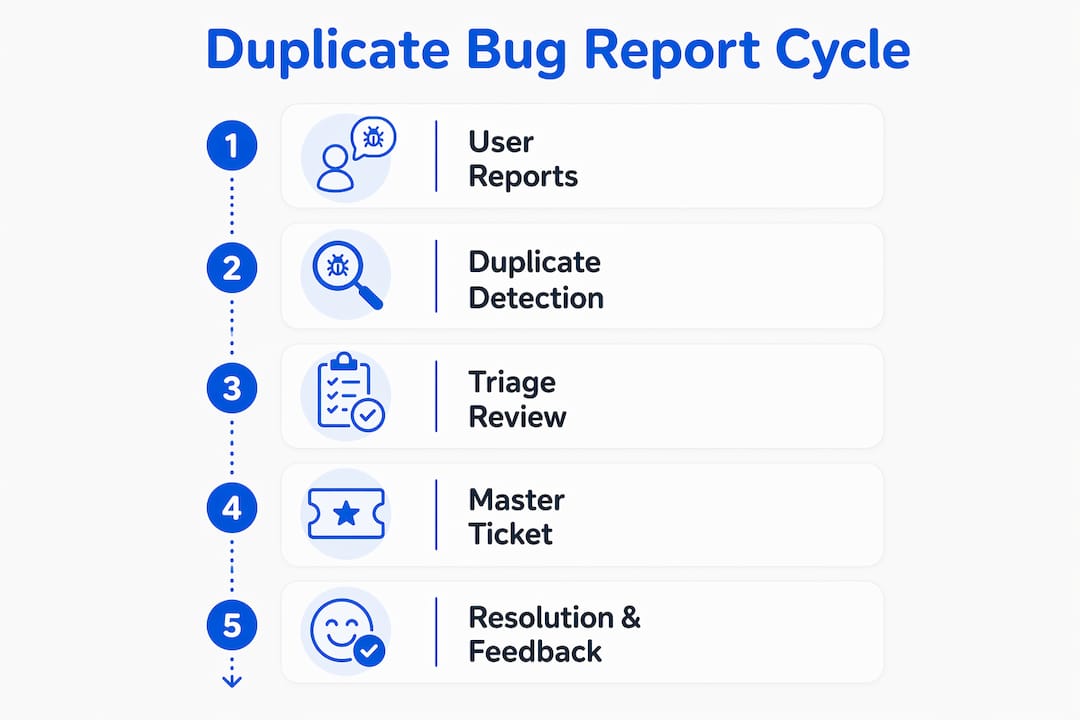
How do technical and system limitations cause duplicate bug reports?
System architecture creates its own category of duplicate reporting problems. Even well-intentioned teams hit these walls.
- Keyword-based detection fails at scale. Traditional search matches exact or near-exact strings. Bug descriptions use diverse, unstructured language, so keyword matching misses semantic equivalents. “App won’t open” and “launch failure on startup” describe the same issue but share no keywords.
- Multi-platform aggregation gaps. Teams collecting reports from email, Slack, in-app forms, and public trackers rarely consolidate them in real time. The same bug filed across three channels creates three separate tickets before anyone notices.
- Missing metadata. Reports without device type, OS version, or reproduction steps are nearly impossible to match against existing tickets. Incomplete reports look unique even when they are not.
- Automated deduplication errors. Aggressive automated systems can create circular duplicate chains where Report A marks Report B as a duplicate, Report B marks Report C as a duplicate, and Report C marks Report A as a duplicate. The original issue becomes invisible.
Closing or deleting duplicate reports destroys diagnostic value. Each submission may contain a unique environment, a different reproduction path, or a screenshot that the master ticket lacks. The correct action is to link duplicates to a master ticket, not remove them.
Linking duplicates to a master ticket preserves context, environment data, and reproduction steps that are critical for diagnosing root causes. A bug that appears on three different devices with three different stack traces is far easier to fix than one with a single data point.
What are the implications and hidden benefits of duplicate bug reports?
Duplicate reports carry a reputation as pure noise. That view misses half the picture.
Duplicate reports function as a voting system. The more reports a bug generates, the more users it affects. That frequency is a direct signal for prioritization. A bug filed 40 times is almost always more urgent than one filed twice, regardless of how either was categorized at intake.
The costs are real. Duplicate issue reports increase triage workload, slow resolution cycles, and frustrate the engineers who must sort through them. A project manager reviewing 200 tickets, where 50 are duplicates, loses hours that could go toward shipping fixes.
The benefits are also real. Not all duplicates are negative. A second report on the same bug sometimes includes a reproduction path the first reporter missed. A third report might show the bug appearing on a device type not previously documented. Experts recommend treating duplicates as opportunities to sharpen severity assessments, not as administrative failures.
The morale dimension matters too. When contributors file a report and receive an immediate “duplicate” closure with no acknowledgment, they often stop reporting. A response that links their report to the master ticket and thanks them for the additional context keeps the community engaged and reporting.
What modern methods reduce and manage duplicate bug reports?
The most effective approach combines machine learning, structured workflow, and realistic expectations about user behavior.
Machine learning and NLP detection
Automated systems using LSTM-CNN architectures with semantic metadata achieve a 92.53% F1-score in detecting duplicates. That is a meaningful leap over manual triage. TF-IDF combined with cosine similarity enables automated confidence levels, reducing human error and bottlenecks at the triage stage. Semantic vector matching compares the meaning of reports rather than their exact words, catching the “crash vs. freeze vs. lag” problem that keyword search cannot solve.
Crash fingerprinting and known issues boards
Crash fingerprinting from stack traces allows automatic grouping of 60–80% of reports accurately. A public-facing known issues board reduces duplicate submissions by over 50%. Both methods address the problem before it reaches the backlog. When users can see that their bug is already logged and being worked on, they do not file a second report.
Workflow practices that work
The comparison below shows how different approaches perform across key management criteria.
| Approach | Detection method | Duplicate handling | Backlog impact |
|---|---|---|---|
| Manual triage only | Keyword search | Close or delete | High noise, slow resolution |
| Automated keyword matching | String similarity | Auto-close | Circular chains, missed bugs |
| Semantic NLP with confidence scoring | Vector similarity | Link to master ticket | Clean backlog, preserved context |
| AI with human review layer | Hybrid NLP + human | Merge and link | Lowest noise, highest accuracy |
The hybrid model, AI detection with a human review layer, produces the best outcomes. AI tools are valuable but overuse without oversight floods channels with misclassified reports. Linus Torvalds has specifically flagged this risk, noting that human oversight remains essential alongside AI in bug report handling.
Pro Tip: Set a confidence threshold for automated duplicate marking. Reports below 85% confidence should route to a human reviewer, not auto-close. This prevents the circular chain problem and keeps your backlog trustworthy.
Wezardapp addresses this directly. It records the screen, transcribes the issue in real time, and uses AI to detect duplicate tickets before they reach your Jira or Azure DevOps backlog. The detection runs at submission, not after the ticket is already logged.
Key Takeaways
Duplicate bug reports are inevitable in any project with multiple reporters, but the right detection and workflow choices keep them from degrading your backlog or your team’s time.
| Point | Details |
|---|---|
| Duplicates are common | Between 12% and 25% of bug reports in large projects are duplicates, making detection a core workflow need. |
| Human behavior drives most duplicates | Users report symptoms, not causes, and rarely search before submitting. Backend detection must compensate. |
| Link, never delete | Preserving duplicates linked to a master ticket retains environment data and reproduction steps critical for fixing bugs. |
| Semantic NLP outperforms keywords | LSTM-CNN systems with semantic metadata reach 92.53% F1-score, far exceeding manual or keyword-based triage. |
| Duplicates signal priority | High duplicate volume on a single bug indicates broad user impact and should raise its fix priority. |
The uncomfortable truth about duplicate bugs in development teams
The standard advice on duplicates is to prevent them. Build better search, add a “check for duplicates” prompt, train your testers. That advice is not wrong, but it targets the wrong layer.
The teams I have seen handle duplicates best are the ones that stopped fighting user behavior and started engineering around it. They accepted that a frustrated user will not search the tracker before filing. They accepted that a tester on a deadline will not cross-reference every ticket. Then they built detection systems that made those behaviors irrelevant.
What actually separates high-performing teams is not zero duplicates. It is a clear policy on what to do when duplicates appear. Link them. Extract the unique data. Update the master ticket’s severity if the new report adds evidence. Then close the duplicate with a note that shows the reporter their contribution mattered.
The teams that delete duplicates silently are the ones that lose contributors. The teams that link and acknowledge are the ones that build reporting cultures where bugs get found early and fixed fast. That cultural layer is something no algorithm replaces. AI handles the detection. Humans handle the response. Both are necessary.
— Marketing
Wezardapp catches duplicates before they reach your backlog
Duplicate tickets slow every team down, but most tools catch them after the damage is done.

Wezardapp works differently. It records your screen during UAT testing, transcribes the issue in real time, and runs AI duplicate detection before the ticket ever hits your Jira or Azure DevOps backlog. Teams get a clean, deduplicated issue list without adding steps for reporters. If you want to sharpen your overall testing process, the guide on acceptance testing criteria covers the upstream decisions that reduce noise at the source. Fewer duplicates, faster triage, and a backlog your team can actually trust.
FAQ
Why do duplicate bug reports exist in software projects?
Duplicate bug reports exist because multiple users or testers independently encounter the same defect and file separate tickets without checking existing reports. Human behavior, varied terminology, and weak backend detection all contribute.
What percentage of bug reports are duplicates?
Between 12% and 25% of all bug reports in large software projects are duplicates. That rate makes automated detection a practical necessity, not an optional upgrade.
Should duplicate bug reports be deleted or kept?
Duplicate reports should be linked to a master ticket, not deleted. Each duplicate may contain unique environment data, reproduction steps, or screenshots that help diagnose the root cause faster.
How does AI improve duplicate bug report detection?
Machine learning systems using LSTM-CNN architectures with semantic metadata reach a 92.53% F1-score in detecting duplicates. Semantic vector matching catches reports that describe the same bug with completely different words, which keyword search misses.
How can teams reduce duplicate bug reports without discouraging reporters?
Teams should keep reporting barriers low and invest in backend detection instead. A public known issues board can cut duplicate submissions by over 50%, and automated semantic matching handles the rest without adding steps for the reporter.


