
SSO for testing tools means your team logs into a UAT platform using the credentials your identity provider already manages, instead of a separate username and password. The one requirement that matters more than any feature checklist: the tool must support SAML 2.0 or OIDC, and you need a plan for provisioning, ideally through SCIM 2.0, so accounts don’t linger after someone leaves. Wezard’s UAT testing platform supports enterprise SSO, which puts it in the category of vendors worth shortlisting on this basis alone.
TL;DR:
- Support for both SAML 2.0 and OIDC is essential, with validation of bindings (POST, redirect) and environment compatibility influencing protocol choice.
- SCIM 2.0 provisioning must include account deactivation, group syncing, and support for standard authentication methods to prevent lingering access after employee departure.
- Key security measures include signing assertions, encrypting data for sensitive environments, enforcing MFA policies at the IdP level, and actively monitoring certificate expiration.
- Testing SSO integration requires validating the complete flow, including signing, audience, timestamps, and inspecting raw tokens for common misconfigurations.
- Choosing a vendor with enterprise SSO support like Wezard reduces setup complexity, provides real-time deprovisioning, and integrates with tools such as Jira and Azure DevOps.
Table of Contents
- SSO Capability Checklist for Evaluating a UAT Tool
- SAML 2.0 vs. OIDC: Which Protocol Fits Your Environment
- Why SCIM Provisioning Matters More Than SSO Alone
- The Security Checklist That Prevents Enterprise Outages
- A Runbook for Configuring and Testing Your SSO Integration
- Why Enterprise SSO Changes Testing Outcomes, Not Just Login Screens
- How Wezard Fits an Enterprise SSO Requirement
- Where to Read the Underlying Standards
- Sources
- FAQ
SSO Capability Checklist for Evaluating a UAT Tool
Before signing a contract or scheduling a rollout, run the vendor through a short technical interrogation. Sales decks rarely volunteer the details that break integrations six months in.
Ask these questions in order, and don’t accept vague answers on any of them:
- Does the tool support both SAML 2.0 and OIDC, or just one? Which bindings (POST, redirect) does it accept?
- Is SCIM 2.0 provisioning available, or is account creation manual and IT-driven?
- Can the tool honor MFA policies enforced at the identity provider, including phishing-resistant factors like passkeys or hardware keys?
- Is assertion signing mandatory, and does the vendor support encryption for organizations with stricter data handling requirements?
- How does the vendor handle certificate rotation, and does it provide SSO event logs you can pipe into your own monitoring?
Pro Tip: Ask the vendor for a sandbox or demo environment where you can test the SSO handshake before your legal team signs anything. A five-minute test login catches integration gaps that a sales call never will.
Most vendors will answer the first two questions confidently and go quiet on the last three. That’s your signal to dig deeper, not your cue to move on.
SAML 2.0 vs. OIDC: Which Protocol Fits Your Environment
Pick based on what your identity provider and testing tool actually support, not on which protocol sounds newer. SAML 2.0 is the older, XML-based standard, and it remains the default for traditional enterprise software because nearly every major identity provider, from Okta to Microsoft Entra ID, has mature SAML support baked in. If your organization runs a conventional enterprise IdP and your testing tool is a standard web application, SAML is the safe, well-trodden choice.
OIDC, built on top of OAuth 2.0, tends to fit better when the testing tool has a mobile component, exposes APIs, or needs token-based access rather than a browser redirect flow. Protocol selection should match the target environment and the assurance level you need, according to NIST guidance on security parameters. Neither protocol is inherently more secure than the other when configured correctly.
Whichever you choose, demand the same baseline protections:
- Signed assertions or tokens, with signature verification enforced, not optional
- Audience restriction so a token issued for one application can’t be replayed against another
- Nonce and state parameters for OIDC flows to block replay attacks
Pro Tip: If your QA team tests on mobile devices or the tool integrates with a CI/CD pipeline through APIs, push for OIDC. If you’re dealing with a legacy enterprise IdP that predates OAuth adoption, SAML will save you integration headaches. A deeper technical comparison of the two protocols is available in Wezard’s breakdown of certificate pitfalls in SAML and OAuth.
Why SCIM Provisioning Matters More Than SSO Alone
SSO answers “who can log in.” SCIM answers “who should still have access, and what should happen the moment they don’t.” Confusing the two is one of the more expensive mistakes IT teams make when rolling out a testing tool, because an SSO-only setup lets a former employee’s account sit active and licensed until someone remembers to disable it manually.
SCIM 2.0 automates Create, Read, Update, and Deactivate operations, which is the direct fix for that gap, according to Okta’s provisioning documentation. When you evaluate a tool’s SCIM support, verify these specifics rather than taking “SCIM supported” at face value:
- All four core operations work, including deactivation, not just account creation
- Group syncing pulls role or team assignments from the IdP automatically
- The tool supports standard SCIM auth methods, typically bearer tokens or OAuth2
Test provisioning in a sandbox first: map a few attributes, push a test user through create and deactivate, then confirm the change reflects correctly before rolling it into production. If a tool genuinely lacks SCIM, don’t treat that as a dealbreaker automatically. Get a documented offboarding process in writing, or build IdP-side automation that revokes access on a schedule.
The Security Checklist That Prevents Enterprise Outages
Three things go wrong with SSO in production more often than anything else: unsigned assertions, expired certificates nobody tracked, and MFA policies that quietly don’t apply to the testing tool. Each one is preventable with a short list of non-negotiables.
- Require signed assertions on every login. Signing alone stops most tampering attempts, and it should never be a configurable “off” switch in a production environment.
- Add encryption in high-security environments. Signing protects integrity; encryption protects the assertion’s contents once it leaves the identity provider, since TLS termination points can expose plaintext data downstream. Cloudflare’s SAML documentation recommends enabling both together for sensitive deployments.
- Enforce phishing-resistant MFA at the IdP level, especially for accounts with access to production-like test data. NIST’s federation guidance treats this as core to maintaining a defensible assurance level, not an optional hardening step.
- Monitor certificate expiration actively. A single expired signing certificate can lock out an entire organization at once, and it’s one of the most common causes of sudden, large-scale SSO outages.
- Feed SSO events into your SIEM and keep a known-good test account isolated from production changes, so you have a clean baseline when something breaks.
Certificate-related failures tend to hit without warning because nobody owns the renewal calendar. Assign that ownership explicitly, the same way you’d assign a domain renewal, and put a reminder well ahead of the expiry date.
A Runbook for Configuring and Testing Your SSO Integration
Configuring SSO for a testing tool follows a predictable sequence once you know what to collect and check at each step.
- Gather your identity provider’s metadata first: the issuer URL, the assertion consumer service (ACS) or redirect URL, the signing certificate, and the exact claims or attributes the testing tool expects (email, group membership, display name).
- Configure the integration inside the testing tool: upload the signing certificate, map the NameID and claims correctly, and set the audience or entity ID to match what the IdP expects. A mismatch here is the single most common cause of failed logins.
- Enable SCIM if it’s supported, and run a test cycle: create a user, update an attribute, sync a group, then deactivate the account and confirm access actually revokes.
- Run both login flows. Test app-initiated login (starting from the testing tool) and IdP-initiated login (starting from your identity provider’s dashboard), since some integrations only work in one direction.
- Inspect the raw assertion or token when something fails. Validate the audience, issuer, and signature, and check the not-before and not-after timestamps for clock skew issues, per NIST’s federation and assertion guidance.
Pro Tip: Keep a redacted log of failed assertion payloads during testing. Most SSO failures trace back to one of three causes: a certificate mismatch, an audience or issuer typo, or clock skew between servers, and having the raw payload saves hours of guessing.
Why Enterprise SSO Changes Testing Outcomes, Not Just Login Screens
Centralized authentication does more than save IT a password reset ticket. When every UAT session is tied to a verified identity from your organization’s IdP, incident response gets faster because you know exactly who triggered which action, and duplicate bug reports stop piling up under inconsistent usernames. That consistency also produces cleaner audit trails, something regulated teams increasingly can’t skip. It’s a small architectural decision that pays off every time something goes wrong during a test cycle, not just when everything goes right.
— Marketing
How Wezard Fits an Enterprise SSO Requirement
If you’re piloting a new UAT tool and enterprise SSO is on your must-have list, some platforms are designed to meet this requirement without forcing IT into a custom integration project, supporting enterprise-grade security and SSO alongside backlog integration with Jira and Azure DevOps.
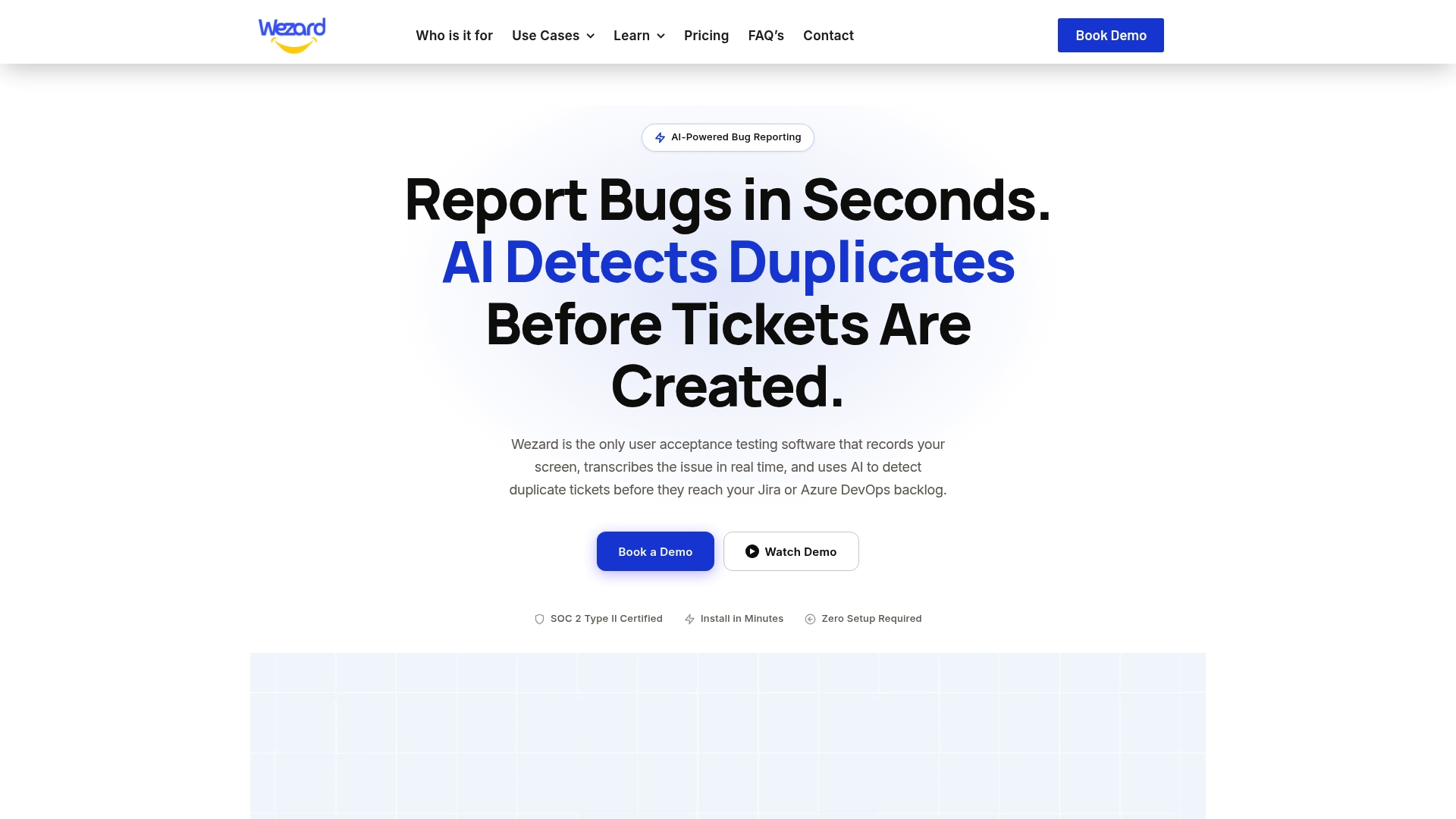
A sensible pilot looks like this: connect a test identity provider, enable provisioning in a staging organization, record a sample UAT session with screen capture and real-time transcription, then confirm deprovisioning actually revokes access when you deactivate the test user. That sequence surfaces integration issues before they hit your production rollout. If your team is coming from Jira-heavy workflows, Wezard’s comparison of Jira alternatives for UAT and bug tracking is worth a look for context on how backlog sync typically works alongside SSO.
Plans start at $25 a month for Starter, scale to $70 for Team and $160 for Business, with Enterprise pricing available on request for organizations that need custom SSO and SCIM terms. Check the full pricing breakdown and start a trial to see how the SSO setup behaves in your own environment.

Where to Read the Underlying Standards
For the identity architecture itself, your security lead should read the Enterprise Single Sign-On Playbook from IDManagement and NIST’s federation and assertions guidance. SREs configuring the actual connection should keep Cloudflare’s SAML integration docs and Okta’s app integration guide open during setup. QA admins running provisioning tests will get the most direct value from Okta’s SCIM provisioning documentation.
Sources
- Enterprise Single Sign-On Playbook – IDManagement
- Choosing security parameters (NIST guidance)
- Add SCIM provisioning to app integrations – Okta Help
FAQ
What Does SSO for Testing Tools Actually Mean?
It means testers and QA staff log into the testing platform using credentials from your organization’s identity provider instead of a separate account. The tool federates authentication through SAML 2.0 or OIDC rather than storing its own passwords.
Do I Need SCIM, or Is SSO Enough on Its Own?
SSO alone handles login, but it won’t remove access when someone leaves your organization. SCIM 2.0 automates that deactivation step, which is why most enterprise security teams treat it as required, not optional.
Should I Choose SAML or OIDC for My Testing Tool?
Choose SAML if your organization runs a traditional enterprise identity provider and the testing tool is a standard web app; choose OIDC if the tool has a mobile or API-first component. Both protocols support signed assertions and replay protection when configured correctly.
What Causes Most SSO Integration Failures?
Certificate mismatches, audience or issuer misconfiguration, and clock skew between servers account for the majority of failed logins during setup. Checking the raw assertion payload against your identity provider’s metadata usually pinpoints the exact cause quickly.
Does Wezard Support Enterprise SSO?
Yes. Wezard supports enterprise-grade security and SSO alongside direct integration with Jira and Azure DevOps, and current pricing for Starter, Team, and Business plans starts at $25 a month, with Enterprise pricing available on request.