
Acceptance criteria are predefined, testable conditions that specify exactly what a feature must do before stakeholders accept it as complete. They are the reason why testers need acceptance criteria as a foundation, not an afterthought. Without them, QA professionals test against assumptions rather than requirements. Tools like Atlassian Jira, TestRail, and VirtuosoQA all treat acceptance criteria as the starting point for any structured testing effort. They convert vague user stories into 100% testable validation scenarios, giving testers a definitive pass/fail framework that removes guesswork from the definition of “done.”
Why testers need acceptance criteria to build effective test cases
Acceptance criteria are the direct source material for test case design. Every scenario a tester writes should trace back to at least one criterion. That connection keeps test coverage aligned with what the business actually asked for, not what a developer happened to build.
Here is how the translation from acceptance criteria to test cases works in practice:
- Identify the success condition. Each criterion states a specific outcome. A criterion like “the user receives a confirmation email within 60 seconds of checkout” gives you an exact pass threshold to test against.
- Define the positive path. Write a test case that walks through the happy path and confirms the criterion is met under normal conditions.
- Define the negative path. Boundary conditions include what happens when the email is delayed, the address is invalid, or the checkout fails mid-process. These negative paths are just as important as the positive ones.
- Map to business outcomes. Acceptance criteria allow testers to create test cases mapped to stakeholder requirements, not just technical functions. This ensures 90–100% of the feature’s intended behavior gets validated during UAT.
- Check for gaps. If a criterion is missing for a known user scenario, flag it before development starts. Gaps at this stage cost far less to fix than gaps found in production.
This five-step process works for both manual and automated testing. When you write automated scripts, acceptance criteria serve as the specification the script validates. When you run manual tests, they serve as the checklist that defines completion.
Pro Tip: Involve testers in acceptance criteria definition sessions before a sprint begins. Testers spot edge cases that product owners and developers overlook, because testers think in failure modes, not success stories.

The UAT test case writing process becomes significantly more structured when criteria are written clearly. Testers spend less time asking clarifying questions and more time executing meaningful tests.
What happens when acceptance criteria are missing or vague?
Testing without clear acceptance criteria produces predictable problems. The consequences are not random. They follow a pattern that QA teams recognize immediately.
- Ambiguity causes rework. When a criterion says “the page should load quickly,” testers have no threshold to test against. One tester passes at 3 seconds. Another fails at 2 seconds. The result is inconsistent coverage and a defect log full of disputes.
- Testers test the implementation, not the requirement. Testers who lack criteria as a source of truth end up validating what was built rather than what was needed. The product passes QA but fails the user.
- “Done” becomes subjective. Without a clear pass/fail benchmark, sprint reviews turn into negotiations. Developers say a feature is complete. Testers disagree. Neither side has a written standard to reference.
- Edge cases go untested. Hidden dependencies and boundary conditions only surface when someone asks “what does failure look like?” If no one asks that question during requirements, testers discover the answer in production.
- Defects multiply late in the cycle. Late-stage defects are expensive. Catching an ambiguity in a user story costs minutes. Catching the same problem after deployment costs days of rework, hotfixes, and stakeholder communication.
Pro Tip: Challenge vague criteria early by asking “what does failure look like?” for every condition. This single question surfaces hidden dependencies and edge cases that developers and product owners did not know existed.
The role of QA in performance testing follows the same logic. Without defined thresholds, performance testing produces data with no context for pass or fail.
Acceptance criteria vs. acceptance tests vs. functional requirements
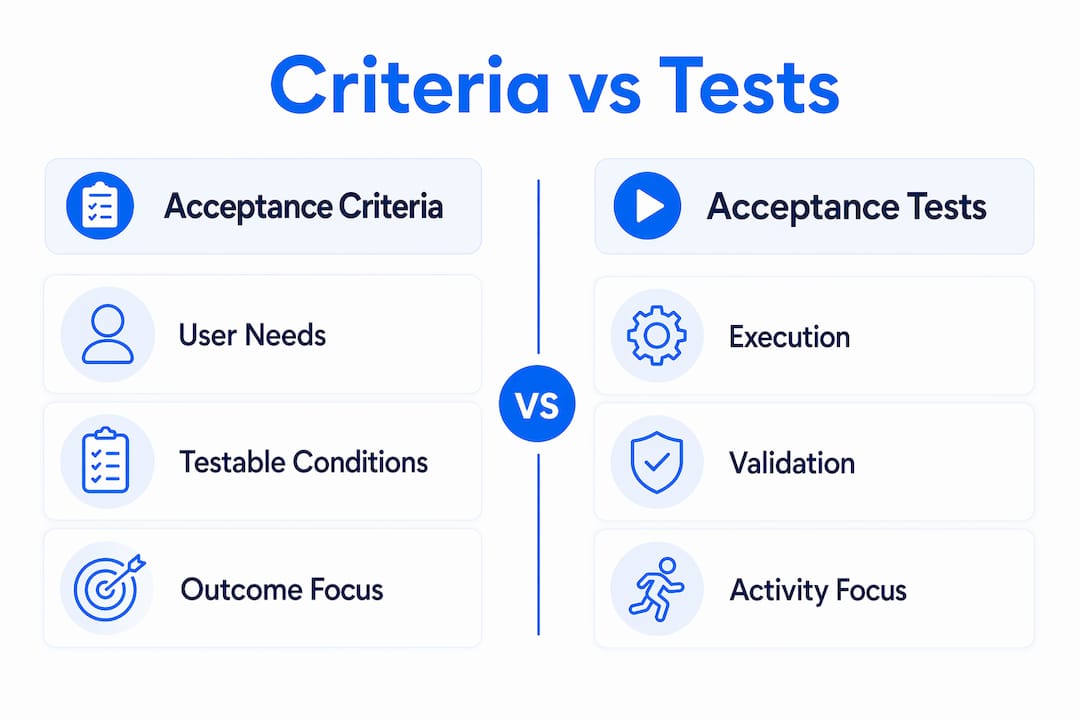
These three terms describe related but distinct concepts. Confusing them leads to brittle test cases and misaligned expectations across the team.
| Concept | What it describes | Tester’s role |
|---|---|---|
| Acceptance criteria | User-focused success conditions defining “what” and “why” | Use as the basis for test case design |
| Acceptance tests | The actual validation activities run against criteria | Execute, record results, and report pass/fail |
| Functional requirements | System behavior and “how” to implement a feature | Reference for technical context, not test design |
Acceptance criteria describe “what” must be done from the user’s perspective. They do not specify how the system achieves it. A criterion like “a logged-out user cannot access the account dashboard” is user-focused and testable. A functional requirement for the same feature might specify session token expiration logic. That is an implementation detail, not a test condition.
Acceptance tests are the execution of validation against those criteria. They are the activities, not the standards. A tester runs an acceptance test to determine whether a criterion passes or fails. The criterion itself is the benchmark.
Confusing acceptance criteria with functional requirements produces the most common testing failure mode: testers write test cases that verify the code works as written, not that the feature works as needed. The difference between UAT and system testing maps directly to this distinction. System testing validates implementation. UAT validates acceptance criteria.
Best practices for testers using acceptance criteria in 2026
The most effective QA teams in 2026 treat acceptance criteria as living documents, not static checklists. Viewing criteria as fixed is one of the most common mistakes in agile testing. Requirements evolve. Criteria must evolve with them.
Here are the practices that separate high-performing QA teams from average ones:
- Attend Three Amigos meetings. Early tester participation in requirements sessions reduces defects by catching ambiguities before development starts. The Three Amigos format brings together a product owner, a developer, and a tester to review each user story before it enters a sprint. Testers contribute failure scenarios that neither of the other two roles would naturally consider.
- Update criteria during sprints. When a user story changes mid-sprint, the acceptance criteria must change with it. A criterion written on day one of a two-week sprint may be outdated by day eight. Treat criteria updates as part of the sprint, not as exceptions to it.
- Avoid AC bloat. Overly detailed criteria become hard to maintain and harder to test against. Each criterion should describe one testable condition. If a single criterion requires three paragraphs to explain, it needs to be split.
- Align criteria with your test management tool. Jira and TestRail both support linking acceptance criteria directly to test cases. This traceability makes it easy to confirm that every criterion has at least one corresponding test and that no test exists without a criterion to justify it.
- Separate automated and manual coverage. Some criteria are best validated through automated regression tests. Others, particularly those involving user experience or visual layout, require manual review. Decide which is which before the sprint begins, not after.
Pro Tip: When writing acceptance criteria in Jira, use the Given/When/Then format from behavior-driven development. It forces criteria to be specific, user-focused, and immediately testable without additional interpretation.
The transition to AI-assisted testing in 2026 makes well-written acceptance criteria even more valuable. AI test generation tools use criteria as input. Vague criteria produce vague tests. Precise criteria produce precise automation.
Key takeaways
Acceptance criteria are the single most important input a tester receives, because they define what “done” means before a single line of code is written.
| Point | Details |
|---|---|
| Criteria drive test case design | Every test case should trace directly to at least one acceptance criterion. |
| Missing criteria cause rework | Vague or absent criteria produce inconsistent coverage and late-stage defects. |
| Criteria differ from requirements | Acceptance criteria describe user-focused outcomes; functional requirements describe implementation. |
| Treat criteria as living documents | Update criteria when user stories change to keep test coverage accurate throughout the sprint. |
| Early tester involvement reduces defects | Joining Three Amigos sessions lets testers catch ambiguities before development begins. |
The part most QA guides skip
I have reviewed hundreds of test plans across teams of every size, and the pattern is always the same. Teams that struggle with quality do not have a testing problem. They have a requirements problem. Their acceptance criteria are either missing, written by developers in technical language, or copied from functional specifications without any user perspective.
The uncomfortable truth is that most testers accept vague criteria without pushing back. They assume the product owner knows what they want and that the developer will figure it out. That assumption is where quality dies. A criterion like “the system should handle errors gracefully” is not a criterion. It is a wish. A tester who accepts it without questioning it will write a test that passes every time, because “gracefully” means whatever the tester decides it means that day.
The teams I have seen do this well share one habit. Their testers ask one question at every requirements session: “What does failure look like?” That question forces specificity. It turns “handle errors gracefully” into “display an error message within 2 seconds and log the event to the audit trail.” Now you have something testable.
The future of acceptance criteria in 2026 is not about better templates or smarter tools. It is about testers claiming their seat at the requirements table and refusing to test against conditions they cannot define. Tools like Wezardapp make it easier to capture and track what happens during UAT. But the criteria themselves still require a human tester willing to ask hard questions before the sprint clock starts.
— Marketing
How Wezardapp supports acceptance criteria-driven testing
Acceptance criteria define what to test. Wezardapp makes it faster to prove you tested it.

Wezardapp is the only UAT software that records your screen, transcribes issues in real time, and uses AI to detect duplicate tickets before they reach your Jira or Azure DevOps backlog. When testers work from clear acceptance criteria, every recorded session maps directly to a defined condition. Nothing gets lost in translation between the test session and the bug report. Start with the acceptance testing entry criteria guide to set up your QA process correctly from the start, then use Wezardapp’s UAT feedback tool to close the loop between criteria and confirmed results.
FAQ
What are acceptance criteria in software testing?
Acceptance criteria are specific, testable conditions that a feature must satisfy before stakeholders accept it as complete. They define the pass/fail standard for each user story in a sprint.
How do acceptance criteria help testers design test cases?
Acceptance criteria give testers a direct source for both positive and negative test scenarios. Each criterion maps to at least one test case, ensuring coverage aligns with business requirements rather than implementation details.
What is the difference between acceptance criteria and functional requirements?
Acceptance criteria describe what the user needs and why, written from the user’s perspective. Functional requirements describe how the system implements a behavior, making them an implementation reference rather than a test standard.
What happens when testers work without acceptance criteria?
Testers without clear criteria end up validating the implementation rather than the requirement. This produces inconsistent coverage, subjective pass/fail decisions, and defects that surface after deployment rather than during testing.
What is the best format for writing acceptance criteria?
The Given/When/Then format from behavior-driven development is the most widely used structure. It forces criteria to be user-focused, specific, and immediately testable without additional interpretation from the tester.


