
Software testing phases are the structured sequence of activities that move a software product from raw requirements to a verified, release-ready state. The industry standard for organizing these activities is the Software Testing Life Cycle (STLC), a six-phase framework that runs parallel to the Software Development Life Cycle (SDLC). Tools like TestRail, Jira, and Azure DevOps are built around this structure. Teams that understand each phase, its inputs, and its exit criteria catch defects earlier and ship with far fewer production failures.
What are the six software testing phases explained?
The STLC consists of six phases: Requirement Analysis, Test Planning, Test Case Development, Test Environment Setup, Test Execution, and Test Closure. Each phase has defined entry criteria (what must be true before it starts) and exit criteria (what must be true before it ends). Skipping either set of criteria is the single fastest way to accumulate testing debt.
1. Requirement Analysis
Requirement analysis is where QA teams study functional and non-functional specifications to identify what is testable. The output is a Requirements Traceability Matrix (RTM) that maps every requirement to at least one test case. Gaps caught here cost a fraction of what they cost when found in production.

2. Test Planning
Test planning sets the go-no-go framework for every release. The plan defines scope, testing strategy, resource allocation, schedules, risk assessment, and exit criteria. TestRail is widely used to document and version-control test plans. A weak plan is the root cause of most blown QA budgets.
3. Test Case Development
Test case development produces the detailed scripts, data sets, and expected results that testers will execute. Each test case maps directly back to a requirement in the RTM. Teams using Behavior-Driven Development (BDD) frameworks like Cucumber write test cases in plain language that both developers and business stakeholders can read.
4. Test Environment Setup
The test environment must mirror production hardware, software, and network configuration. Any deviation introduces variables that make test results unreliable. Docker and Kubernetes are common tools for creating reproducible, production-equivalent environments quickly.
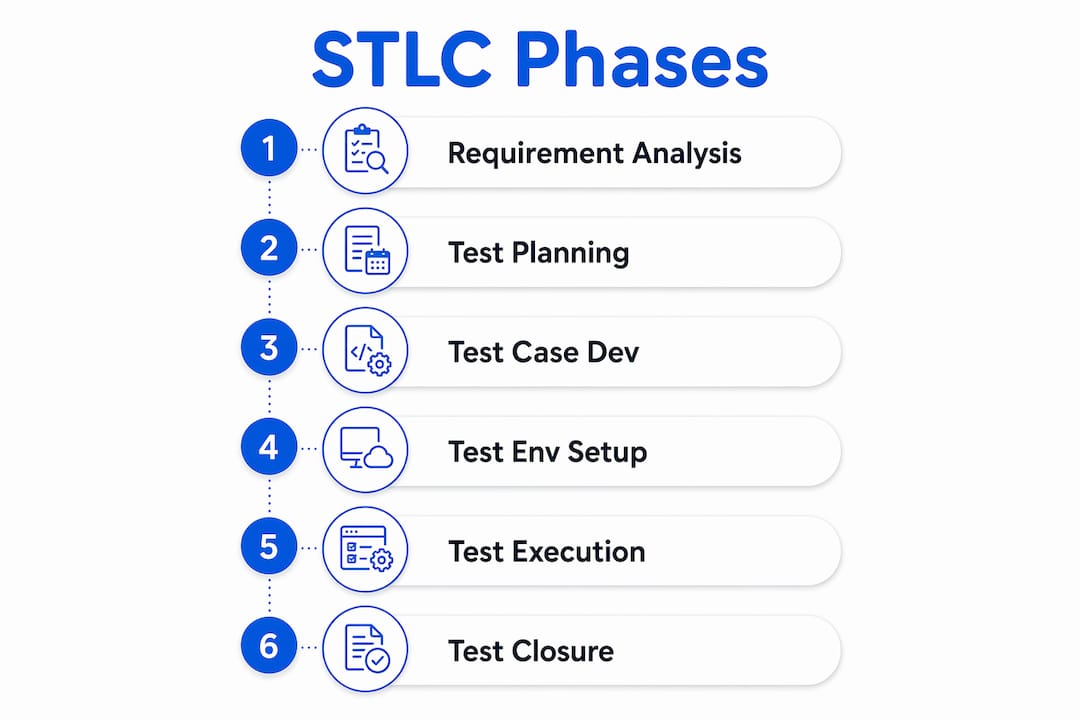
5. Test Execution
Test execution is where testers run cases, log defects in tools like Jira or Azure DevOps, and retest after fixes. The exit criterion for this phase is typically a defect closure rate above a defined threshold. Automated regression suites run here alongside manual exploratory testing.
6. Test Closure
Test closure produces a final test summary report covering pass/fail metrics, defect density, and lessons learned. This phase is frequently skipped under deadline pressure. Teams that skip it repeat the same mistakes in the next release cycle.
Pro Tip: Define exit criteria for every phase before the project starts, not after it slips. Strict entry and exit criteria separate professional QA teams from those that constantly fight fires in production.
How do the four testing levels align with STLC phases?
Software testing executes across four primary levels: Unit, Integration, System, and Acceptance Testing. Each level targets a different scope of verification and maps to specific STLC phases.
- Unit Testing runs during and immediately after development. Developers test individual functions or components in isolation using frameworks like JUnit (Java), pytest (Python), or Jest (JavaScript). This level catches logic errors before they compound.
- Integration Testing verifies that combined components communicate correctly. It typically starts after unit testing completes and uses tools like Postman for API-level checks or TestNG for service integration. Defects here are often interface mismatches.
- System Testing validates the fully assembled application against all functional and non-functional requirements. QA teams own this level, running it during the Test Execution phase. It covers end-to-end workflows and is the primary gate before user acceptance.
- Acceptance Testing is the final level before release. It confirms the software meets business requirements and user expectations. UAT vs system testing is a common point of confusion: system testing is QA-owned and technical; acceptance testing is stakeholder-owned and business-focused.
| Testing level | STLC phase alignment | Primary owner | Typical tools |
|---|---|---|---|
| Unit | Test Execution (dev cycle) | Developer | JUnit, pytest, Jest |
| Integration | Test Execution | QA / Dev | Postman, TestNG |
| System | Test Execution | QA team | Selenium, TestRail |
| Acceptance | Test Execution / Closure | Stakeholders / QA | Wezardapp, manual scripts |
Each level builds on the one before it. A defect that escapes unit testing becomes an integration defect. An integration defect that escapes becomes a system defect. The cost of fixing a defect grows at each level.
What are functional and non-functional testing types?
Functional testing validates software behavior against documented requirements. Non-functional testing assesses qualities like speed, security, and usability. Both categories run during the Test Execution phase, but they answer fundamentally different questions.
Functional testing types
- Smoke testing runs a small set of critical tests after each build to confirm the application is stable enough for deeper testing. It is the gatekeeper before full regression.
- Regression testing re-runs existing test cases after any code change to confirm nothing broke. Automation is mandatory here. Running regression manually on a large codebase is not practical.
- System testing covers end-to-end functional scenarios across the full application.
- Acceptance testing confirms business requirements are met. Defining acceptance criteria types before test case development prevents scope disputes during closure.
Non-functional testing types
- Performance testing measures response times and throughput under expected load. Tools like Apache JMeter and Gatling are standard choices.
- Load testing pushes the system to its expected peak user volume to find bottlenecks.
- Stress testing pushes beyond peak load to find the breaking point and observe recovery behavior.
- Security testing identifies vulnerabilities like SQL injection, cross-site scripting, and authentication flaws. OWASP provides the standard checklist.
- Usability testing evaluates whether real users can complete tasks without confusion. This is where screen recording tools add significant value.
- Compatibility testing verifies behavior across browsers, operating systems, and devices.
Pro Tip: Non-functional testing is consistently under-resourced. Schedule performance and security testing during Test Planning, not as an afterthought after functional testing completes. Late-stage security findings are among the most expensive defects to fix.
The manual versus automated split matters here. Functional regression and performance testing benefit most from automation. Exploratory, usability, and acceptance testing benefit most from human judgment. The transition to AI-assisted testing is shifting where that line sits, but human review remains irreplaceable for acceptance testing.
How do Agile and DevOps change the traditional testing phases?
Agile teams run STLC phases in parallel with development through continuous integration and frequent testing iterations. The six phases do not disappear. They compress, overlap, and repeat across every sprint rather than executing once in sequence.
The practical impact on each phase is significant:
- Requirement Analysis happens at sprint planning, not once at project start. QA joins backlog refinement to flag untestable stories before development begins.
- Test Planning shifts from a single large document to a living artifact updated each sprint. Exit criteria still exist but apply to sprint-level releases.
- Test Case Development runs alongside feature development. Developers and QA write test cases for a story before the code is written, which is the core of Test-Driven Development (TDD).
- Test Environment Setup relies heavily on infrastructure-as-code tools like Terraform and Docker Compose to spin up and tear down environments on demand.
- Test Execution runs continuously via CI/CD pipelines using tools like Jenkins, GitHub Actions, or GitLab CI. Automation strategy is a core part of test planning in these environments.
- Test Closure becomes a sprint retrospective artifact rather than a project-end document.
“Agile does not eliminate the need for structured testing phases. It distributes them across the delivery cycle and demands that automation carry the load that manual sequential testing used to handle.”
The biggest risk in Agile testing is compressing or skipping STLC phases under sprint velocity pressure. Teams that treat testing as a checkbox at the end of a sprint, rather than an activity woven through it, accumulate technical debt that eventually forces a full regression cycle anyway. The discipline of entry and exit criteria matters more in Agile, not less, because the feedback loops are shorter and the cost of a missed defect reaching production is immediate.
Key takeaways
Structured STLC phases with defined entry and exit criteria are the single most effective way to reduce production defects and control QA costs across both traditional and Agile projects.
| Point | Details |
|---|---|
| Six STLC phases are non-negotiable | Requirement Analysis through Test Closure each serve a distinct purpose; skipping any phase increases defect risk. |
| Test planning is the highest-leverage phase | Exit criteria and resource estimates defined here determine whether a release succeeds or fails. |
| Four testing levels build on each other | Unit, Integration, System, and Acceptance Testing catch progressively larger defects; escaping one level raises fix cost. |
| Functional and non-functional testing both belong in the plan | Schedule performance and security testing during Test Planning, not after functional testing ends. |
| Agile compresses phases, it does not remove them | Sprint-level STLC requires automation and living test plans to maintain quality in continuous delivery. |
The phase most teams get wrong
Test planning is where QA projects are won or lost, and most teams treat it as a formality. I have watched experienced QA leads spend two weeks writing detailed test cases for requirements that were never finalized, because no one enforced a requirement analysis exit criterion. The test cases were technically correct and completely useless.
The uncomfortable truth about the software testing lifecycle is that the phases nobody wants to do, specifically requirement analysis and test closure, deliver the highest return. Requirement analysis prevents you from testing the wrong thing. Test closure prevents you from repeating the same mistakes. Both get cut when schedules slip.
Environment fidelity is the other silent killer. A test environment that differs from production in even minor ways, a different database version, a missing network latency simulation, produces results you cannot trust. I have seen teams pass full system testing only to hit critical failures on day one of production because the test database had referential integrity constraints disabled. That is not a testing failure. That is an environment setup failure that masquerades as one.
The balance between automated and manual testing is not a philosophical debate. Automation owns regression, performance, and smoke testing. Humans own exploratory, usability, and acceptance testing. Teams that try to automate acceptance testing entirely miss the point of the phase. Stakeholders need to interact with the software themselves. That interaction is the test.
— Marketing
How Wezardapp fits into your testing phases
Wezardapp is built specifically for the acceptance testing and test closure phases, where feedback quality and defect tracking accuracy matter most.

Wezardapp records your screen during UAT sessions, transcribes issues in real time, and uses AI to detect duplicate tickets before they reach your Jira backlog or Azure DevOps queue. That means your test closure report reflects actual unique defects, not the same bug filed six times by six different testers. For QA teams running acceptance testing across distributed stakeholder groups, Wezardapp removes the manual overhead of consolidating feedback and keeps your STLC exit criteria measurable. You can review acceptance testing entry criteria to see how structured phase gates work alongside Wezardapp’s tracking features.
FAQ
What are the six phases of the STLC?
The six STLC phases are Requirement Analysis, Test Planning, Test Case Development, Test Environment Setup, Test Execution, and Test Closure. Each phase has defined entry and exit criteria that gate progression to the next phase.
What is the difference between STLC and SDLC?
The SDLC covers the full software development process from planning to deployment. The STLC runs in parallel, focusing exclusively on testing activities. Both start at requirements gathering to catch architectural defects early.
How do Agile teams handle software testing phases?
Agile teams compress and overlap STLC phases within each sprint rather than running them sequentially. Test planning, case development, and execution happen continuously, supported by CI/CD automation tools like Jenkins or GitHub Actions.
Why is test environment setup so critical?
A test environment that does not mirror production hardware, software, and network configuration produces unreliable results. Defects that exist in production but not in the test environment are the most damaging kind because they pass every gate before reaching users.
What is the purpose of test closure?
Test closure produces a final summary of pass/fail metrics, defect density, and lessons learned. Teams that skip this phase repeat the same defect patterns in subsequent releases because no structured review captures what went wrong.


