
A reproducible bug is a software defect that any developer or tester can trigger on demand by following a specific, documented set of steps under defined conditions. Reproducibility is the foundation of effective debugging. Without it, engineers guess at root causes, waste hours in dead ends, and ship fixes they cannot verify. A structured bug report captures at minimum six core fields: User Role/State, Environment, URL, Sequential Steps, Expected Result, and Actual Result. These fields transform a vague complaint into a precise, actionable defect record that any team member can act on immediately.
What is a reproducible bug, and what makes one valid?
A reproducible bug meets one strict test: a second person, following your documented steps in the same environment, sees the same failure every time. That consistency is what separates a confirmed defect from noise. The industry term for this concept is “bug reproducibility,” and QA practitioners treat it as the entry gate for any bug worth fixing.

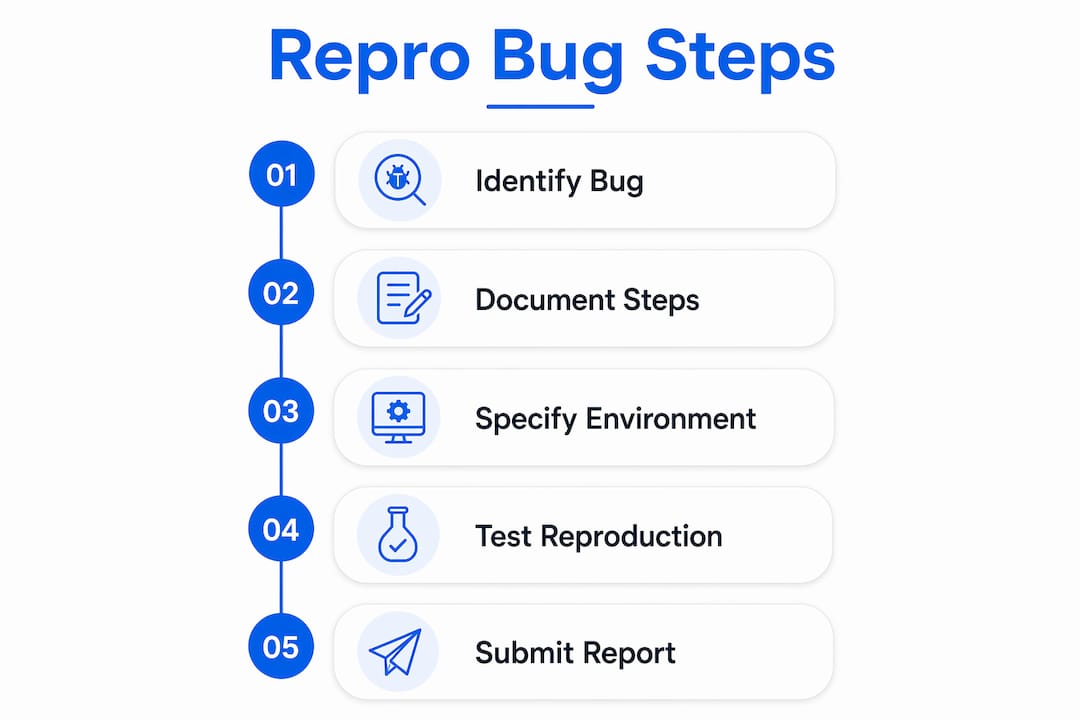
Standardized bug reports require a numbered sequence of steps starting from a clear, known state. Each step describes one action only and stops exactly at the point where the bug appears. That single-action-per-step rule matters because stacking actions inside one step hides which specific interaction triggers the failure.
The six required fields in a valid report are:
- User Role/State — who is logged in, what permissions they hold, and what session state exists
- Environment — operating system, browser name and version, device type, and app version
- URL or screen location — the exact path where the bug appears
- Sequential steps — numbered, one action per line, starting from a clean state
- Expected result — what the system should do according to its specification
- Actual result — what the system actually does
Environment details like OS, browser, and version are not optional extras. Removing any required step and checking whether the bug still appears is the fastest way to confirm which details are truly necessary. If the bug disappears without a step, that step is required.
Pro Tip: Before filing a report, open a private browser window and run your steps from scratch. If the bug appears again, your steps are solid. If it does not, you are missing a precondition, likely a cached state or a specific user permission.
Why are some bugs hard to reproduce?
Intermittent bugs, also called “flaky” defects, appear unpredictably and resist consistent reproduction. Race conditions, timing dependencies, environment variability, and hidden application state are the four most common causes. A race condition, for example, occurs when two processes compete for a shared resource and the outcome depends on which one finishes first. That outcome changes run to run, making the bug appear only under specific timing windows.
The key strategies for handling intermittent bugs include:
- Capture logs immediately. Timestamps, API responses, and error stack traces taken at the moment of failure contain context that memory cannot.
- Record session replays. Session replay tools capture hidden state data, reducing non-reproducible rates by surfacing what the user saw and what the system returned.
- Document frequency precisely. Vague descriptions waste triage time. Specific frequency data gives developers a baseline for investigation.
- Take environment snapshots. Note cache state, user permissions, background processes, and network conditions at the time of failure.
- Increase logging verbosity. Adding more granular logging around the suspected area converts an intermittent bug into a reproducible one by exposing the hidden state that triggers it.
Probabilistic reporting like “3 out of 5 attempts after a fresh login on Chrome 124” is far more useful than “happens sometimes.” That frequency and context data gives developers a concrete baseline for investigation and triage. Intermittent bugs should never be written off as impossible to reproduce. Approximate frequency and contextual clues are the starting point for making them reproducible.
Pro Tip: Add a “Frequency” field to your bug report template. Even a rough estimate like “2 out of 10 attempts” forces reporters to observe the bug multiple times, which almost always surfaces the missing precondition.
How does reproducibility speed up bug fixing?
Reproducibility cuts debugging time by allowing engineers to isolate variables systematically. When a bug can be triggered on demand, the team can apply binary search debugging: disable half the system, check if the bug appears, then narrow down further. Without reproducibility, that method is impossible.
Treating reproducibility as a design principle rather than a testing afterthought changes how systems get built. Systems designed with immutable inputs, versioned configurations, and controlled states are inherently easier to debug. Containerization tools like Docker pin the environment so that “works on my machine” stops being an excuse. Version pinning for dependencies removes an entire class of environment-related failures.
High-quality reproduction steps serve a dual purpose: they act as human-readable instructions for the engineer fixing the bug and as automated verification scripts for AI testing agents. Once a fix is deployed, the same steps confirm the defect is gone without any manual re-testing. That tight feedback loop is what makes reproducible bugs the backbone of continuous integration pipelines.
Reproducible workflows enable binary search debugging, variable isolation, and fix verification using immutable inputs and stable environments. Each of those techniques requires the same starting condition every time. AI-powered testing agents take this further by automating fix verification based on well-crafted reproduction steps, creating continuous testing feedback loops that run without human intervention. The result is a shorter development cycle and higher confidence in every release.
How to write effective reproducible bug reports
The gold standard for a reproducible bug report is the Minimal Reproducible Example, or MRE. An MRE provides the shortest, clearest path from a clean starting state to the defect, stripping out every irrelevant action, dependency, and configuration. MREs reduce runtime, complexity, and dependencies, which makes fault isolation faster and regression testing more reliable.
Most reporters overlook application state beyond user actions. API responses, cache contents, feature flags, and user permissions are all part of the system state at the moment of failure. Leaving them out of the report forces the developer to reconstruct that state through guesswork, which adds hours to the investigation.
Common pitfalls and how to avoid them:
- Vague starting state. Always specify the exact screen, user role, and data state before step one.
- Bundled actions. Split “log in and navigate to settings” into two separate steps.
- Missing environment details. Include OS version, browser version, and app build number every time.
- No expected result. State what the system should do according to the specification, not just what it does wrong.
- Skipping frequency for intermittent bugs. Use probabilistic language and note how often the bug appears.
The table below contrasts a weak report with a strong one across the fields that matter most.
| Field | Weak report | Strong report |
|---|---|---|
| Starting state | “On the app” | “Logged in as Admin on Chrome 124, dashboard loaded” |
| Steps | “Click save and it breaks” | “1. Click Save button. 2. Observe error modal.” |
| Environment | “Windows” | “Windows 11, Chrome 124.0.6367.82, App v3.4.1” |
| Expected result | Omitted | “Record saves and success toast appears” |
| Actual result | “It doesn’t work” | “Error modal: ‘Save failed: 500 Internal Server Error’” |
| Frequency | “Sometimes” | “3 out of 5 attempts after clearing cache” |
Standardizing bug reports across your team is as important as writing good individual reports. When every tester uses the same template, duplicate reports drop and triage becomes faster. AI tools that detect duplicate tickets before they reach the backlog add another layer of efficiency on top of standardized templates.
Pro Tip: Write your acceptance criteria before you write your bug report. If the expected result in your report does not match the acceptance criteria, you may be reporting a misunderstanding rather than a defect.
Key Takeaways
A reproducible bug is only as useful as the report behind it. Structured, minimal, and precise reproduction steps are what convert a defect observation into a fixable, verifiable engineering task.
| Point | Details |
|---|---|
| Reproducible bug definition | A defect any engineer can trigger on demand by following documented steps in a defined environment. |
| Six required report fields | User Role/State, Environment, URL, Sequential Steps, Expected Result, and Actual Result are all mandatory. |
| MRE is the gold standard | A Minimal Reproducible Example strips noise and gives developers the shortest path to the root cause. |
| Intermittent bugs need frequency data | Reporting “3 out of 5 attempts” gives developers a concrete baseline instead of a vague complaint. |
| Reproducibility as design principle | Systems built with immutable inputs and versioned configs are faster to debug and easier to test. |
The mindset shift that actually changes how teams debug
Reproducibility is not a documentation task. It is a thinking discipline. After years of working with QA teams across different product types, the single biggest gap I see is not in tooling. It is in how testers think about what they are reporting. Most reporters describe what they saw. The best reporters reconstruct the exact conditions that made it happen.
The teams that fix bugs fastest treat every report as a recipe. If someone else cannot follow that recipe and get the same result, the recipe is incomplete. That standard sounds obvious, but it is rarely enforced. Teams that enforce it consistently ship fewer regressions and spend less time in “I can’t reproduce it” loops.
AI is changing this further. Automated reproduction agents can now take a well-written report and attempt to trigger the bug without human involvement. That only works when the report is precise enough for a machine to follow. The teams investing in report quality today are the ones who will get the most out of AI-assisted debugging tomorrow. Reproducibility is not just a QA skill. It is the interface between human observation and machine verification.
— Marketing
How Wezardapp supports reproducible bug reporting
Reproducible bug reports are only as good as the process behind them. Wezardapp is the only UAT testing tool that records your screen, transcribes the issue in real time, and uses AI to detect duplicate tickets before they reach your Jira or Azure DevOps backlog.

Every report Wezardapp generates includes the environment details, sequential steps, and expected versus actual results that make a bug truly reproducible. The AI duplicate detection layer means your backlog stays clean and your team spends time fixing defects, not sorting through redundant tickets. For teams running acceptance testing workflows, Wezardapp connects bug reports directly to entry criteria so nothing slips through. See how it works at wezardapp.com/bug-tracking.
FAQ
What is the reproducible bug definition in software testing?
A reproducible bug is a software defect that can be consistently triggered by following a specific set of documented steps under defined conditions. Reproducibility is the minimum requirement for a bug to be triaged and fixed efficiently.
How do you reproduce a bug that only happens sometimes?
Document the frequency precisely, such as “3 out of 5 attempts after a fresh login,” and capture logs, timestamps, and session replays at the moment of failure. Probabilistic reporting gives developers the context they need to investigate intermittent defects.
What is a Minimal Reproducible Example?
A Minimal Reproducible Example is the shortest sequence of steps, in the simplest possible environment, that reliably triggers a defect. MREs reduce complexity and dependencies, making fault isolation and regression testing significantly faster.
Why does environment information matter in a bug report?
Environment details like OS, browser version, and app build determine whether a bug is platform-specific or universal. Leaving them out forces developers to test across multiple configurations before they can even begin isolating the root cause.
What fields does a standard reproducible bug report require?
A standard bug report requires six fields: User Role/State, Environment, URL, Sequential Steps, Expected Result, and Actual Result. Every field is necessary; removing any one of them reduces the report’s reproducibility.


