
Structured bug reports are detailed, precise descriptions of software issues that include clear reproduction steps, expected versus actual behavior, environment details, and error outputs, giving developers everything they need to fix a defect without asking a single follow-up question. The reason why structured bug reports speed up fixes comes down to one principle: a well-written report turns a vague complaint into a reproducible experiment. AI coding assistants fix 67% of well-structured reports on the first attempt, compared to only 12% for poorly structured ones. That gap is not a minor efficiency gain. It is the difference between a bug resolved in hours and one that sits in a backlog for weeks.
Why structured bug reports speed up fixes
The core mechanism is simple. A structured report removes ambiguity. When a developer opens a ticket and sees exact reproduction steps, a clear description of expected versus actual behavior, and the relevant environment details, they can reproduce the defect on their first attempt. Developers who reproduce a bug immediately cut resolution time from days to hours. That single factor accounts for most of the speed difference between good and bad reports.
Structured reports also reduce triage time by up to 50% by cutting the back-and-forth communication that consumes engineering hours. Missing reproduction steps or environment details are the leading cause of “cannot reproduce” outcomes. Every “cannot reproduce” response sends the ticket back to the reporter, adds a delay of at least one sprint cycle, and erodes trust between QA and development teams.

The same logic applies to AI-assisted debugging. AI tools need precise inputs to generate useful outputs. Including file paths and function names reduces AI investigation time by roughly 80%. That means a report with a specific function reference like AuthService.validateToken() and a file path like src/auth/auth.service.ts gives an AI assistant a direct entry point into the codebase. A report that says “login is broken” gives it nothing.
What essential elements make a bug report effective?
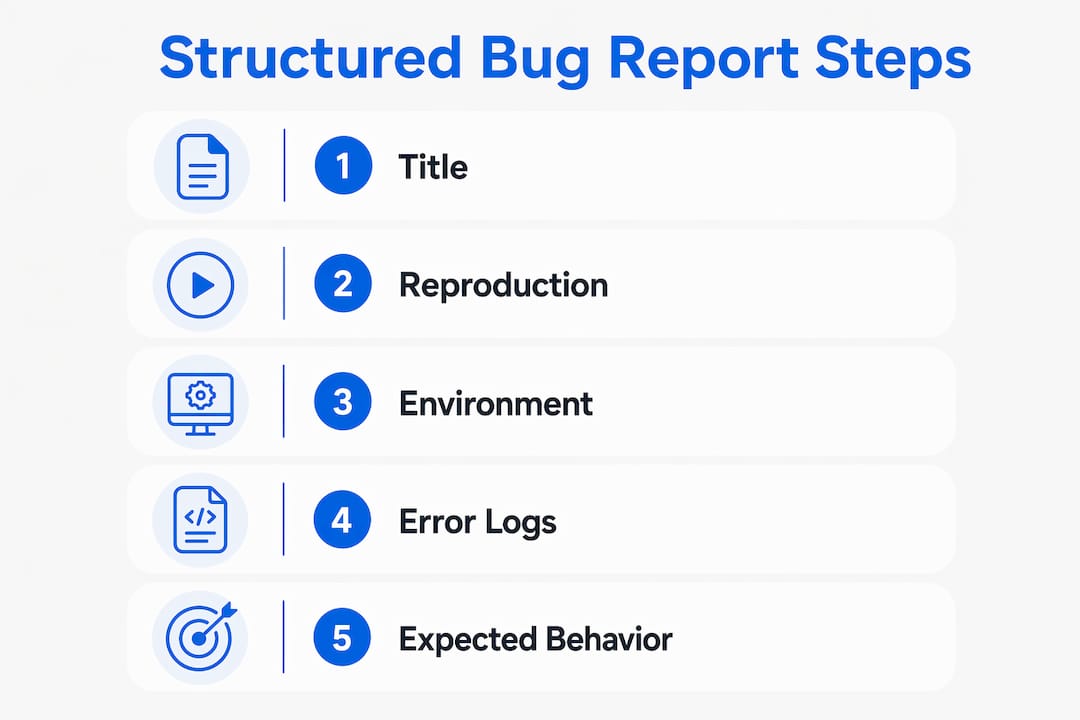
A structured bug report is built from specific, required fields. Each field serves a purpose. Leaving one out forces the developer to investigate what you already know.
- Reproduction steps: Number each step. Write them as commands, not descriptions. “Click the Submit button” beats “I tried submitting the form.”
- Expected versus actual behavior: State what should happen, then state what did happen. Keep each to one sentence.
- Environment details: Browser version, operating system, app version, and any relevant configuration. A bug that only appears on Safari 17 on macOS Sonoma is not reproducible on Chrome.
- Error outputs: Paste the full stack trace, not a summary. Include relevant log lines and any error codes shown in the console.
- Isolation: Shrink the triggering inputs until the bug still occurs. Isolation is one of the highest-value contributions a QA engineer can make, because it dramatically reduces the investigation scope for developers.
- One bug per report: Combining multiple bugs in one report creates “fix-in-limbo” scenarios where partial fixes block ticket closure. Keep reports atomic.
- Visual evidence: Screen recordings and screenshots support the text but do not replace it. Visual evidence prevents “cannot reproduce” delays and can reduce fix times to under one day for common issues.
Pro Tip: Write your reproduction steps, then hand them to a colleague who was not involved in finding the bug. If they cannot reproduce it from your steps alone, your report is not ready to submit.
A good title also matters more than most teams realize. “Submit button unresponsive when cart is empty on checkout page” gives a developer immediate context. “Button not working” gives them nothing. Descriptive titles add debugging direction before the developer even opens the ticket.
How do structured reports reduce investigation and triage time?
The efficiency gains from clear bug reporting are not theoretical. They show up in measurable ways across every stage of the fix cycle.
“A structured report turns a bug complaint into a reproducible experiment, where clearly defined variables eliminate ambiguity. This approach supports both human developers and AI tools in resolving bugs quickly.”
When a developer opens a structured ticket, they skip the investigation phase almost entirely. They know which file to open, which function to check, and which input to test. AI assistants fix 6x more bugs autonomously when reports include this level of detail. That multiplier compounds across a sprint. A team filing 30 bugs per week with structured reports effectively gives their AI tooling six times the throughput on autonomous fixes.
Vague reports create a different kind of cost that rarely shows up in sprint metrics. A developer who receives “the dashboard crashes sometimes” must first reproduce the crash, then identify the conditions, then isolate the cause. Each of those steps takes time that a structured report would have eliminated. The hidden cost of a bad report is not just the fix time. It is the investigation time, the clarification time, and the context-switching cost when the developer has to stop and ask questions.
A five-minute conversation between QA and a developer often resolves ambiguity faster than three rounds of ticket comments. The best teams build that habit into their workflow. They treat a quick sync as a legitimate part of the reporting process, not a failure of documentation.
What nuances and best practices improve report quality beyond basics?
Report quality is a team metric, not an individual one. Blaming a single tester for a vague report misses the point. The process itself needs to support good reporting through templates, training, and feedback loops.
- Track “cannot reproduce” rates as a process metric. Viewing report quality as a team-wide metric leads to faster long-term improvement than individual blame. Review these rates in retrospectives and treat them as signals about template gaps, not personal failures.
- Review reports regularly for patterns. If five reports this sprint all lacked OS version details, the template needs a required field, not a reminder email.
- Avoid long “Additional Context” sections. Developers and automated tools ignore lengthy context sections. Focus on isolation work instead. A concise, minimal reproduction case beats three paragraphs of background.
- Prioritize isolation over description. The smaller the input set that still triggers the bug, the faster the fix. Shrinking a failing test from 15 steps to 3 is worth more than any amount of additional context.
- Use templates aligned with developer needs. A template built by developers, not just QA, reflects what actually helps during debugging. Involve both sides when designing your standard format.
Pro Tip: Combine your bug reporting workflow with an AI tool like Wezardapp, which records your screen, transcribes the issue in real time, and detects duplicate tickets before they reach your Jira or Azure DevOps backlog. This removes the manual overhead of structured formatting while enforcing consistency across every report.
The importance of clear bug reporting also extends to AI tooling adoption. Teams that invest in report quality get dramatically more value from AI coding assistants. A team with poor reporting practices will find AI tools frustrating and unreliable. A team with structured reports will find them genuinely useful.
How can teams implement structured reporting to maximize fix speed?
Embedding structured reporting into your workflow requires more than distributing a template. It requires process changes, training, and measurement.
- Introduce mandatory templates. Create a bug report template with required fields: title, reproduction steps, expected behavior, actual behavior, environment, and error output. Make every field required in your issue tracker. Optional fields get skipped.
- Train QA and developers together. Run a joint session where developers explain what information they actually need to start debugging. QA engineers often do not know which details matter most until a developer shows them. Learn how to submit clear bug reports as a starting point for that training.
- Integrate AI-powered tools. Tools that auto-generate structured content from screen recordings remove the burden of manual formatting. Wezardapp records the session, transcribes the issue, and pushes a structured ticket directly to Jira or Azure DevOps. That removes the single biggest barrier to consistent reporting: the time it takes to write a good report from scratch.
- Measure “cannot reproduce” rates. Set a baseline, then track it sprint over sprint. A declining rate means your reports are improving. A flat or rising rate means your template or training needs adjustment.
- Build direct communication channels. Slack threads or brief syncs between reporters and developers resolve ambiguity faster than ticket comments. Make it easy for a developer to ask one quick question without creating a formal back-and-forth chain.
- Balance detail with conciseness. A structured report is not a long report. It is a complete report. Every field should contain exactly what the developer needs, nothing more. Explore how to standardize bug reporting across your entire QA team to keep that balance consistent.
Key Takeaways
Structured bug reports cut fix times by eliminating ambiguity, enabling immediate reproduction, and giving AI tools the precise inputs they need to resolve defects autonomously.
| Point | Details |
|---|---|
| Structure eliminates ambiguity | Reports with reproduction steps, environment details, and error outputs let developers fix bugs without follow-up questions. |
| AI tools need structured inputs | AI coding assistants fix 67% of well-structured reports autonomously, versus only 12% for vague ones. |
| One bug per report | Combining bugs in one ticket creates partial-fix deadlocks; atomic reports close faster and cleaner. |
| Track “cannot reproduce” rates | Measuring this rate as a team metric drives process improvement faster than individual feedback. |
| Isolation beats context | Shrinking the triggering input set is the highest-value contribution a QA engineer can make to any report. |
The real cost of vague bug reports is measured in trust
The teams I have seen struggle most with bug resolution share one trait: they treat bug reports as a formality rather than a communication tool. A ticket gets filed, a developer marks it “cannot reproduce,” and the cycle repeats. Nobody learns anything. The reporter feels ignored. The developer feels frustrated. The bug stays open.
What changes when teams commit to structured reporting is not just speed. It is the relationship between QA and engineering. When a developer opens a ticket and finds exactly what they need, they trust the reporter. That trust compounds. Developers start acting on reports faster because they expect them to be useful. QA engineers invest more in report quality because they see it pay off.
The part most articles skip is the role of AI tooling in making this sustainable. Writing a thorough structured report takes discipline and time. Most teams cannot maintain that standard manually across hundreds of tickets per sprint. AI tools that record, transcribe, and auto-structure reports remove the friction entirely. The role of AI in test reporting is not to replace QA judgment. It is to handle the formatting work so QA engineers can focus on isolation and reproduction, which are the parts that actually require human thinking.
My honest recommendation: start with one sprint where your team tracks “cannot reproduce” rates and reviews every flagged ticket together. The patterns you find will tell you exactly where your template needs work. No consultant required.
— Marketing
Wezardapp turns every bug report into a structured ticket automatically
Wezardapp is the only user acceptance testing tool that records your screen, transcribes the issue in real time, and uses AI to detect duplicate tickets before they reach your Jira or Azure DevOps backlog. Every report it generates follows a structured format by default, so your team stops debating what to include and starts fixing bugs faster.

Teams using Wezardapp eliminate the manual overhead of formatting, reduce duplicate tickets in their backlog, and give developers the precise inputs they need from the first report. The AI bug tracking tool integrates directly with Jira and Azure DevOps, pushing structured tickets in one click. If your team is serious about cutting fix times, that is where to start.
FAQ
Why do structured bug reports speed up fixes?
Structured reports give developers exact reproduction steps, environment details, and error outputs, so they can reproduce and fix a defect on the first attempt without asking follow-up questions.
What is the most important element of a bug report?
Reproduction steps are the most critical element. Without them, developers cannot confirm the bug exists, which leads to “cannot reproduce” outcomes and delays.
How do bug reports affect AI coding assistants?
AI coding assistants fix 67% of well-structured bug reports autonomously on the first attempt, compared to only 12% for poorly structured ones. Including file paths and function names reduces AI investigation time by roughly 80%.
How should teams measure bug report quality?
Track the “cannot reproduce” rate as a team-wide process metric each sprint. A declining rate signals that report quality is improving across the team.
Should one bug report cover multiple issues?
No. Combining multiple bugs in one report creates partial-fix deadlocks where a ticket cannot close until every issue is resolved. One report per bug is the standard practice.


