
Collaborating with testers on acceptance conditions is the most direct way to produce clear, testable requirements that actually drive successful software delivery. Acceptance conditions, known in the industry as acceptance criteria, define when a user story or feature is complete and ready to ship. Teams that skip this collaboration routinely discover defects late, burn sprint capacity on rework, and miss the definition of done entirely. The structured practices covered here, including the “Three Amigos” session and the Given-When-Then format, give business analysts and project managers a repeatable system for getting this right.
How to collaborate with testers on acceptance conditions effectively
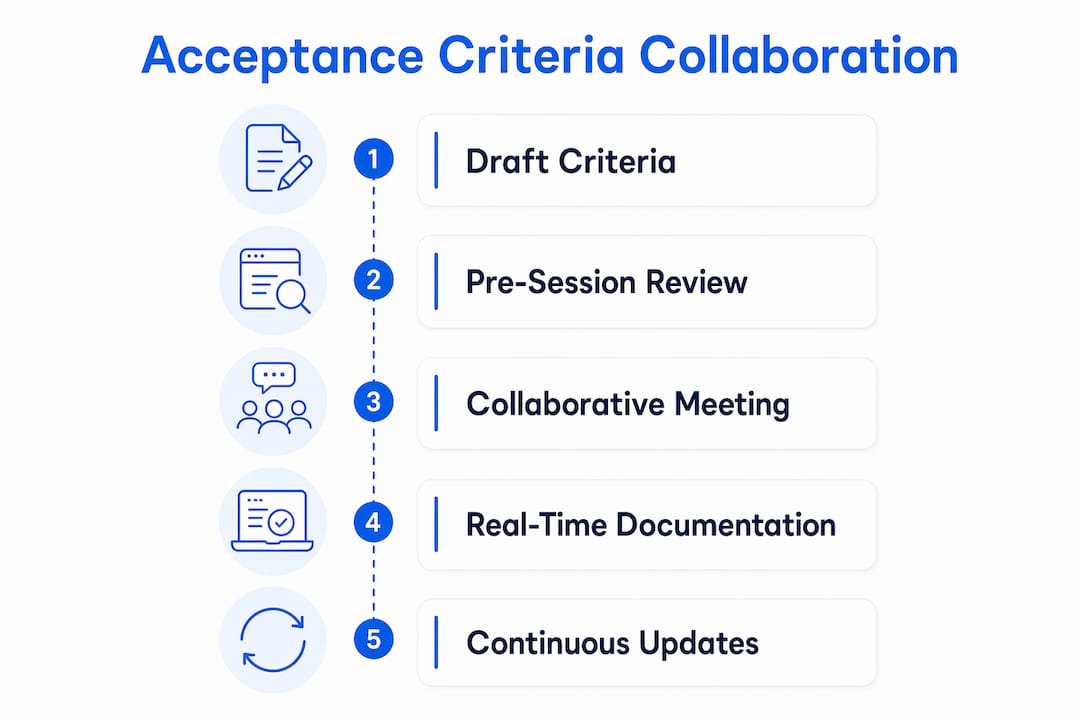
Productive acceptance criteria collaboration starts before any meeting happens. The business analyst or project manager drafts an initial version of the criteria, not to finalize them, but to give the team something concrete to react to. That draft becomes the raw material for a focused refinement session.
Three roles must be present for the collaboration to work:
- Business analyst or project manager. Owns the story intent and facilitates the session.
- Developer. Assesses technical feasibility and flags implementation constraints.
- QA tester. Challenges assumptions, identifies edge cases, and confirms testability.
Platforms like Jira and Confluence serve as the home for living acceptance criteria, keeping them visible, editable, and linked to the relevant stories. Static documents stored in email threads or slide decks lose accuracy within days. Scheduling these sessions during backlog refinement, not the day before sprint planning, gives the team enough time to resolve disagreements without pressure.
The table below shows what “ready to collaborate” looks like versus what most teams actually bring to the session.

| Preparation element | Not ready | Ready |
|---|---|---|
| Initial criteria draft | None or vague bullet points | Specific, scenario-based statements |
| Roles confirmed | Only the PM attends | PM, developer, and tester all present |
| Story context shared | Story written same day | Story groomed at least one sprint ahead |
| Tool access | Criteria in a Word doc | Criteria in Jira or Confluence, editable |
| Session length | Open-ended | Timeboxed to 15–30 minutes per story |
Pro Tip: Send the draft criteria to testers 24 hours before the session. Testers who arrive with questions already formed ask sharper ones and catch more gaps.
How do you run a collaborative session to define acceptance criteria?
The “Three Amigos” session is the gold standard approach for defining acceptance criteria before sprint planning. The name reflects the three perspectives that must be in the room: the person who owns the story, the person who builds it, and the person who breaks it.
The session follows a clear sequence:
- Read the story aloud. The PM or business analyst states the user story and its current draft criteria. Everyone hears the same words at the same time.
- Write Given-When-Then scenarios. Each acceptance condition takes the form: Given a specific starting state, When the user takes an action, Then a measurable outcome occurs. This format eliminates ambiguity because it forces specificity.
- Pressure-test for unhappy paths. Refinement is a teardown, not a passive review. The tester asks “what happens when the user submits an empty form?” or “what if the API times out?” These questions expose gaps that the happy-path scenario misses entirely.
- Capture disagreements in real time. When the developer says a condition is technically impossible and the tester says it is required for sign-off, the PM documents both positions. The disagreement itself becomes a decision point, not something to resolve offline and forget.
- Finalize and confirm. The session ends with every participant able to state the acceptance conditions in their own words. If they cannot, the criteria are not clear enough yet.
Timeboxing each story to 15–30 minutes keeps sessions productive. Teams that run open-ended refinement meetings report rubber-stamping rather than genuine debate, which defeats the purpose entirely.
Pro Tip: Assign one person to type criteria directly into Jira during the session. Real-time documentation prevents the “I thought we agreed on X” problem that surfaces two days later.
The Given-When-Then format also makes it straightforward to convert acceptance criteria into UAT test cases later, because the scenario structure maps directly to a test step sequence.
What communication strategies keep acceptance criteria aligned?
Acceptance criteria drift the moment the session ends and development begins. Maintaining alignment requires deliberate communication habits, not just a good kickoff meeting.
The most underused strategy is treating testers as adversarial thinkers throughout the sprint, not just at the end. Testers who ask “what happens when…” questions during development catch assumption failures before they become defects. That mindset needs to be invited and protected, not treated as obstruction.
Specific habits that sustain alignment:
- Review criteria at sprint mid-point. A 10-minute check confirms that implementation matches the agreed conditions. Surprises caught here cost far less than surprises caught in UAT.
- Use one centralized tool. Criteria scattered across Confluence pages, Slack threads, and email chains guarantee inconsistency. One source of truth, linked directly to the Jira story, removes that risk.
- Write criteria in plain language. Avoid phrases like “the system shall” or “appropriate response.” Every condition should be readable by a non-technical stakeholder and still be specific enough to test.
- Flag changes immediately. When a developer discovers that a condition is technically infeasible mid-sprint, that information goes into the story the same day, not in the retrospective.
Empowering testers to update criteria dynamically during development prevents the criteria from becoming obsolete. A tester who finds an edge case not covered by the current conditions should have both the permission and the process to add it without waiting for a formal meeting.
Pro Tip: Add a “last reviewed” date field to every acceptance criteria block in Confluence. Criteria older than one sprint without a review flag deserve a quick check before testing begins.
What challenges come up when collaborating with testers on criteria?
The most common failure mode is solo drafting. A business analyst writes acceptance criteria alone, the story enters the sprint, and the tester discovers during execution that three conditions are untestable. Early collaborative drafting eliminates this pattern by building tester perspective into the criteria from the start.
“Acceptance criteria writing is a negotiation where testers and developers debate feasibility and testability, with the PM facilitating to capture friction points. Strong collaboration drives precise, testable definitions of done.”
Time pressure is the second most common obstacle. Teams under sprint deadlines skip refinement sessions or cut them short, which feels efficient and costs more later. A 20-minute Three Amigos session per story is not overhead. It is the cheapest defect prevention available.
Other challenges and their direct solutions:
- Conflicting requirements. The developer says a condition cannot be built as specified. The tester says it must be testable as written. The PM’s job is to surface the conflict, not paper over it. Document the constraint and adjust the condition to reflect what is actually buildable and testable.
- Criteria becoming static. Treating acceptance criteria as living artifacts subject to continuous refinement is the only way to prevent obsolescence. A condition written in sprint one may need revision by sprint three as the product evolves.
- Testers excluded from early conversations. Teams that involve testers only at the end of development consistently face delayed defect detection and higher fix costs. Tester involvement in acceptance from the first refinement session is not optional for teams that care about quality.
How does structured collaboration improve project outcomes?
The difference between solo criteria writing and Three Amigos collaboration shows up in measurable ways. Stories with collaboratively written criteria enter the sprint with a shared mental model across all three roles. Stories written by one person enter with assumptions that the other two roles have never validated.
| Approach | Defect detection timing | Rework rate | Sprint readiness |
|---|---|---|---|
| Solo criteria writing | Late, often in UAT | High | Low, stories frequently blocked |
| Three Amigos collaboration | Early, during refinement | Low | High, stories enter sprint ready |
Acceptance criteria written as a negotiation between PM, developer, and tester produce conditions that are feasible, testable, and agreed upon before a single line of code is written. That agreement is what makes the definition of done meaningful rather than aspirational.
Continuous improvement cycles build on this foundation. After each sprint, teams that review which criteria caused confusion or required mid-sprint revision accumulate a body of knowledge about where their process breaks down. That knowledge feeds directly into better drafting, sharper sessions, and fewer surprises. The role of QA analysts in this feedback loop is central, not peripheral.
Key Takeaways
Effective acceptance criteria collaboration requires all three roles, a structured session format, and criteria treated as living documents throughout the sprint.
| Point | Details |
|---|---|
| Start with a draft | The PM or BA drafts initial criteria before the session to give the team something concrete to challenge. |
| Use Three Amigos sessions | Include PM, developer, and tester in every refinement session to build a shared mental model. |
| Apply Given-When-Then | Structure each condition as a scenario to eliminate ambiguity and enable direct test case creation. |
| Treat criteria as living documents | Update conditions mid-sprint when new information surfaces rather than waiting for the next refinement cycle. |
| Empower testers to challenge | Testers who ask adversarial questions during development catch defects before they reach UAT. |
What I’ve learned from watching teams get this wrong
Most teams treat acceptance criteria as a formality. The PM writes them, the tester reads them, and everyone moves on. The defects that show up in UAT are almost always traceable to a condition that was never pressure-tested by someone whose job is to break things.
The insight that changed how I think about this process is that testers are not validators. They are the best critics a story will ever have. A tester who asks “what happens when the user does something unexpected?” in a refinement session is doing something a developer and a PM structurally cannot do: they are thinking from the perspective of failure. That perspective is exactly what acceptance criteria need to be complete.
The friction that comes up in Three Amigos sessions is not a problem to manage. It is the product. When a developer says “that condition is not buildable” and a tester says “then the story is not testable,” that conversation is the most valuable thing that happens in the sprint. The PM’s job is to stay in that discomfort long enough to produce a condition that is both buildable and testable, not to smooth it over.
Teams that make this collaboration a continuous habit, not a one-time kickoff ritual, consistently ship with fewer surprises. The criteria evolve, the team’s shared understanding deepens, and the definition of done becomes something everyone actually believes in.
— Marketing
Wezardapp and acceptance criteria collaboration
Wezardapp is built for teams that take acceptance criteria seriously. It records your screen during UAT, transcribes issues in real time, and uses AI to detect duplicate tickets before they reach your Jira backlog or Azure DevOps board. That means every defect caught during acceptance testing is logged with full context, linked to the relevant story, and free of the noise that duplicate reports create.

For teams working through acceptance testing entry criteria and managing complex UAT cycles, Wezardapp removes the manual overhead that slows down feedback loops. Your testers spend their time finding real issues, not filing redundant tickets or chasing down screen recordings after the fact.
FAQ
What is the “Three Amigos” session in acceptance criteria?
The Three Amigos session is a structured collaboration involving the PM or business analyst, a developer, and a QA tester to define and pressure-test acceptance criteria before sprint planning. The goal is a shared mental model, not just a signed-off document.
How do you write acceptance criteria with testers?
Start with a draft in Given-When-Then format, then run a timeboxed session where the tester challenges assumptions and identifies edge cases. Collaborative drafting produces criteria that are specific, testable, and agreed upon by all roles before development begins.
Why should testers be involved in defining acceptance conditions?
Testers catch blind spots that PMs and developers miss because they think from the perspective of failure. Early tester involvement reduces post-development defects and prevents untestable conditions from entering the sprint.
How often should acceptance criteria be reviewed during a sprint?
Criteria should be reviewed at least once mid-sprint and updated immediately when new technical constraints or edge cases surface. Treating criteria as living artifacts prevents them from becoming obsolete before testing even begins.
What tools support acceptance criteria collaboration?
Jira and Confluence are the most widely used platforms for maintaining visible, editable acceptance criteria linked directly to user stories. The key requirement is a single source of truth that all three roles can access and update in real time.


