
Stakeholder interviews are the fastest, most reliable way to convert vague project ambitions into requirements a team can actually build against. They surface business goals, technical and legal constraints, and the tacit knowledge that never shows up in a project brief but determines whether a feature gets adopted or ignored. Structured elicitation methods have long treated interviews as one of the most commonly used techniques for collecting requirements, and for good reason: a 45-minute conversation with the right person can eliminate weeks of rework.
Three things happen in a well-run interview that don’t happen anywhere else in the requirements process:
- Success metrics get named out loud. Stakeholders rarely write down what “done” looks like, but they’ll tell you if you ask directly.
- Constraints surface before they become blockers. Legacy integrations, compliance mandates, and budget ceilings tend to stay hidden until someone asks a pointed question.
- Assumptions turn into acceptance criteria. What a product owner assumes users already know is often exactly what needs to be tested.
Run stakeholder interviews before user research and before you draft formal requirements documents. Map every finding to a specific deliverable, whether that’s a user story, a functional requirement, a nonfunctional requirement, or an acceptance criterion, so nothing gathered in the room gets lost on the way to the backlog.
Key Takeaways
Stakeholder interviews work because they surface the business goals, constraints, and tacit knowledge that written documents leave out, and they only pay off when findings get mapped directly to requirements and acceptance criteria.
| Point | Details |
|---|---|
| Interview before kickoff | Run interviews before formal requirements drafting to surface constraints while they’re still cheap to fix. |
| Prioritize with a grid | Use a Power-Interest Grid to decide who gets interviewed first and how often. |
| Map notes to deliverables | Convert every stakeholder quote and artifact into a specific requirement with acceptance criteria attached. |
| Watch for internal gaps | Interview support, legal, and operations staff, not just the primary requester, to avoid last-mile blocking. |
| Close the loop in UAT | Wezardapp captures recorded UAT sessions and AI-transcribed feedback so requirements gathered in interviews stay traceable through testing. |
Table of Contents
- The Role of Stakeholder Interviews in Requirements Quality
- When Should You Conduct Stakeholder Interviews?
- Who Should You Interview, and in What Order?
- How to Prepare So the Interview Produces Usable Requirements
- Techniques That Turn Conversation Into Testable Requirements
- What Should You Actually Ask Stakeholders?
- Turning Raw Interview Notes Into Requirements
- When to Use Workshops, Surveys, or JAD Sessions Instead
- The Mistakes That Quietly Break Requirements
- What the Research Actually Says About Interview Practice
- What Changed When We Started Treating Interviews as the First Draft of Requirements
- From Interviews to Verified Requirements
- Frequently Asked Questions
- Sources
The Role of Stakeholder Interviews in Requirements Quality
Interviews don’t just add information to a requirements document. They change whether that document is complete, feasible, and something people will actually support once it ships. A requirements list built purely from a kickoff deck or a product roadmap tends to miss the operational reality of the organization that has to live with the result.
The clearest value shows up in rework avoidance. When a team skips interviews with support staff or compliance officers, they often discover the missing constraint after development starts, not before. A legacy database that can’t handle the new data model, a regulatory retention rule nobody flagged, a sales process that assumes manual overrides. Each one is expensive to fix late and nearly free to fix early, and each one is exactly the kind of detail Nielsen Norman Group’s guidance on stakeholder interviews identifies as the reason to interview before kickoff rather than after.
Proactive stakeholder engagement at the start of a project reduces the need for redundant rework and helps teams avoid expensive fixes after launch, because the constraints that would have caused those fixes get named early instead of discovered late.
Buy-in works the same way. When a stakeholder says, out loud, what success looks like to them, they’ve effectively written the acceptance criteria you’ll hold the final product against. Skip that conversation and you’re guessing at what “good” means for someone who wasn’t in the room.
- A missed interview with the support team can mean a feature ships without the escalation path reps actually need, and adoption stalls within weeks.
- A missed interview with legal can mean a data retention rule gets discovered during a compliance audit instead of during design.
- A missed interview with finance can mean a pricing assumption baked into the product doesn’t match how contracts are actually structured.
None of these gaps show up in a typical requirements template. They show up in a conversation.
When Should You Conduct Stakeholder Interviews?
Timing determines whether an interview prevents a problem or just documents one that already happened. The rule practitioners at 18F follow is simple: interview before kickoff, not after, because early conversations surface constraints while there’s still time to design around them.
- Pre-kickoff. Talk to stakeholders before the project charter is finalized. This is when constraints are cheapest to absorb.
- Pre-design. Before wireframes or architecture decisions lock in, revisit stakeholders whose input shapes those choices directly.
- Pre-UAT. Confirm that what’s being built still matches what stakeholders described weeks or months earlier. Priorities shift; assumptions decay.
- Post-release retrospective. A short round of interviews after launch tells you whether the requirements actually held up in production.
Interviews aren’t a one-time gate. Scope changes, new stakeholders join mid-project, and conflicting views between departments surface things that a single round of conversations at the start will never catch.
Pro Tip: Short follow-ups are dramatically cheaper than late-stage rework. A 20 to 30 minute check-in scheduled at each project milestone catches drift long before it turns into a missed requirement.
Who Should You Interview, and in What Order?
Stakeholders aren’t the same thing as end users, and treating them as interchangeable is one of the fastest ways to end up with incomplete requirements. Executives, product owners, support leads, sales reps, legal and compliance officers, and operations staff all hold information that shapes whether a product succeeds, even if none of them ever touch the interface. NN/g’s research on stakeholder interviews makes this point directly: people with organizational influence define success in ways that a usability test never will, and skipping them invites last-mile blocking even when the product itself works fine for users.
The Power-Interest Grid gives you a practical way to decide who goes first. Plot each stakeholder by how much authority they hold and how much they care about the outcome:
- High power, high interest: interview first, and check back often. These people can stop the project.
- High power, low interest: interview early, keep updates brief. They need to be satisfied, not consulted constantly.
- Low power, high interest: valuable for detail and tacit knowledge; interview when you need depth, not just direction.
- Low power, low interest: monitor, but don’t burn interview slots here first.
For a typical software project, a first-round roster usually includes:
- The executive sponsor who owns the budget and the definition of success.
- The product owner who will prioritize the backlog against the requirements.
- A support team lead who knows where current tickets and complaints cluster.
- A sales or customer-facing rep who hears objections and unmet needs directly.
- A compliance or legal contact if the product touches regulated data.
- An operations or IT lead who understands technical dependencies and legacy systems.
Academic work on requirements gaps backs this up directly: research on requirements engineering found that elicitation processes leaning too heavily on a single customer or requester, while overlooking internal stakeholders like support and legal, routinely produce requirements with hidden gaps that surface only after the product ships.
How to Prepare So the Interview Produces Usable Requirements
Preparation matters more than most people assume. One striking finding from research into requirements elicitation is that careful preparation of interview questions can outweigh interviewer experience, meaning a well-prepared newcomer to the team can out-elicit a veteran analyst who walks in without a plan.
- Define the interview’s goal against a specific deliverable. Are you trying to identify constraints that become nonfunctional requirements, or surface assumptions that become acceptance criteria? Name it before you schedule the meeting.
- Identify every stakeholder who touches the outcome, not just the ones who requested the project.
- Request artifacts in advance, so the conversation builds on real material instead of starting from memory.
- Draft a topic guide organized around buckets, not a rigid script, so you can follow up on interesting answers without losing structure.
- Confirm logistics and recording consent before the interview, not during it.
When requesting artifacts, ask stakeholders to share:
- Existing process documentation, even if it’s outdated. Outdated process docs reveal what changed and why.
- Support ticket logs or complaint trends from the last quarter.
- Metrics or dashboards they currently use to judge success.
- Prior requirements documents or specs, if the project has a history.
Structure your topic guide around a few core buckets: business goals and success metrics, current process and pain points, known constraints and dependencies, assumptions about users, and how they’d define “done.” That structure keeps the conversation grounded without boxing it into a checklist.
Techniques That Turn Conversation Into Testable Requirements
A good interview has a shape. 18F’s guidance on the conversation itself recommends opening with purpose, working through domain-specific questions, drilling into constraints once trust is established, and closing by asking who else should be in the conversation.
- Open with purpose. State plainly why you’re talking to them and what will happen with what they say.
- Ask domain questions first. Let them describe their world before you ask them to evaluate solutions.
- Drill on constraints once rapport is built. People share limitations more honestly once they trust the conversation isn’t a trap.
- Close by asking “who else should I talk to?” This single question is one of the most reliable ways to catch a stakeholder group you’d otherwise miss entirely.
A few dos and don’ts separate a useful interview from a wasted one:
- Do ask open “how” and “why” questions instead of yes/no confirmations.
- Do request a specific recent example rather than a general description.
- Don’t lead with a proposed solution; you’ll get agreement, not insight.
- Don’t skip recording consent, even for informal conversations.
- Do capture direct quotes tied to specific artifacts they reference.
Probing for tacit knowledge, the stuff people know but never think to mention, works best when you ask about a recent event rather than a hypothetical. “Walk me through the last time this process broke down” produces sharper, more specific answers than “What are the risks with this process?”
Pro Tip: Ask stakeholders to pull up an artifact, an old ticket, a spreadsheet, a support email, and walk you through it live. Concrete events convert into requirements far faster than hypothetical descriptions ever do.
What Should You Actually Ask Stakeholders?
Different question categories produce different requirement types, and knowing which is which helps you plan an interview guide that doesn’t waste time.
| Question Category | Typical Requirement Output |
|---|---|
| Success metrics and goals | Business goals and high-level acceptance criteria |
| Current process walkthrough | Functional requirements |
| Constraints and dependencies | Nonfunctional requirements |
| Assumptions about users | User stories and edge-case requirements |
| Definition of “done” | Acceptance criteria |
A few copy-ready examples for each category:
- “What does success look like for you six months after launch?”
- “Walk me through what happens today when a customer hits this problem.”
- “What systems, regulations, or budget limits does this need to work within?”
- “What do you assume users already know how to do?”
- “How would you know, without a doubt, that this requirement has been met?”
Plan for roughly 10 to 15 core questions across these categories for a 45-minute session, but treat the guide as a map, not a script. If a stakeholder opens up on something unplanned, follow it. The best material in most interviews shows up in the tangent, not the agenda.
Turning Raw Interview Notes Into Requirements
Interview output is only useful once it’s structured. The process that works consistently looks like this:
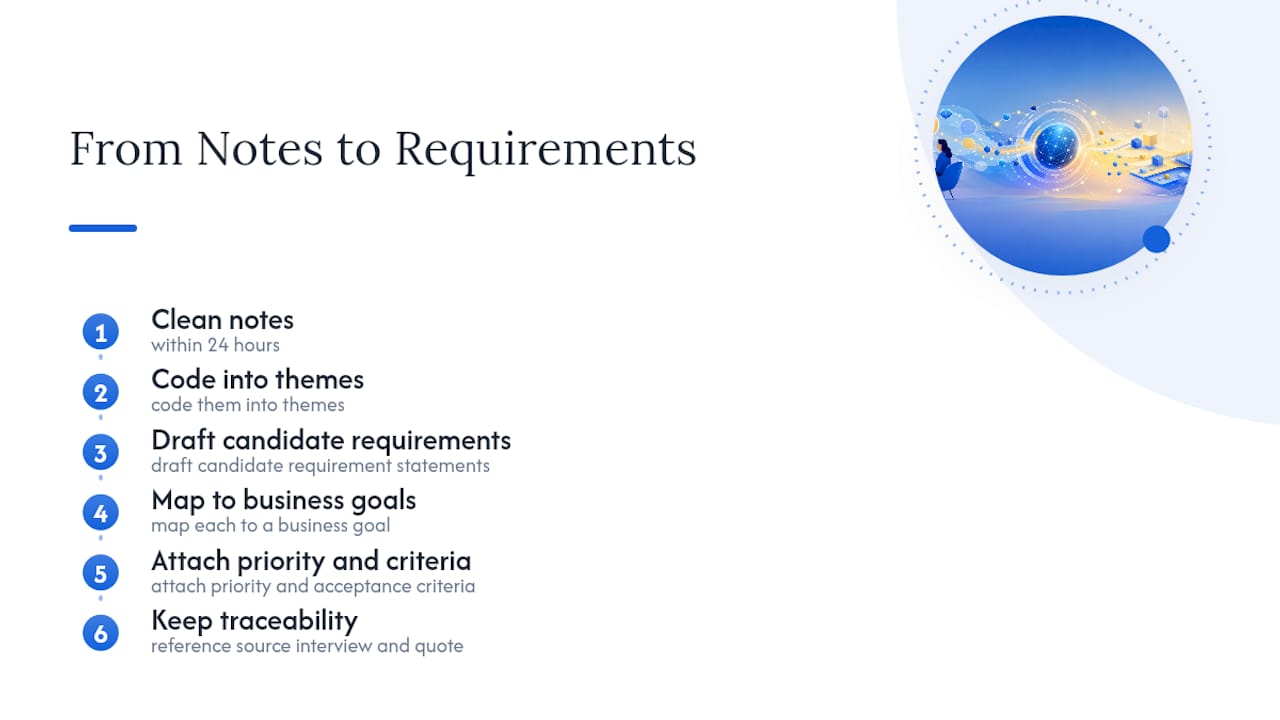
- Clean up notes within 24 hours, while context is still fresh.
- Code the notes into themes, tagging repeated concerns, constraints, and goals.
- Draft candidate requirement statements directly from those themes.
- Map each candidate back to a business goal, so nothing floats free of purpose.
- Assign priority and draft acceptance criteria for each one.
Here’s what that looks like in practice. A support lead says, during an interview: “We spend 20 minutes on every refund call just verifying the customer’s original order because the system doesn’t show order history on the account page.” That quote, paired with a screenshot of the current account page (the artifact), becomes a functional requirement: the account page must display the customer’s last 12 months of order history. The acceptance criterion follows directly: support agents can locate any order from the last 12 months without leaving the account page.
When stakeholders conflict, a simple priority matrix helps: plot each candidate requirement by business impact against implementation effort, then sequence high-impact, low-effort items first and flag high-impact, high-effort disagreements for a follow-up workshop rather than a unilateral call.
| Documentation Element | Why It Matters |
|---|---|
| Source interview reference | Ties every requirement back to who said it and when |
| Direct quote or paraphrase | Preserves the original intent if the requirement is questioned later |
| Linked artifact | Grounds the requirement in something concrete, not just a memory |
| Priority and rationale | Makes tradeoff decisions visible instead of arbitrary |
That traceability matters most when a requirement gets challenged three months later. Being able to point to the exact interview, quote, and artifact that produced it settles the argument fast.
When to Use Workshops, Surveys, or JAD Sessions Instead
Interviews aren’t the right tool for every situation. Each elicitation method has a job it does best and a weakness that shows up when you push it too far.
- One-on-one interviews excel at depth and tacit knowledge but don’t scale well across dozens of stakeholders.
- Workshops are best when you need to align many stakeholders at once and resolve disagreements in real time, but they can be dominated by the loudest voice in the room.
- Email surveys work for low-touch fact gathering across a large group, but they lose the follow-up questions that make interviews valuable.
- JAD (Joint Application Design) sessions combine stakeholders and technical staff to hash out requirements collaboratively, which speeds consensus but requires heavy facilitation to stay productive.
A practical hybrid: interview a representative sample of five to eight stakeholders first, run a workshop to resolve the conflicts and gaps those interviews expose, then send a short survey to validate the resulting requirements across the wider group. This sequence keeps the depth of interviews while scaling input to everyone who needs a voice. Research into UX-focused stakeholder interviews recommends coding interview output specifically into consensus, conflicts, and gaps, which maps directly onto that workshop-then-survey sequence.
The Mistakes That Quietly Break Requirements
Most requirements failures trace back to a handful of repeatable mistakes, and most of them are avoidable with a small process change.
| Pitfall | Practical Fix |
|---|---|
| Skipping internal stakeholders (support, legal, ops) | Build a stakeholder map before scheduling any interviews, and ask “who else?” at the end of every session |
| Treating stakeholder assumptions as verified facts | Request the underlying artifact or data before accepting a claim as a requirement |
| Poor note hygiene and delayed write-ups | Clean up and code notes within 24 hours, while memory is still accurate |
| No traceability from quote to requirement | Log the source interview and excerpt next to every requirement statement |
Pro Tip: Never let a stakeholder’s confident tone substitute for evidence. “Everyone does it this way” is an assumption until someone shows you the process document that proves it.
What the Research Actually Says About Interview Practice
The academic and practitioner literature on this topic converges on a few specific points that are worth taking seriously, not just as general advice but as findings with real backing.
A socio-technical approach to elicitation, one that captures social, political, and organizational context alongside technical detail, produces more complete requirements than a purely technical interview ever will.
The socio-technical research on questionnaire-based elicitation is blunt about this: interviews that ignore organizational politics miss requirements that later resurface as adoption failures. The same research found that preparation quality predicts elicitation success more reliably than years of interviewer experience, a genuinely counterintuitive finding for anyone who assumes seniority alone produces better interviews.
- Interviews should be treated as iterative, not a one-time gate at project start.
- Preparation, drafted questions, requested artifacts, a clear goal, consistently outperforms improvisation.
- Political and social context is not optional detail; it’s part of the requirement.
- Internal stakeholders like support and legal need dedicated interview slots, not an afterthought.
What Changed When We Started Treating Interviews as the First Draft of Requirements
The biggest shift we’ve seen in how teams use stakeholder interviews isn’t about asking better questions. It’s about treating the interview transcript itself as a working draft of the requirements document, instead of a soft input that gets rewritten from scratch later. Projects that skip that step tend to lose the nuance stakeholders actually gave them, the caveat, the edge case, the “well, except when,” and replace it with a clean but hollow requirement that reads well and misses the point.
Empathy and traceability aren’t soft skills here. They’re operational habits. Every requirement should be able to answer the question “who said this, and why,” and if it can’t, that’s a sign the interview process skipped a step somewhere.
From Interviews to Verified Requirements
Interviews give you the requirements. What happens next determines whether those requirements survive contact with a real build. Written specs drift, developers interpret acceptance criteria differently than the stakeholder who described them, and gaps that never came up in a 45-minute conversation surface the moment real users touch the product.

That’s the gap Wezardapp is built to close. It’s the alternative to relying on written bug tickets alone during UAT, where context from stakeholder conversations gets lost in translation. Wezardapp records the screen during testing so testers can show exactly what they mean instead of describing it secondhand, uses AI transcription to preserve the tester’s exact language in real time, and flags duplicate tickets before they clutter your Jira or Azure DevOps backlog. Those three pieces matter directly for requirements traceability: a recorded UAT session tied back to an acceptance criterion from a stakeholder interview closes the loop that written specs alone can’t.
If you’re mapping stakeholder-defined success metrics into formal entry criteria for testing, Wezardapp’s guide to acceptance testing entry criteria walks through exactly how that mapping works, and you can see the full UAT workflow on the Wezardapp UAT testing page to check whether it fits your team’s current process.
Frequently Asked Questions
What is the primary role of stakeholder interviews in requirements gathering?
Stakeholder interviews uncover the business goals, technical and legal constraints, and tacit assumptions that turn a vague project idea into testable requirements. They also build the trust and alignment needed for stakeholders to support the final product.
How many stakeholders should I interview before writing requirements?
There’s no fixed number, but a first round typically covers five to eight roles: the executive sponsor, product owner, support lead, a sales or customer-facing rep, legal or compliance if relevant, and an operations or IT contact. Use a Power-Interest Grid to decide who else needs a slot.
When should stakeholder interviews happen in a project timeline?
Ideally before kickoff, and again whenever scope changes, new stakeholders join, or conflicting views emerge. Treat interviews as iterative rather than a single upfront exercise.
How do I turn interview notes into actual requirements?
Clean up notes within 24 hours, code them into themes, draft candidate requirement statements from those themes, map each to a business goal, and attach priority and acceptance criteria. Keep a reference to the source interview and quote for traceability.
Are stakeholder interviews better than surveys or workshops?
Interviews are strongest for depth and tacit knowledge but don’t scale to large groups easily. Workshops are better for aligning many stakeholders at once, and surveys work for low-touch fact gathering. Many teams combine all three: interview a sample, workshop the conflicts, then survey to validate.
Sources
- Stakeholder Interviews 101 – NN/G
- Build empathy with stakeholder interviews, part 1: Preparation – 18F
- Requirements engineering study (academic)
- A socio-technical-based process for questionnaire development in requirements elicitation via interviews
- Stakeholder Analysis – MindTools


