
A feedback loop in QA is the path a finding takes from the person who spots it to the person who fixes it, and back again as a verified result that changes how the team works next time. The loop is only closed when the learning changes a future decision. For business users, analysts and project managers running acceptance testing, the weak points are almost always at the edges: a vague report going in, or a fix that never gets confirmed coming out. That is why we built Wezard to record the screen, transcribe the issue as the tester speaks and flag duplicates before they reach Jira or Azure DevOps.
TL;DR
- A QA feedback loop connects a finding to a decision, a fix, a verification and a lesson. Skip any link and the same defects return.
- Report quality decides loop speed. A triage-ready report states observed and expected behavior, reproduction steps, environment and evidence.
- Classify defects by origin and review them regularly, so you fix the process and not only the symptom.
- Measure the loop with defect leakage, reopen rate, defect age and rejection rate, and use them to guide improvement, not to rank people.
- Loops fail when alerts are noisy, nobody owns the review, or actions vanish from the backlog.
Table of Contents
- What a feedback loop in QA actually is
- Loops run at different speeds
- The stages, from finding an issue to verifying the fix
- How feedback moves between roles
- Metrics that show whether the loop works
- What breaks a QA feedback loop
- Wezard for your UAT feedback loop
- Our perspective
- FAQ
- Sources
What a feedback loop in QA actually is
The MSQE handbook describes a feedback loop as something that connects evidence to a decision and then changes future behavior. A test result, a tester’s note or a production incident is evidence. The decision might be to fix now, defer or change the requirement. The behavior change might be a new acceptance criterion or an added check.
Timing matters because cost grows with distance. The MinimumCD defect feedback guide points out that a requirements defect caught while the team is still discussing examples costs minutes, while the same defect found in production costs days of incident response, rollback and rework.
The same guide defines the improvement side of the loop in four steps:
- Classify every defect by where it originated.
- Review the classifications monthly or in retrospectives to spot patterns.
- Apply the systemic fix, not only the local one.
- Track defect counts by category over time to see whether the fix worked.
If counts in a category do not fall after the fix, the fix is not working and the team needs a different approach.
Loops run at different speeds
The MSQE handbook sorts loops by speed and scope, which helps business teams see where UAT sits:
| Loop | Typical signal | Decision it drives |
|---|---|---|
| Immediate | Compiler, static analysis, unit tests | Correct a local change |
| Iteration | Review findings, integration results, exploratory testing | Refine the increment or test strategy |
| Release | Deployment verification, canary signals | Continue, pause or adjust exposure |
| Operational | Service indicators, incidents | Restore service and improve controls |
| Strategic | Recurring trends | Change platform, staffing, governance or priorities |
User acceptance testing is an iteration-level loop with strategic consequences. Business testers confirm the software does what the business asked for, and the pattern of what they find tells you whether requirements were clear in the first place. Lisa Crispin’s holistic testing expansion for Scrum states that the focus is continuous improvement through small experiments and short feedback loops, with testing activities placed at the right time across the whole cycle.
The stages, from finding an issue to verifying the fix

1. Capture the finding
Everything downstream depends on this step. A triage-ready defect report contains the observed behavior, the expected behavior, the shortest reproduction path, the environment and build, data conditions, frequency and supporting logs or images. Testers who are business users, not engineers, rarely know which of these matter, so reports arrive as “the screen is broken” and a developer spends a day asking questions.
This is where we put our effort. Wezard records the screen while the tester works, transcribes what they say in real time, and supports guided ticket submission, so the observed behavior, the steps and the spoken explanation arrive together. For a closer look at choosing between formats, see screenshot versus video bug reports.

2. Remove duplicates before they hit the backlog
In a UAT round, ten testers often hit the same defect. Ten tickets mean ten triage conversations and a backlog that hides the real count. Wezard uses AI to detect duplicate tickets before they reach your Jira or Azure DevOps backlog, and we position it as reducing duplicate noise by up to 40% compared with manual processes. Our guide on preventing duplicate Jira tickets at capture walks through the approach.
3. Triage
Triage separates three questions: is the defect valid, how severe is it, and how urgent is it to fix. They are not the same. QABattle’s example: a spelling error can be low severity but urgent before a launch, while rare data corruption can be critical but deferrable behind a feature flag. Keep outcomes such as duplicate, works as designed or cannot reproduce as resolution reasons, not as permanent queues, so reporting stays readable and it is clear who must act. Our UAT bug triage guide covers sorting and ranking for business testers.
4. Fix and hand back
A good handoff from development says what the suspected cause is, which change fixes it, which versions are affected, which tests were added and whether a deployment or migration step is needed. Before the ticket moves to “Ready for test,” confirm the change is merged, the named build contains it, it is deployed to a testable environment and nearby regression areas are noted.
The MinimumCD guide adds a strong rule: every bug fix includes a test that fails before the fix and passes after. That proves the fix addresses the defect, prevents recurrence and adds coverage where the code is weakest.
5. Verify
Retesting repeats the original failure conditions. Regression testing checks nearby behavior the change could have disturbed. Both go back to the person who reported the problem, which is what actually closes the loop for them. Our article on closing the feedback loop in UAT with human review lays out five stages for this part.
6. Learn
Classify, review, change the process. If most defects come from integration boundaries, the MinimumCD guide says the answer is to make contract tests mandatory for each new boundary, not to write more integration tests. Treat each failure as data about where the process breaks.
How feedback moves between roles
Feedback travels through several hands, and each pair of hands is a place it can stall.
- Business analysts and QA agree acceptance criteria early. In the Agile Alliance QA process, QA works with the analyst to write criteria that feed the development team, and after a story is built a joint session checks those criteria on the developer’s environment. All failures must be fixed before the story counts as development-complete. See our guide to types of software acceptance criteria.
- UAT testers and developers exchange reports and fixes. Testers need a fast way to report and a clear status back. Our piece on tracking feedback status in Jira shows how to keep that status visible.
- Project managers watch flow: how long items wait, how many return, which areas keep failing.
Crispin and Gregory’s Agile Testing calls quick feedback from testing the most critical difference for testers on an agile project. Wezard integrates directly with Jira, Azure DevOps and ServiceNow, so the report lands in the system developers already use with the recording and transcript attached.
Metrics that show whether the loop works
Start with a small set and review it on a schedule. Commonly used defect measures, as listed by QAReady, include:
- Defect leakage: production defects divided by total defects, times 100.
- Defect removal efficiency: defects found before release divided by total, times 100.
- Defect reopen rate: reopened divided by closed, times 100, a signal of fix quality.
- Defect age: close date minus open date.
- Defect rejection rate: a signal of report quality.
GitScrum’s coordination guide suggests also tracking tasks sent back from QA and average time in QA. A high send-back rate points to unclear requirements or gaps in acceptance criteria, and long QA times point to bottlenecks.
Traceability speeds up diagnosis. An IJMCSIT study of Jira, Jenkins and Azure DevOps integration reported that after integrating, mean time to restore fell 60% and the release failure rate dropped from 17.1% to 8.4%. The authors attribute the restore-time gain to being able to trace a production bug back through the release, build, commit and originating ticket. That is one organization’s result, not a promise, but it shows why tickets linked to the backlog matter.
Per the MSQE handbook, which draws on DORA guidance, use measures to guide local improvement, not as rankings between teams or people. Rankings push testers to under-report. For more on reporting, read our QA reporting best practices.
What breaks a QA feedback loop
The MSQE handbook names three failure modes:
- Noisy signals. An alert or ticket stream is not feedback if the people receiving it cannot tell what it means. Duplicates and thin reports are the UAT version of this.
- No owner. A dashboard creates no learning if nobody is responsible for reviewing it.
- Vanishing actions. A postmortem does not improve quality if its actions disappear from the backlog.
To these, add unassigned defects, which are invisible to everyone, and a high reopen rate, which points to weak fixes or thin test coverage. The prevention is plain: give each stage a named owner, put review dates on the calendar, and keep improvement actions in the same backlog as feature work. Teams working on how engineering lessons become practice may find this predictable engineering playbook helpful, and our own look at why QA standards reduce production bugs covers the standards side.
Wezard for your UAT feedback loop
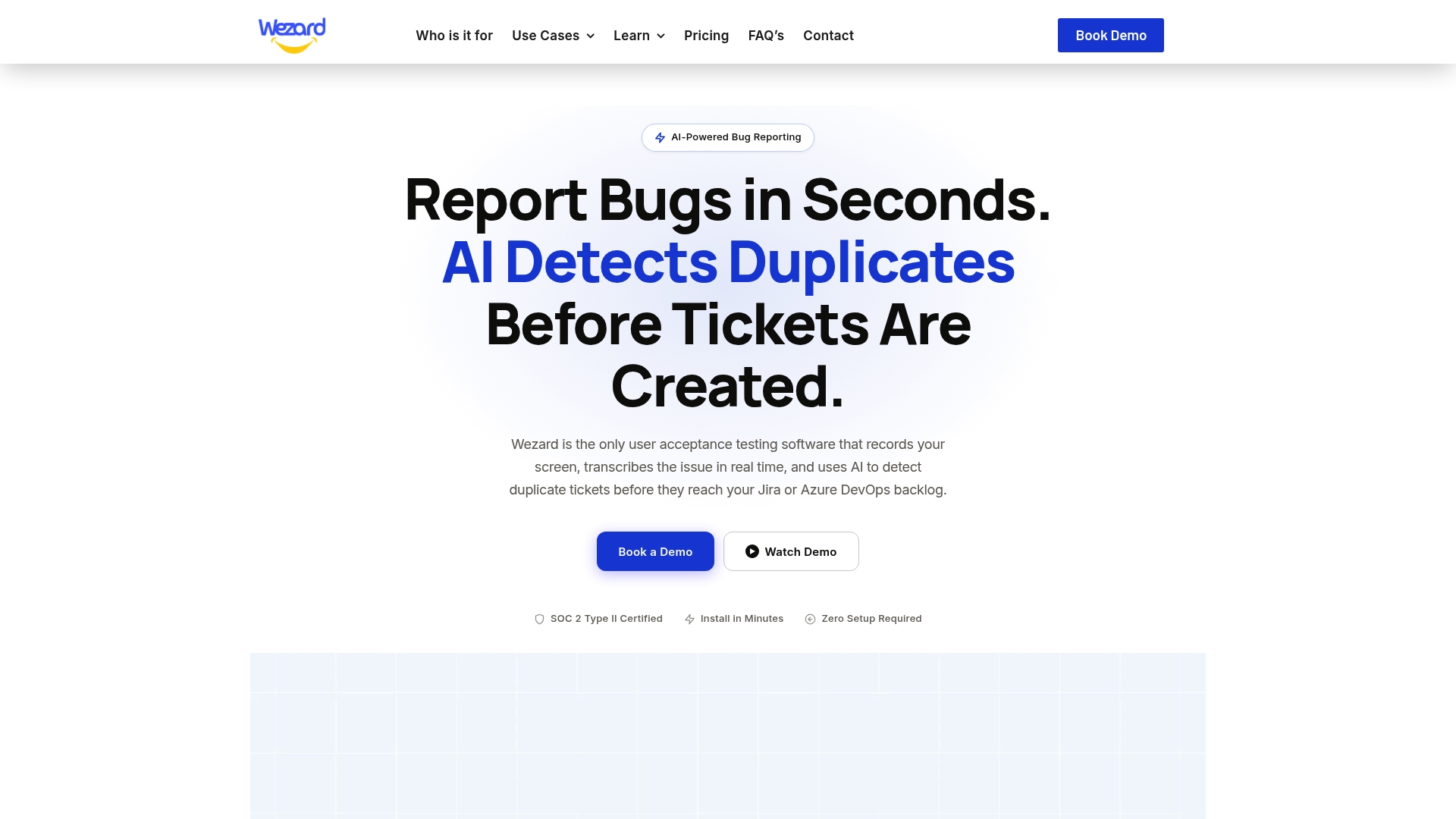
Wezard is user acceptance testing software built for the capture and handoff stages of the loop: screen recording, real-time transcription, voice or video ticket creation, screenshots and file attachments, duplicate detection and direct integration with Jira, Azure DevOps and ServiceNow. It carries SOC 2 certification and supports enterprise SSO.
Plans are published at wezardapp.com/pricing: Starter at $25 per month, Team at $70 per month and Business at $160 per month, with Enterprise priced on request.
To see how teams use it across a UAT round, browse our use cases.
Our perspective
Most teams treat the feedback loop as a process diagram. We treat it as a quality-of-evidence problem. When a business tester spends two minutes recording what they see and saying what they expected, the developer gets the observed behavior, the steps and the intent in one place, and the loop starts fast.
The second half is signal. A backlog full of duplicates trains people to stop reading it. We designed Wezard to detect duplicates before they reach Jira or Azure DevOps, so the tickets that arrive each mean something, and the tester who reported it can see what happened next.
A loop that runs on clear reports and a clean backlog is one a team will keep reviewing, and a loop that gets reviewed is one that improves releases.
Marketing
FAQ
What is a feedback loop in QA?
It is the cycle in which a finding from testing reaches the people who can act, the action is verified, and the lesson changes future work. The loop is complete only when learning changes a later decision.
How is a UAT feedback loop different from developer testing?
Developer tests check code behavior quickly and locally. UAT is run by business users who confirm the software meets business needs, so its feedback concerns requirements and workflows. Our guide on UAT versus system testing explains the split.
Who should own the loop?
Name one owner per stage: testers for capture and retest, QA or analysts for triage, developers for fixes and project managers for review of trends. Unowned stages are where loops stall.
How often should we review defect patterns?
The MinimumCD guide recommends monthly or at retrospectives. Review classifications by origin, apply a systemic fix, then check whether counts in that category fall.
Sources
- Defect Feedback Loop, MinimumCD Practice Guide
- Chapter 5, Shift Left, Shift Right and Shift Everywhere, MSQE handbook
- Holistic Testing, Quality Engineering, and Scrum
- Defect Life Cycle Explained, QABattle
- Agile QA Process, Agile Alliance
- Agile Testing: A Practical Guide for Testers and Agile Teams
- QA/SDET Theory Questions, QAReady
- QA and Development Coordination Best Practices, GitScrum
- Integrating Jira, Jenkins, and Azure DevOps, IJMCSIT
- Improving Software Quality: Predictable Engineering Playbook