
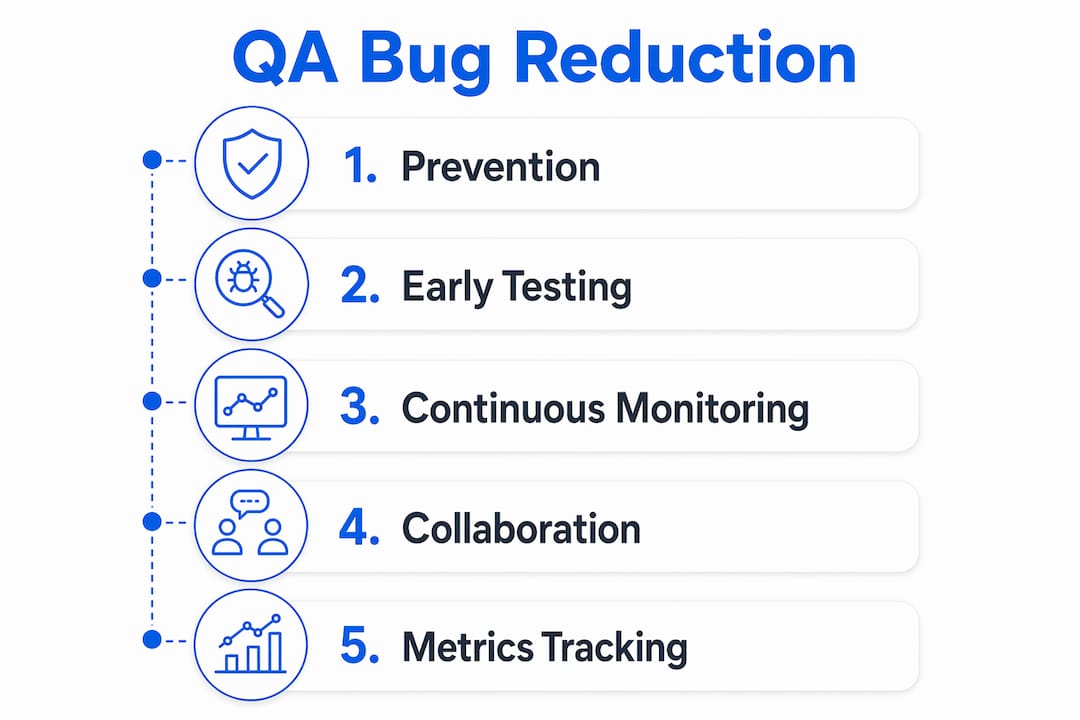
QA standards reduce production bugs by shifting the entire quality effort upstream, from detecting defects after they are built to preventing them from being introduced in the first place. Organizations that implement robust QA practices report a 45% reduction in post-release defects and a 30% decrease in overall development costs. The mechanism is not mysterious: when you define consistent processes, enforce quality gates at every pipeline stage, and treat quality as a shared responsibility across the whole team, defects get caught where they cost almost nothing to fix rather than in production where they cost orders of magnitude more.
The primary mechanisms QA standards use to keep bugs out of production:
- Defect prevention over detection: Code reviews, design walkthroughs, and static analysis stop bugs from being written in the first place.
- Shift-left testing: Requirements reviews, behavior-driven development (BDD), and unit tests catch defects when context is still fresh and fixes are cheap.
- Quality gates in CI/CD pipelines: Automated checks block flawed code from progressing to the next stage.
- Standardized error logging and bug reporting: Consistent formats accelerate triage and reduce duplicate tickets clogging the backlog.
- Critical-to-Quality (CTQ) focus: ISO quality frameworks direct resources toward the defect types that actually hurt users, not just the easiest ones to find.
- Production monitoring: Canary releases, feature flags, and observability tools act as a final safety net when something slips through.
- Shared quality ownership: When developers write tests, product managers define acceptance criteria, and any team member can block a release, defect escape rates drop.
Why bugs keep reaching production
The answer is almost never a single failure. Bugs reach production because of compounding systemic problems, and understanding those root causes is what makes QA standards worth implementing.
- Testing too late: Most teams still concentrate testing at the end of the development cycle. By the time testers find defects, the development context is gone, fixes are expensive, and deadline pressure forces teams to ship with known issues. Teams with less than 60% automation coverage are up to 3x more likely to experience critical production defects.
- Insufficient test coverage: Having 1,000 test cases means nothing if they only cover happy paths. The bugs that reach production live in edge cases, error handling paths, race conditions, and integration boundaries.
- Manual regression at scale: A team releasing weekly cannot re-test every feature by hand. Without automation, regression coverage shrinks with every release, and defect escape probability rises proportionally.
- No quality gates in CI/CD: When there are no mandatory checks blocking merges or deployments, flawed code flows downstream unchallenged.
- Environment mismatches: Differences in data volume, configuration, and third-party service versions mean tests pass locally but features fail in production.
- Siloed quality responsibility: When QA is treated as one team’s job rather than a shared concern, developers skip tests, product managers skip acceptance criteria, and managers pressure teams to ship on deadline regardless.
- No production monitoring: Without observability and alerting, defects that slip through testing go undetected until customers report them, sometimes days later.
Key stat: Production defects cost up to 100x more to fix than defects caught during the design phase. Every stage a bug travels downstream multiplies the cost of fixing it.
Why preventing production bugs matters beyond the technical cost
Production bugs are expensive in ways that go well beyond the engineering hours to patch them. A defect caught during requirements review costs roughly 1x to fix. The same defect caught in production costs 100x or more, and that figure does not include reputational damage, customer churn, or the compliance exposure that follows a public incident.
The business case is concrete. Organizations with robust production monitoring report faster mean time to resolution and lower development costs. Companies using structured post-release validation see substantially fewer critical hotfixes in the first month after release. Those are not marginal gains; they directly affect release velocity and developer capacity.
There is also a morale dimension that rarely shows up in ROI calculations. Bug-induced firefighting is one of the fastest ways to burn out a development team. When engineers spend a third of their time on production incidents instead of building features, velocity collapses and attrition follows. Structured QA breaks that cycle.
Pro Tip: Frame QA investment to leadership using the Cost of Quality framework: prevention costs (tooling, reviews, training) are orders of magnitude cheaper than failure costs (incidents, rework, lost customers). The ROI argument almost always wins when the numbers are laid out this way.
Customer satisfaction scores improve by over 60% when organizations implement thorough QA practices, which correlates directly with reduced defect rates and lower maintenance costs. That is the business case in one number.
Key QA standards and practices that actually improve software quality
ISO quality assurance frameworks reduce process variation by focusing resources on Critical-to-Quality factors and standardized procedures, which directly correlates to fewer defects. ISO 9001, the most widely adopted quality management standard, requires organizations to define quality objectives, enforce consistent processes, and pursue continual improvement. It is not a software-specific standard, but its discipline around process control applies directly to development teams.
Beyond ISO, the practices that move the needle most are:
- Code reviews: When systematically implemented, code reviews reduce defect density by up to 60%. Pair programming and regular walkthroughs compound that effect.
- Static analysis: Tools like ESLint catch code defects automatically, before any human reviewer spends time on them. A pre-commit hook enforcing static analysis makes the cost of ignoring findings higher than fixing them.
- Unit and integration testing: Projects with comprehensive unit test coverage above 80% show a 40% reduction in integration issues.
- Continuous integration: Automatically building, testing, and validating code changes has been shown to reduce integration problems by 70% and improve team productivity by 25%.
- Standardized bug reporting: Consistent formats for logging defects reduce miscommunication, speed up triage, and prevent duplicate tickets from clogging the backlog. Teams that standardize bug reporting across testers spend less time on rework and more time on prevention.
- Design and requirements reviews: Stakeholder review of specifications is the highest-ROI quality activity in the entire lifecycle. It catches ambiguities before they become bugs.
The table below shows the impact of these core QA practices on key defect metrics, drawn from multi-industry research.
| QA Practice | Primary Impact | Reported Improvement |
|---|---|---|
| Code reviews | Defect density reduction | Up to 60% fewer defects |
| Continuous integration | Integration problem reduction | 70% fewer integration issues |
| Comprehensive unit testing (>80% coverage) | Integration issue reduction | 40% fewer integration issues |
| Automated regression testing | Regression defects in production | 80% fewer regression issues |
| Structured post-release validation | Critical hotfixes in month one | 40% reduction |
| Production monitoring | Mean time to resolution | 30% faster MTTR |
Quality management systems implemented with genuine internal improvement motives, rather than just for certification, lead to measurably improved profitability, employee motivation, and operational efficiency. The distinction matters: teams that adopt QA standards to actually get better see far greater benefits than those chasing a compliance checkbox.
Continuous and shift-left testing strategies to catch bugs early
Shift-left testing is the single most effective structural change a team can make to reduce defect escape rates. The principle is simple: move testing to the earliest possible point in the lifecycle, starting at requirements, not at the end of a sprint. Organizations integrating continuous quality gates at requirements, design, code, test, and production stages achieve very high defect catch rates before production with layered shift-left approaches.

Continuous testing embedded throughout the development pipeline enables a 60% reduction in critical defects and 40% faster time to market. That combination, fewer bugs and faster releases, is what makes the business case for shift-left so compelling.
The practices that make this work in practice:
- Test creation at requirements stage: Writing test cases before code exists catches specification defects that no amount of code-level testing will find. BDD with Gherkin syntax creates executable specifications that both developers and product managers can validate.
- The 70/20/10 test pyramid: Aim for 70% unit tests, 20% integration tests, and 10% end-to-end tests. This ratio maximizes coverage while minimizing maintenance overhead and flaky test failures.
- Automated quality gates in CI/CD: Block merges when unit tests fail. Block deployments when integration tests fail. Set minimum code coverage thresholds. Require security scan clearance before production.
- Exploratory testing alongside automation: Automation excels at regression and repetitive scenarios. Human judgment catches UX problems, edge cases, and the unexpected interactions that scripted tests miss.
- Shared test ownership: Developers write unit and integration tests. QA engineers design test strategies and exploratory plans. Product managers define acceptance criteria that become the baseline for every test scenario.
- Shift-right validation: Canary releases, feature flags, and synthetic monitoring validate real user conditions in production safely, complementing the shift-left approach rather than replacing it.
Pro Tip: Shift test creation left, not just test execution. A test case written during requirements review catches specification defects that no code-level test will ever surface. That is where shift-left delivers its highest return.
Best practices to implement QA standards effectively and reduce defects
Adopting QA standards is not primarily a tooling problem. It is a culture and process problem. The teams that see the biggest reductions in production defects are the ones that change how they think about quality, not just which tools they run.
- Define and enforce a strong Definition of Done: Every piece of work must satisfy explicit quality criteria before it is considered complete. A strong DoD prevents the “works on my machine” problem and ensures consistent standards across the team. If a story cannot be completed to the DoD within a sprint, it carries over rather than shipping incomplete.
- Invest in prevention, not just detection: High-performing teams spend a larger share of quality time on defect prevention activities like code reviews, pair programming, and static analysis, and less on detection alone. The Cost of Quality framework makes this case clearly: prevention costs are orders of magnitude cheaper than failure costs.
- Empower any team member to block a release: In Toyota’s manufacturing plants, any worker can pull the Andon cord to stop the production line on a quality concern. The software equivalent is giving every team member the authority to block a release. Without explicit cultural support from leadership, this never happens, and defects flow to production.
- Enforce quality gates in CI/CD automatically: Manual enforcement breaks down under deadline pressure. Automated gates that block merges and deployments on test failure, coverage thresholds, or security scan results do not bend to schedule pressure.
- Augment pre-production testing with production validation: Staging environments rarely replicate production conditions fully. Leading teams use canary releases and feature flags as last-resort quality gates, catching issues that pre-production testing cannot surface.
- Foster shared ownership across all roles: Quality is not QA’s job. Developers who do not write tests, product managers who skip acceptance criteria, and managers who pressure teams to skip testing all contribute to bugs reaching production. Embedding QA engineers in development teams from sprint planning onward is the structural fix.
- Use QA reporting practices that communicate clearly: Defect data that sits in a spreadsheet no one reads does not drive improvement. Reporting that surfaces trends, escape rates, and phase containment data gives leadership the visibility to make good decisions.
A useful pre-launch reference for teams building out their QA process is a comprehensive QA checklist covering the checks that matter most before any release goes live.
Metrics and KPIs to measure the impact of QA standards on production bugs
You cannot improve what you do not measure. The right metrics tell you whether your QA standards are actually working or just creating the appearance of process.

Defect escape rate is the most direct measure of QA effectiveness. It tracks the percentage of defects that reach production versus those caught in pre-production stages. A team with a high escape rate has a process problem somewhere upstream, and this metric points you toward it.
Phase containment breaks defect escape rate down by lifecycle stage, showing how many defects were introduced and caught at requirements, design, code review, unit test, integration test, and system test. This is where you find the specific gaps in your quality gates.
Mean time to detect (MTTD) and mean time to resolve (MTTR) measure how quickly your team finds and fixes production issues. Organizations with robust production monitoring report 30% faster MTTR. Tracking these over time shows whether your observability and alerting investments are paying off.
Defect density measures bugs per unit of code, usually per thousand lines or per feature. Tracking this across releases shows whether code quality is improving or degrading as the codebase grows.
Test coverage is a proxy metric, not a quality guarantee, but coverage below 80% on critical paths is a reliable predictor of integration issues. Pair it with defect density to get a fuller picture.
Regression rate tracks how often new releases introduce defects in previously working functionality. Companies with comprehensive regression test automation report 80% fewer regression issues in production.
Cost of quality tracks the ratio of prevention costs (reviews, tooling, training) to failure costs (incidents, rework, support). As QA standards mature, this ratio should shift toward prevention. If failure costs are still dominating, the process is not working.
The DORA four metrics (deployment frequency, lead time for changes, change failure rate, and time to restore service) provide a team-level view of whether quality practices are enabling or constraining delivery speed. Research from the DORA team, published in Accelerate by Nicole Forsgren, Jez Humble, and Gene Kim, conclusively showed that high-performing teams deploy more frequently and have lower change failure rates simultaneously. Quality and speed are not a tradeoff.
What real QA standard adoption looks like in practice
The numbers from teams that have gone through a full shift-left transformation are striking. One documented case involved a team that dramatically reduced production defects per release, simultaneously increased release frequency, lowered defect escape rate significantly, reduced mean time to detect production issues substantially, and greatly cut monthly cost of production defects.
The total investment in tooling, training, and process changes was approximately $280,000. Annual savings exceeded $9 million. That is not an outlier. Teams that adopt shift-left practices consistently see 60–90% reductions in production defects.
What made the difference in that case was not a single tool or technique. It was the combination: requirements reviews using BDD, contract tests across all integration points, automated quality gates at every pipeline stage, and production monitoring that fed defect data back into the test suite. Each layer caught what the previous layer missed.
Mature organizations treat production bugs as signals for process improvement, not just incidents to resolve. When a defect escapes to production, the right question is not “who missed this?” but “which quality gate should have caught it, and why didn’t it?” That feedback loop is what separates teams that continuously improve from teams that keep shipping the same categories of bugs year after year.
How team communication and collaboration enforce QA standards
QA standards fail in isolation. A perfectly written Definition of Done means nothing if developers do not know it exists, product managers do not reference it during story writing, and managers override it under deadline pressure.
The teams with the lowest defect escape rates share a few structural habits. QA engineers join sprint planning from day one, not just the testing phase. Requirements reviews include QA, development, and product together, so ambiguities get surfaced before anyone writes a line of code. Acceptance criteria validation by QA analysts happens at the story level, not after development is complete.
Cross-functional visibility into defect data matters just as much. When defect escape rates, phase containment numbers, and regression trends are visible to the whole team, quality becomes a shared concern rather than a QA team metric. Developers who can see that their code review shortcuts are showing up as integration defects two weeks later tend to change their behavior.
The cultural piece is harder to mandate than the process piece. Leadership has to explicitly support the ability to block a release on quality grounds. If pulling the Andon cord gets someone criticized, no one will pull it. That requires stated policy, not just good intentions, and it requires managers who back it up when a release gets blocked the week before a deadline.
Challenges and pitfalls in adopting QA standards and how to overcome them
The most common failure mode is treating QA standard adoption as a documentation exercise. Teams write a Definition of Done, create a test plan template, and check the box. Six months later, the DoD is ignored, the templates are empty, and defect escape rates are unchanged. Standards only reduce bugs when they are enforced, not just written.
A second common pitfall is automating the wrong things first. Teams under pressure to show automation progress often automate end-to-end UI tests because they are visible and impressive. But UI tests are slow, brittle, and expensive to maintain. The 70/20/10 pyramid exists for a reason: start with unit tests, build integration coverage, and keep end-to-end tests minimal and risk-targeted.
Resistance from developers is real and usually stems from two sources: the perception that QA standards slow them down, and the feeling that writing tests is someone else’s job. Both are addressable with data. The DORA research is unambiguous: quality practices enable speed rather than constraining it. Teams that invest in automated testing and code reviews deploy more frequently, not less. Sharing that data with skeptical developers tends to shift the conversation.
Organizational silos are the structural version of the same problem. When QA is a separate department that receives code at the end of a sprint, no amount of standards documentation will fix the fundamental timing problem. The fix is embedding QA engineers in development teams and making quality a sprint-level concern from the first day of planning.
Finally, environment parity is a persistent technical challenge. Staging environments that do not match production conditions will always produce false confidence. The practical answer is not to build a perfect staging environment, which is rarely achievable, but to complement pre-production testing with production validation techniques: canary releases, feature flags, and synthetic monitoring that catch what staging cannot. For SaaS teams building out these practices from scratch, a 21-discipline engineering framework can provide a structured starting point for proactive defect prevention before deployment.
How Wezardapp fits into a QA standards-driven workflow
Wezardapp is built for the moment where QA standards meet real user testing. It records your screen during user acceptance testing, transcribes the issue in real time, and uses AI to detect duplicate tickets before they reach your Jira or Azure DevOps backlog. That last part matters more than it sounds: duplicate tickets are one of the most consistent sources of wasted QA effort, and catching them automatically keeps your backlog clean and your team focused on real defects.
For teams implementing the kind of shift-left, standards-driven QA process described in this guide, Wezardapp handles the UAT layer where structured acceptance testing criteria meet actual user behavior. It closes the loop between the quality gates you build into your pipeline and the real-world validation that happens before a release goes live.

If your team is working to reduce production bugs through better QA standards, start with the UAT layer. Explore Wezardapp’s UAT testing tool to see how AI-assisted bug capture and duplicate detection fit into your existing workflow.
Key Takeaways
QA standards reduce production bugs by embedding defect prevention throughout the entire software development lifecycle, not by adding more testing at the end.
| Point | Details |
|---|---|
| Prevention beats detection | Defects caught at requirements cost 1x to fix; the same defect in production costs 100x or more. |
| Shift-left delivers measurable results | Organizations using layered shift-left approaches achieve very high defect catch rates before production. |
| Automation coverage matters | Teams with less than 60% automation coverage are up to 3x more likely to experience critical production defects. |
| QA standards reduce costs | Organizations with mature QA processes report over 60% reduction in post-release defects and a 30% decrease in development costs. |
| Culture enforces standards | A Definition of Done and the authority to block releases on quality grounds are what turn written standards into actual defect reduction. |


