
Tester feedback is defined as the structured communication of test results, defect observations, and behavioral insights from testers to developers and stakeholders. This communication is the primary mechanism through which quality assurance (QA) converts testing activity into real product improvements. Testing generates value only to the extent that its feedback improves understanding and supports better decisions at both the individual and team level. Frameworks like ISTQB and the CLEAR feedback model (Concise, Logical, Empathetic, Actionable, Relevant) exist precisely because feedback quality determines whether defects get fixed or ignored. Teams that treat feedback as a formal discipline, not an afterthought, consistently ship more reliable software.
Why tester feedback improves software quality
Feedback from testers functions as an iterative learning system. Each test cycle produces signals that developers use to adjust code, refine requirements, and reprioritize work. Without that loop, development teams operate on assumptions rather than evidence.
Testers act as the organization’s intelligence system, generating feedback that informs decisions ranging from a developer’s next commit to an executive’s release approval. That framing matters because it repositions testers from gatekeepers to active contributors in the development process.

The timing of feedback is as important as its content. Catching defects immediately after code is written preserves developer context, making fixes faster and cheaper. When feedback arrives weeks later, developers must re-learn what they built before they can fix it. That delay is not just inefficient. It is expensive.
Clarity and framing also shape how feedback lands. A report that says “the login button doesn’t work” gives a developer almost nothing to act on. A report that includes the operating system, browser version, reproduction steps, and a screenshot gives them everything. The difference between those two reports is the difference between a fix and a reopened ticket.
- Feedback shapes risk perception. Developers and product owners prioritize work based on what testers surface. Vague feedback produces vague priorities.
- Feedback closes the requirement gap. Testers often catch misalignments between what was specified and what was built before users ever see the product.
- Feedback drives learning. Teams that review feedback patterns over time identify recurring defect types and address root causes, not just symptoms.
Pro Tip: Schedule a 15-minute feedback review at the end of each sprint. Reviewing patterns across the sprint catches systemic issues that individual bug reports never reveal.
What makes tester feedback effective?
Effective feedback follows a consistent structure. The CLEAR framework (Concise, Logical, Empathetic, Actionable, Relevant) gives testers a practical model for writing reports that developers can act on immediately.
Each element carries weight. Concise means no unnecessary context. Logical means the steps to reproduce the issue follow a clear sequence. Empathetic means the report acknowledges that developers care about quality too. Actionable means the report contains enough detail to fix the issue without a follow-up conversation. Relevant means the report connects the defect to a real user impact or business requirement.
- Include precise reproduction steps. Number each step. Assume the developer has never seen the screen you are describing.
- Capture environment context. Browser version, OS, device type, and test data all affect reproducibility. Missing one of these details can make a real bug look like a false positive.
- Attach evidence. Screenshots, screen recordings, and log files cut the back-and-forth between testers and developers by more than half in most teams.
- State the expected versus actual result. This single habit eliminates the most common source of confusion in bug reports.
- Link the defect to acceptance criteria. When a report references the specific criterion it violates, developers and product owners immediately understand the business impact.
False positives and false negatives destroy developer trust in feedback signals. When developers learn that test failures sometimes reflect environment issues rather than real product problems, they start ignoring alerts. Rebuilding that trust takes far longer than maintaining it.
Pro Tip: Use a standard bug report template across your team. Consistency reduces the cognitive load on developers and makes triage faster for QA leads.
How is AI transforming tester feedback in 2026?
AI is changing how teams collect, classify, and act on tester feedback. The shift is not about replacing human testers. It is about giving them better tools to structure and communicate what they find.
AI-driven sentiment analysis maps emotional signals from audio recordings to specific app interactions, generating heatmaps that highlight user experience problems without manual surveys. That capability turns qualitative tester reactions into quantifiable data that product teams can prioritize.
- Automated report classification groups incoming feedback by feature area, severity, and defect type. Teams with high-volume testing cycles, such as crowdsourced or beta programs, can process hundreds of reports without manual sorting.
- Duplicate detection prevents the same defect from flooding the backlog with redundant tickets. Agent-generated feedback in crowdsourced testing studies showed that AI assistance improved both the quality of individual reports and testers’ performance on subsequent tasks.
- Impact prediction ranks defects by their likely effect on user behavior and business metrics, helping teams allocate developer time to the issues that matter most.
The human tester’s role in this system is exploration and judgment. AI structures the data. Testers provide the contextual reasoning that no algorithm can replicate. A tester notices that a checkout flow feels confusing even when no error is thrown. That observation, properly documented, is the kind of feedback that prevents churn. AI tools can help surface and organize it. They cannot generate it.
Wezardapp is built on exactly this model. It records the tester’s screen, transcribes the issue in real time, and uses AI to detect duplicate tickets before they reach a Jira or Azure DevOps backlog. The role of AI in test reporting is to reduce noise so that the feedback that reaches developers is clean, contextualized, and ready to act on.
How can teams leverage feedback to improve project outcomes?
Integrating tester feedback into development workflows requires process design, not just good intentions. Teams that treat feedback as a formal input to planning consistently outperform those that treat it as an informal signal.
Early and frequent stakeholder feedback reduces rework, improves requirement quality, aligns development with business needs, and enables faster defect detection. The ISTQB Foundation Level syllabus identifies early feedback as a fundamental best practice, not an optional enhancement. That consensus reflects decades of evidence from production failures caused by late-stage defect discovery.
- Use structured feedback request forms. Teams using structured forms during beta testing achieve higher success rates in securing production access approval. A form forces testers to provide the context developers need and prevents the vague, one-line reports that waste everyone’s time.
- Incorporate tester insights into acceptance criteria. When testers flag edge cases during one cycle, those cases should appear as explicit criteria in the next. This is how feedback compounds into quality over time. The role of acceptance criteria in guiding testers is well established, but the reverse flow, testers shaping criteria, is equally powerful.
- Track feedback status in your project management tool. Feedback that disappears into a backlog without a status update erodes tester motivation. Tracking feedback in Jira creates accountability and gives teams a clear record of which issues were addressed and which were deferred.
- Measure feedback quality metrics. Track defect escape rate, mean time to resolution, and the ratio of valid to invalid reports. These numbers tell you whether your feedback process is improving.
| Metric | What it measures |
|---|---|
| Defect escape rate | Percentage of defects found in production vs. testing |
| Mean time to resolution | Average time from report submission to fix deployment |
| Valid report ratio | Percentage of reports that result in confirmed defects |
| Feedback cycle time | Time from test execution to developer acknowledgment |
What are the common pitfalls in tester feedback processes?
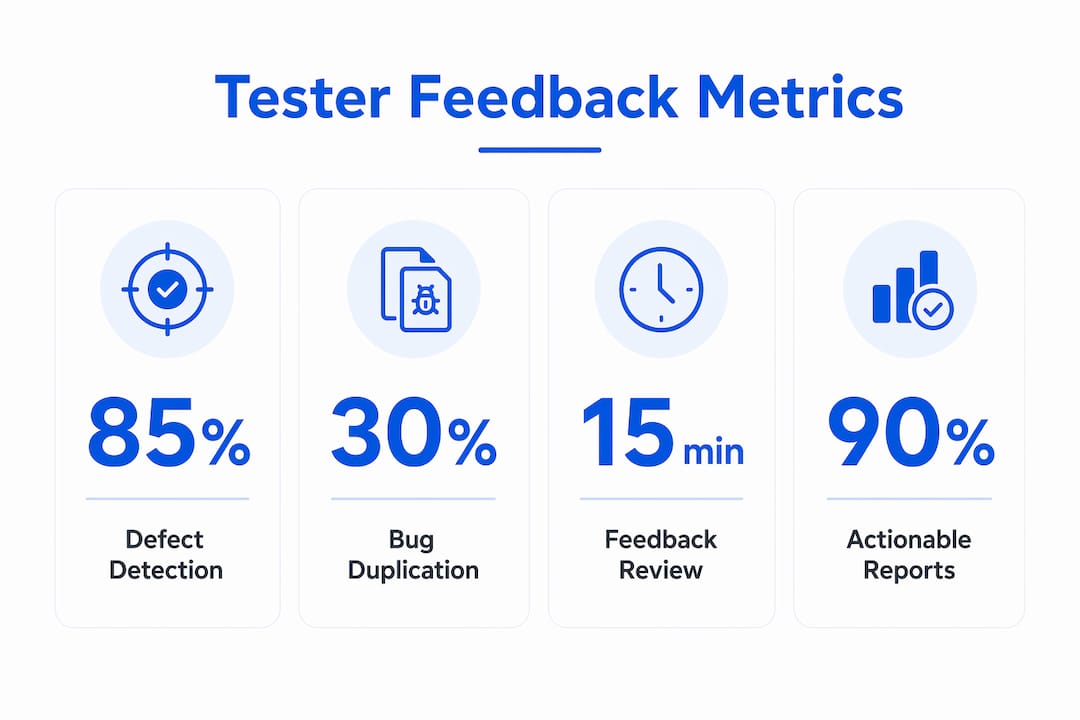
The most common failure in feedback processes is not a lack of effort. It is a lack of structure. Teams that rely on informal communication channels produce inconsistent reports that developers cannot act on reliably.
Maintaining a trustworthy test suite requires both adding meaningful tests and pruning flaky or incorrect ones. Poor testing produces confident ignorance rather than useful knowledge. A team that ships with a green test suite full of unreliable tests is in a worse position than a team that knows its coverage gaps.
- Inconsistent report formats force developers to interpret rather than act. Standardize templates and enforce them through tooling, not policy documents.
- Delayed feedback breaks the connection between a defect and the code that caused it. Feedback delivered days after a test cycle forces developers to reconstruct context they no longer have.
- Feedback overload occurs when every minor observation gets logged with equal urgency. Triage discipline, assigning severity and priority at submission, prevents critical issues from drowning in noise.
- Confusing failed tests with failed products is a subtle but damaging error. Distinguishing a failed test from a failed product is fundamental. A test can fail because of a data setup issue, an environment problem, or a flawed test case. Reporting that failure as a product defect erodes developer trust in the entire feedback system.
Pro Tip: Run a quarterly feedback audit. Pull 20 random bug reports and score them against your CLEAR criteria. The results will show you exactly where your team’s reporting breaks down.
Key Takeaways
Tester feedback improves software quality by converting test observations into decisions that developers, product owners, and stakeholders can act on immediately and consistently.
| Point | Details |
|---|---|
| Feedback timing is critical | Catching defects immediately after code creation preserves developer context and reduces fix cost. |
| CLEAR framework guides quality | Concise, Logical, Empathetic, Actionable, Relevant reports produce faster resolutions and fewer reopened tickets. |
| AI structures, humans explore | AI tools classify and deduplicate reports; human testers provide the contextual judgment that drives real quality gains. |
| Early feedback prevents rework | ISTQB standards identify early, frequent feedback as fundamental to reducing defect propagation and requirement drift. |
| Metrics close the loop | Tracking defect escape rate, resolution time, and valid report ratio shows whether your feedback process is actually improving. |
The feedback infrastructure most teams are missing
Most teams treat feedback as a byproduct of testing. The teams that consistently ship high-quality software treat it as infrastructure. That distinction sounds subtle. The outcomes are not.
I have watched development teams invest heavily in test automation, coverage metrics, and CI/CD pipelines while their feedback process remained a shared spreadsheet and a Slack channel. The automation caught regressions. The feedback process failed to communicate why those regressions mattered, which features were most affected, or what the business impact was. Developers fixed what they could reproduce and ignored the rest.
The shift I have seen work is treating feedback as a first-class artifact. That means structured templates, defined severity levels, mandatory environment context, and a clear owner for every report. It also means closing the loop. Testers who never hear what happened to their reports stop investing in quality. Testers who see their feedback drive real fixes become the most valuable people in the room.
The 2026 AI tools that classify, deduplicate, and prioritize feedback are genuinely useful. But they amplify whatever process you already have. If your feedback is vague, AI will organize vague feedback faster. The foundation has to be human discipline. The technology makes that discipline scale.
Teams that build feedback infrastructure see compounding returns. Each cycle produces better reports. Better reports produce faster fixes. Faster fixes produce more reliable products. That is not a theory. It is the pattern I have seen repeat across every team that takes feedback seriously.
— Marketing
How Wezardapp supports structured feedback and UAT quality
Tester feedback only improves software quality when it reaches developers in a form they can act on. Wezardapp is built to close that gap.
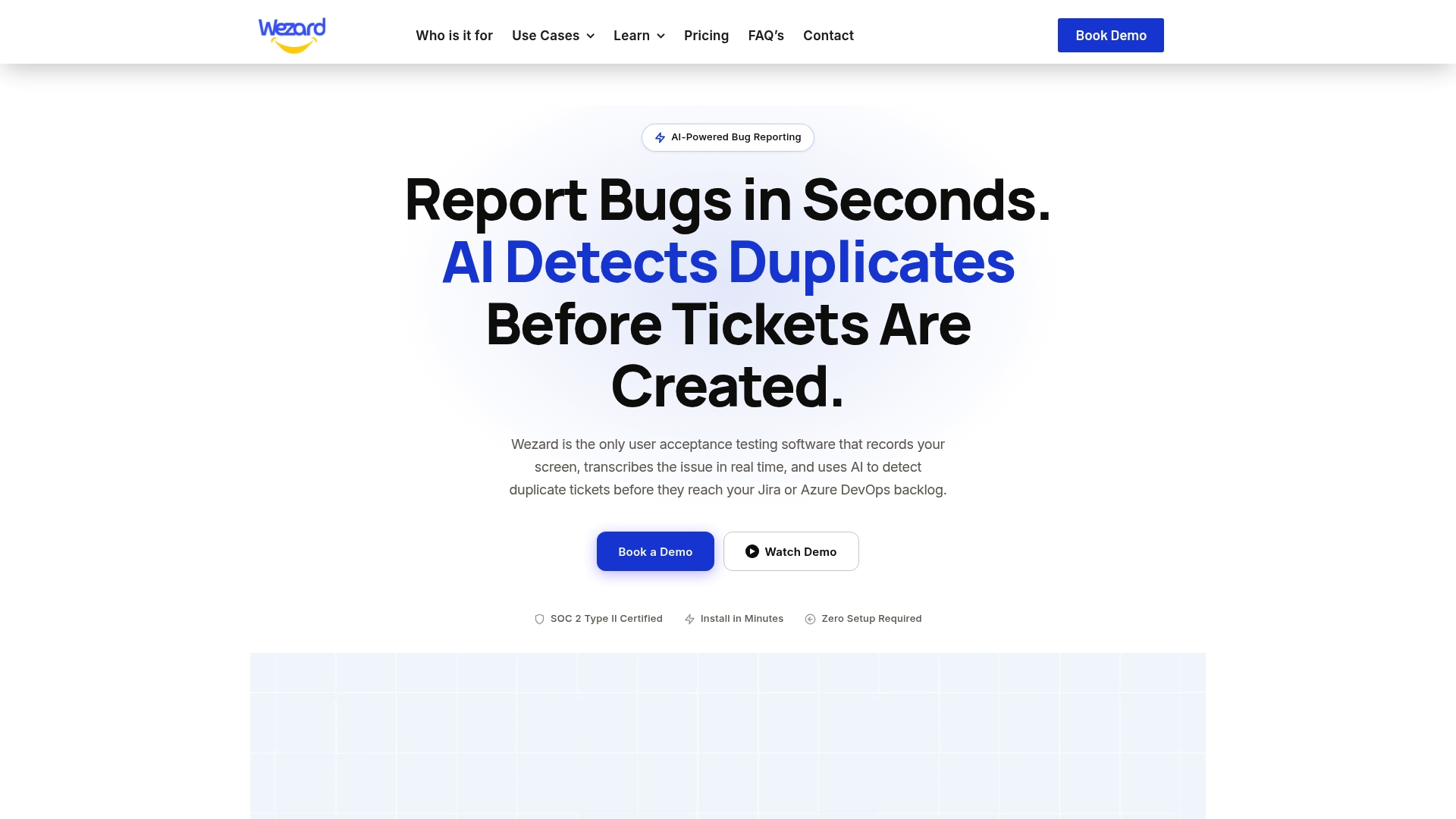
Wezardapp records your screen during UAT, transcribes the issue in real time, and uses AI to detect duplicate tickets before they reach your Jira or Azure DevOps backlog. That means your developers receive clean, contextualized reports instead of a flood of redundant noise. Teams running UAT testing cycles with Wezardapp report faster triage and fewer back-and-forth clarification requests. For teams building out their acceptance testing process, the acceptance testing entry criteria guide covers exactly what needs to be in place before feedback collection begins.
FAQ
What is tester feedback in software development?
Tester feedback is the structured communication of test results, defect observations, and behavioral insights from testers to developers and stakeholders. It functions as the primary mechanism through which quality assurance converts testing activity into product improvements.
How does early feedback reduce software defects?
Early feedback preserves developer context, making defects faster and cheaper to fix. The ISTQB Foundation Level syllabus identifies early, frequent feedback as a fundamental practice for preventing defect propagation and reducing rework.
What makes a bug report actionable?
An actionable bug report includes precise reproduction steps, environment context, expected versus actual results, and attached evidence such as screenshots or logs. Reports that follow the CLEAR framework (Concise, Logical, Empathetic, Actionable, Relevant) produce the fastest resolutions.
How does AI improve tester feedback quality?
AI classifies reports, detects duplicates, and maps sentiment signals to specific interactions, reducing manual sorting and noise in the backlog. Human testers still provide the contextual judgment that determines which observations matter most.
Why do teams struggle to act on tester feedback?
The most common causes are inconsistent report formats, delayed submission, and confusion between failed tests and genuine product defects. Standardized templates, triage discipline, and a clear feedback status process resolve most of these issues.